PUBLISHER: Global Market Insights Inc. | PRODUCT CODE: 2027642

PUBLISHER: Global Market Insights Inc. | PRODUCT CODE: 2027642
Walkie Talkie Market Opportunity, Growth Drivers, Industry Trend Analysis, and Forecast 2026 - 2035
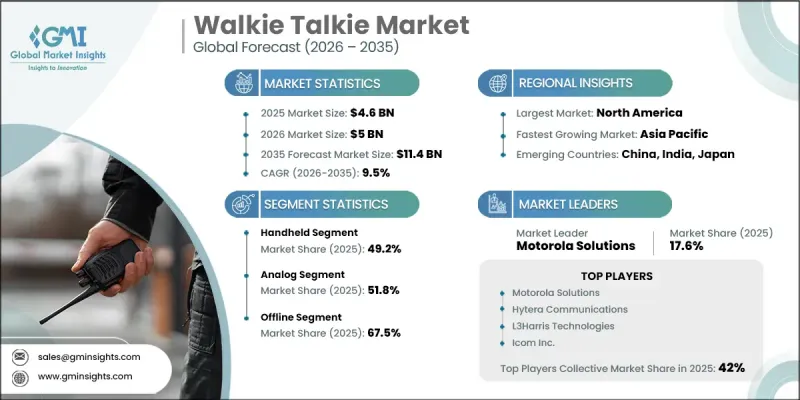
The Global Walkie Talkie Market was valued at USD 4.6 billion in 2025 and is estimated to grow at a CAGR of 9.5% to reach USD 11.4 billion by 2035.
The market is witnessing growth due to rising demand for dependable communication solutions across public safety, government operations, and industrial environments. Increasing deployment of advanced communication systems in emergency response, defense operations, and large-scale public management is significantly strengthening market adoption. Organizations are prioritizing real-time, uninterrupted communication to improve coordination, response time, and operational efficiency. The shift toward digital walkie talkie systems in industrial and commercial settings is further accelerating demand, as businesses seek improved clarity, extended range, and enhanced connectivity features. Growth in logistics, transportation, and e-commerce operations is also contributing to higher adoption of portable and hands-free communication devices. Additionally, wearable communication solutions are gaining traction as enterprises focus on workforce mobility and safety compliance. Expanding online distribution channels and retail accessibility are making these devices more widely available across end-user segments, further supporting market expansion.
| Market Scope | |
|---|---|
| Start Year | 2025 |
| Forecast Year | 2026-2035 |
| Start Value | $4.6 Billion |
| Forecast Value | $11.4 Billion |
| CAGR | 9.5% |
The wearable walkie talkies segment is projected to grow at a CAGR of 11.1% over the forecast period. Growth in this segment is driven by rising demand for hands-free communication devices that improve worker mobility and safety in logistics, manufacturing, and emergency response environments. Increasing integration of compact and ergonomically designed devices with smart connectivity features is further supporting adoption in high-mobility work settings.
The analog segment accounted for 51.8% share in 2025. Its dominance is attributed to operational simplicity, cost efficiency, and strong reliability across public safety, commercial, and industrial applications. Analog devices remain widely used for short-range communication and continue to serve organizations that operate on established communication infrastructure, particularly in small and medium-scale operations.
North America Walkie Talkie Market held 35.8% share in 2025. Growth in the region is driven by rising investment in public safety communication infrastructure, modernization of emergency response systems, and government-led initiatives promoting advanced digital radio technologies across the United States and Canada. Strong adoption is observed across law enforcement, firefighting, and industrial sectors, where both handheld and wearable devices are widely deployed. Regulatory support for interoperable and integrated communication systems is further accelerating the transition toward advanced digital communication solutions.
Major companies operating in the Global Walkie Talkie Market include Motorola Solutions, L3Harris Technologies, Hytera Communications, JVCKENWOOD Corporation, Icom Inc., Tait Communications, Sepura Limited, Simoco Wireless Solutions Ltd., Cobra Electronics, Midland Radio Corporation, Inc., Uniden Holdings, Entel Group, Kirisun Communications Co., Ltd., Baofeng Radio, DEWALT, B&E Antec, Retevis, Trucom, and Vertel Digital. Companies in the Walkie Talkie Market are focusing on expanding their product portfolios with advanced digital and hybrid communication solutions that offer improved range, clarity, and durability. Strong investment in research and development is enabling integration of IoT connectivity, GPS tracking, and enhanced encryption features for secure communication. Manufacturers are also emphasizing miniaturization and ergonomic design to support wearable and hands-free applications. Strategic partnerships with defense agencies, emergency service providers, and industrial enterprises are strengthening long-term contracts and recurring demand. Expansion of online sales channels and global distribution networks is improving product accessibility.
Table of Contents
Chapter 1 Methodology and Scope
- 1.1 Market scope and definition
- 1.2 Research design
- 1.2.1 Research approach
- 1.2.2 Data collection methods
- 1.3 Data mining sources
- 1.3.1 Global
- 1.3.2 Regional/Country
- 1.4 Base estimates and calculations
- 1.4.1 Base year calculation
- 1.4.2 Key trends for market estimation
- 1.5 Primary research and validation
- 1.5.1 Primary sources
- 1.6 Forecast model
- 1.7 Research assumptions and limitations
Chapter 2 Executive Summary
- 2.1 Industry 360° synopsis, 2022 - 2035
- 2.2 Key market trends
- 2.2.1 Device type trends
- 2.2.2 Technology trends
- 2.2.3 Range trends
- 2.2.4 Application trends
- 2.2.5 Distribution channel trends
- 2.2.6 Regional trends
- 2.3 TAM Analysis, 2026-2035
- 2.4 CXO perspectives: Strategic imperatives
Chapter 3 Industry Insights
- 3.1 Industry ecosystem analysis
- 3.1.1 Supplier Landscape
- 3.1.2 Profit Margin
- 3.1.3 Cost structure
- 3.1.4 Value addition at each stage
- 3.1.5 Factor affecting the value chain
- 3.1.6 Disruptions
- 3.2 Industry impact forces
- 3.2.1 Growth drivers
- 3.2.1.1 Increasing demand for reliable communication in public safety and government sectors
- 3.2.1.2 Growing adoption of digital walkie talkies in industrial and commercial applications
- 3.2.1.3 Rising need for portable, hands-free communication devices in logistics and transportation
- 3.2.1.4 Expansion of wearable walkie talkies for workforce mobility and operational efficiency
- 3.2.1.5 Surge in e-commerce and online sales channels facilitating easy access to devices
- 3.2.2 Industry pitfalls and challenges
- 3.2.2.1 High initial cost of advanced digital and wearable walkie talkie systems
- 3.2.2.2 Limited range and signal interference in densely populated or remote areas
- 3.2.3 Market opportunities
- 3.2.3.1 Integration with IoT and smart devices
- 3.2.3.2 Adoption in emerging markets
- 3.2.1 Growth drivers
- 3.3 Growth potential analysis
- 3.4 Regulatory landscape
- 3.4.1 North America
- 3.4.2 Europe
- 3.4.3 Asia Pacific
- 3.4.4 Latin America
- 3.4.5 Middle East & Africa
- 3.5 Porter’s analysis
- 3.6 PESTEL analysis
- 3.7 Technology and Innovation landscape
- 3.7.1 Current technological trends
- 3.7.2 Emerging technologies
- 3.8 Price trends
- 3.8.1 By region
- 3.8.2 By product
- 3.9 Pricing Strategies
- 3.10 Emerging Business Models
- 3.11 Compliance Requirements
- 3.12 Patent and IP analysis
Chapter 4 Competitive Landscape, 2025
- 4.1 Introduction
- 4.2 Company market share analysis
- 4.2.1 By region
- 4.2.1.1 North America
- 4.2.1.2 Europe
- 4.2.1.3 Asia Pacific
- 4.2.1.4 Latin America
- 4.2.1.5 Middle East & Africa
- 4.2.2 Market concentration analysis
- 4.2.1 By region
- 4.3 Competitive benchmarking of key players
- 4.3.1 Financial performance comparison
- 4.3.1.1 Revenue
- 4.3.1.2 Profit margin
- 4.3.1.3 R&D
- 4.3.2 Product portfolio comparison
- 4.3.2.1 Product range breadth
- 4.3.2.2 Technology
- 4.3.2.3 Innovation
- 4.3.3 Geographic presence comparison
- 4.3.3.1 Global footprint analysis
- 4.3.3.2 Service network coverage
- 4.3.3.3 Market penetration by region
- 4.3.4 Competitive positioning matrix
- 4.3.4.1 Leaders
- 4.3.4.2 Challengers
- 4.3.4.3 Followers
- 4.3.4.4 Niche players
- 4.3.5 Strategic outlook matrix
- 4.3.1 Financial performance comparison
- 4.4 Key developments
- 4.4.1 Mergers and acquisitions
- 4.4.2 Partnerships and collaborations
- 4.4.3 Technological advancements
- 4.4.4 Expansion and investment strategies
- 4.4.5 Digital transformation initiatives
- 4.5 Emerging/ startup competitors landscape
Chapter 5 Market Estimates and Forecast, By Device Type, 2022 - 2035 (USD Million)
- 5.1 Key trends
- 5.2 Handheld
- 5.3 Wearable
- 5.4 Vehicle-mounted
Chapter 6 Market Estimates and Forecast, By Technology, 2022 - 2035 (USD Million)
- 6.1 Key trends
- 6.2 Analog
- 6.3 Digital
Chapter 7 Market Estimates and Forecast, By Range, 2022 - 2035 (USD Million)
- 7.1 Key trends
- 7.2 Short range (<2 km)
- 7.3 Medium range (2-8 km)
- 7.4 Long-range (>8 km)
Chapter 8 Market Estimates and Forecast, By Application, 2022 - 2035 (USD Million)
- 8.1 Key trends
- 8.2 Public safety & government
- 8.3 Military & defense
- 8.4 Industrial & commercial
- 8.5 Hospitality & retail
- 8.6 Residential/personal
- 8.7 Others
Chapter 9 Market Estimates and Forecast, By Distribution Channel, 2022 - 2035 (USD Million)
- 9.1 Key trends
- 9.2 Online
- 9.3 Offline
Chapter 10 Market Estimates and Forecast, By Region, 2022 - 2035 (USD Million)
- 10.1 Key trends
- 10.2 North America
- 10.2.1 U.S.
- 10.2.2 Canada
- 10.3 Europe
- 10.3.1 Germany
- 10.3.2 UK
- 10.3.3 France
- 10.3.4 Spain
- 10.3.5 Italy
- 10.3.6 Netherlands
- 10.4 Asia Pacific
- 10.4.1 China
- 10.4.2 India
- 10.4.3 Japan
- 10.4.4 Australia
- 10.4.5 South Korea
- 10.5 Latin America
- 10.5.1 Brazil
- 10.5.2 Mexico
- 10.5.3 Argentina
- 10.6 Middle East and Africa
- 10.6.1 South Africa
- 10.6.2 Saudi Arabia
- 10.6.3 UAE
Chapter 11 Company Profiles
- 11.1 Global Key Players
- 11.1.1 Motorola Solutions
- 11.1.2 Hytera Communications
- 11.1.3 L3Harris Technologies
- 11.1.4 JVCKENWOOD Corporation
- 11.1.5 Icom Inc.
- 11.1.6 Sepura Limited
- 11.1.7 Simoco Wireless Solutions Ltd.
- 11.1.8 Tait Communications
- 11.2 Regional key players
- 11.2.1 North America
- 11.2.1.1 Midland Radio Corporation, Inc.
- 11.2.1.2 Cobra Electronics
- 11.2.2 Asia Pacific
- 11.2.2.1 Kirisun Communications Co., Ltd.
- 11.2.2.2 Uniden Holdings
- 11.2.3 Europe
- 11.2.3.1 Entel Group
- 11.2.1 North America
- 11.3 Niche Players/Disruptors
- 11.3.1 Baofeng Radio
- 11.3.2 DEWALT
- 11.3.3 Trucom
- 11.3.4 Vertel Digital
- 11.3.5 B&E Antec

