PUBLISHER: Global Market Insights Inc. | PRODUCT CODE: 2027659

PUBLISHER: Global Market Insights Inc. | PRODUCT CODE: 2027659
North America Mini Split Air Conditioning System Market Opportunity, Growth Drivers, Industry Trend Analysis, and Forecast 2026 - 2035
North America Mini Split Air Conditioning System Market was valued at USD 4.6 billion in 2025 and is estimated to grow at a CAGR of 8.7% to reach USD 10.5 billion by 2035.
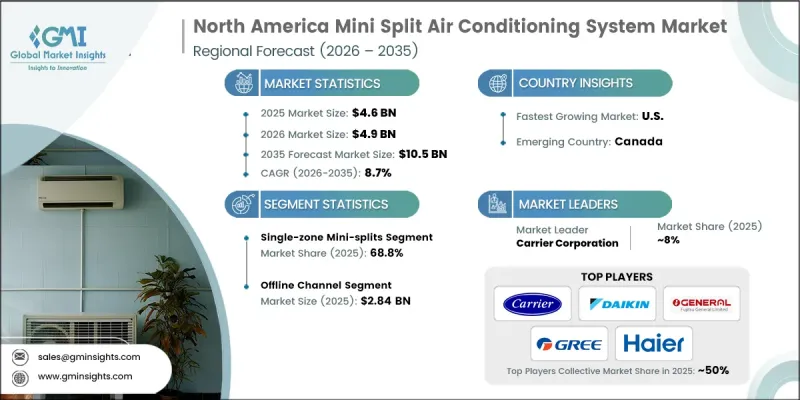
The market is witnessing substantial growth driven by three key trends transforming the residential and commercial HVAC landscape. First, the adoption of inverter technology is rising as consumers and businesses seek energy-efficient solutions that reduce operational costs while complying with strict energy regulations. According to the U.S. Department of Energy, ductless mini split systems minimize duct losses, which can account for over 30% of a home's energy consumption for space conditioning, making them highly attractive for retrofits. Second, the integration of smart home technologies is positioning mini splits as advanced climate management solutions that deliver precise temperature control and improved energy efficiency. Finally, changing consumer preferences are encouraging homeowners to adopt systems that combine convenience, cost-effectiveness, and sustainability, driving market expansion across urban and suburban areas.
| Market Scope | |
|---|---|
| Start Year | 2025 |
| Forecast Year | 2026-2035 |
| Start Value | $4.6 Billion |
| Forecast Value | $10.5 Billion |
| CAGR | 8.7% |
The single-zone mini split systems segment held a 68.8% share, generating USD 3.17 billion in 2025. These units are in high demand due to their ease of installation, lower upfront costs, and energy efficiency for heating or cooling individual rooms. Rising residential construction, urban housing development, and home renovation trends are boosting single-zone adoption, particularly in apartments, home offices, and additional living spaces.
The offline distribution segment reached USD 2.84 billion, accounting for 62% share in 2025. Dealers, contractors, and specialized HVAC stores continue to be preferred for purchases, as buyers often rely on professional guidance and installation services. Contractor-led sales remain central to residential installations, while specialty stores cater to both commercial and residential customers seeking tailored solutions.
U.S. Mini Split Air Conditioning System Market held an 84.2% share, generating USD 3.88 billion in 2025. Market growth is driven by the increasing adoption of ductless and energy-efficient solutions, particularly in older homes, smaller apartments, and retrofit scenarios where ductwork installation is expensive or impractical. The U.S. market is being shaped by the growing focus on sustainability, energy efficiency, and modern cooling technology.
Key players in the North America Mini Split Air Conditioning System Market include Fujitsu General Ltd., Carrier Corporation, Daikin Industries, Haier Group Corporation, Hitachi, Johnson Controls Plc, GREE Electric Appliances, Midea Group Co. Ltd., LG Electronics, Mitsubishi Electric Corporation, Samsung Electronics Co. Ltd., Panasonic Corporation, Lennox International, Trane Technologies, and Friedrich Air Conditioning. Companies in the North America Mini Split Air Conditioning System Market are leveraging several strategies to strengthen their market presence. They focus on product innovation, including energy-efficient and inverter-based systems, smart home integration, and user-friendly designs. Expanding distribution networks through dealers, contractors, and specialty HVAC stores ensures wider market reach. Strategic partnerships and collaborations enable entry into new residential and commercial segments. Firms also invest in marketing and after-sales services, providing installation support, maintenance, and technical guidance.
Table of Contents
Chapter 1 Methodology & Scope
- 1.1 Market scope and definition
- 1.2 Research design
- 1.2.1 Research approach
- 1.2.2 Data collection methods
- 1.3 Data mining sources
- 1.3.1 Regional
- 1.3.2 Country
- 1.4 Base estimates and calculations
- 1.4.1 Base year calculation
- 1.4.2 Key trends for market estimation
- 1.5 Primary research and validation
- 1.5.1 Primary sources
- 1.6 Forecast model
- 1.7 Research assumptions and limitations
Chapter 2 Executive Summary
- 2.1 Industry 360° synopsis
- 2.2 Key market trends
- 2.2.1 Country
- 2.2.2 Product Type
- 2.2.3 Installation
- 2.2.4 Technology
- 2.2.5 Capacity
- 2.2.6 Price Range
- 2.2.7 End Use
- 2.2.8 Distribution Channel
- 2.3 CXO perspectives: Strategic imperatives
- 2.3.1 Key decision points for industry executives
- 2.3.2 Critical success factors for market players
- 2.4 Future outlook and strategic recommendations
Chapter 3 Industry Insights
- 3.1 Industry ecosystem analysis
- 3.1.1 Supplier landscape
- 3.1.2 Profit margin
- 3.1.2.1 Profit Margin Analysis by Value Chain Stage (Driven by Primary Research)
- 3.1.3 Value addition at each stage
- 3.1.4 Factor affecting the value chain
- 3.2 Industry impact forces
- 3.2.1 Growth drivers
- 3.2.1.1 Increasing technological advancements
- 3.2.1.2 Shifting towards consumer demographics
- 3.2.1.3 Growing trend toward home renovation and retrofitting
- 3.2.2 Industry pitfalls & challenges
- 3.2.2.1 High initial installation cost of premium systems
- 3.2.2.2 Competition of traditional central HVAC systems
- 3.2.3 Industry Opportunities
- 3.2.3.1 Expansion of online sales and direct-to-consumer channels
- 3.2.3.2 Integration of air quality monitoring features
- 3.2.1 Growth drivers
- 3.3 Growth potential analysis
- 3.4 Future market trends
- 3.5 Technology and innovation landscape
- 3.5.1 Current technological trends
- 3.5.2 Emerging technologies
- 3.6 Price trends
- 3.6.1 North America
- 3.6.2 By product
- 3.7 Regulatory landscape
- 3.7.1 Standards and compliance requirements
- 3.7.2 Regional regulatory frameworks
- 3.7.3 Certification standards
- 3.8 Trade statistics
- 3.8.1 Major importing countries
- 3.8.2 Major exporting countries
- 3.9 Porter's analysis
- 3.10 PESTEL analysis
- 3.11 Trade Data Analysis (Driven by Primary Research)
- 3.11.1 Import/Export Volume & Value Trends (2021-2024) (Driven by Primary Research)
- 3.11.2 Key Trade Corridors & Tariff Impact (Driven by Primary Research)
- 3.12 Impact of AI & Generative AI on the Market
- 3.12.1 AI-Driven Disruption of Existing Business Models
- 3.12.1.1 GenAI Use Cases & Adoption Roadmap by Segment
- 3.12.1.2 Smart HVAC Systems & IoT Integration
- 3.12.2 Predictive Maintenance & Energy Optimization
- 3.12.3 Risks, Limitations & Regulatory Considerations
- 3.12.1 AI-Driven Disruption of Existing Business Models
- 3.13 Capacity & Production Landscape (Driven by Primary Research)
- 3.13.1 Installed Capacity by Region & Key Producer (Driven by Primary Research)
- 3.13.2 Capacity Utilization Rates & Expansion Pipelines (Driven by Primary Research)
- 3.13.3 North American Manufacturing vs. Import Dependency
Chapter 4 Competitive Landscape, 2025
- 4.1 Introduction
- 4.2 Company market share analysis (Driven by Primary Research)
- 4.2.1 By Country
- 4.2.1.1 U.S.
- 4.2.1.2 Canada
- 4.2.1 By Country
- 4.3 Company matrix analysis
- 4.4 Competitive analysis of major market players
- 4.5 Competitive positioning matrix
- 4.6 Key developments
- 4.6.1 Mergers & acquisitions
- 4.6.2 Partnerships & collaborations
- 4.6.3 New product launches
- 4.6.4 Expansion plans
Chapter 5 Market Estimates & Forecast, By Product Type, 2022 - 2035, (USD Billion) (Thousand Units)
- 5.1 Key trends
- 5.2 Single-zone mini-splits
- 5.3 Multi-zone mini splits
Chapter 6 Market Estimates & Forecast, By Installation, 2022 - 2035, (USD Billion) (Thousand Units)
- 6.1 Key trends
- 6.2 Wall mounted
- 6.3 Free standing
- 6.4 Others (floor ceiling)
Chapter 7 Market Estimates & Forecast, By Technology, 2022 - 2035, (USD Billion) (Thousand Units)
- 7.1 Key trends
- 7.2 Inverter mini splits
- 7.3 Non-inverter mini splits
Chapter 8 Market Estimates & Forecast, By Capacity, 2022 - 2035, (USD Billion) (Thousand Units)
- 8.1 Key trends
- 8.2 Less than 1 ton
- 8.3 1 to 1.5 ton
- 8.4 1.5 to 2 ton
- 8.5 More than 2 ton
Chapter 9 Market Estimates & Forecast, By Price Range, 2022 - 2035, (USD Billion) (Thousand Units)
- 9.1 Key trends
- 9.2 Low
- 9.3 Medium
- 9.4 High
Chapter 10 Market Estimates & Forecast, By End User, 2022 - 2035, (USD Billion) (Thousand Units)
- 10.1 Key trends
- 10.2 Household
- 10.3 Commercial
Chapter 11 Market Estimates & Forecast, By Distribution Channel, 2022 - 2035, (USD Billion) (Thousand Units)
- 11.1 Key trends
- 11.2 Online
- 11.3 Offline
Chapter 12 Market Estimates & Forecast, By Country, 2022 - 2035, (USD Billion) (Thousand Units)
- 12.1 Key trends
- 12.2 U.S.
- 12.3 Canada
Chapter 13 Company Profiles
- 13.1 Carrier Corporation
- 13.2 Daikin Industries
- 13.3 Fujitsu General Ltd.
- 13.4 GREE Electric Appliances
- 13.5 Haier Group Corporation
- 13.6 Hitachi
- 13.7 Johnson Controls Plc
- 13.8 LG Electronics
- 13.9 Midea Group Co. Ltd.
- 13.10 Mitsubishi Electric Corporation
- 13.11 Panasonic Corporation
- 13.12 Samsung Electronics Co. Ltd.
- 13.13 Trane Technologies
- 13.14 Lennox International
- 13.15 Friedrich Air Conditioning

