PUBLISHER: Global Market Insights Inc. | PRODUCT CODE: 2027667

PUBLISHER: Global Market Insights Inc. | PRODUCT CODE: 2027667
Video Surveillance Market Opportunity, Growth Drivers, Industry Trend Analysis, and Forecast 2026 - 2035
The Global Video Surveillance Market was valued at USD 63.1 billion in 2025 and is estimated to grow at a CAGR of 10.1% to reach USD 162.4 billion by 2035.
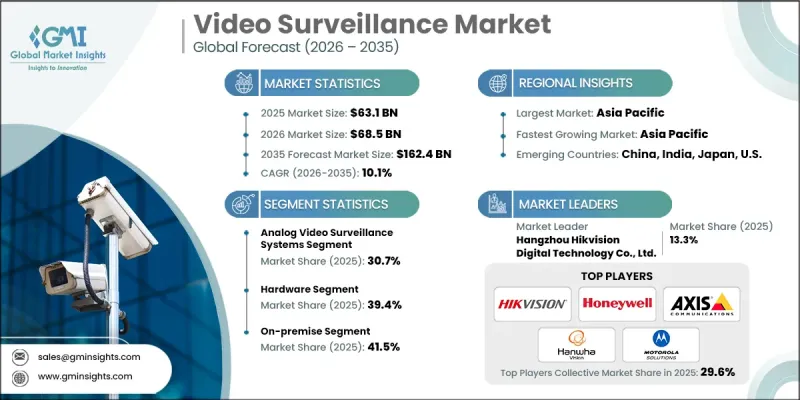
Market expansion is driven by the rising adoption of advanced security technologies and the growing emphasis on real-time monitoring across public and private infrastructure. Increasing security concerns related to crime, terrorism, and safety threats are significantly accelerating the deployment of surveillance systems worldwide. At the same time, the integration of edge-based artificial intelligence is emerging as a key growth catalyst, enabling faster data processing, reduced latency, and improved privacy management. These capabilities are particularly valuable in environments that require immediate response and continuous monitoring. There is also a growing trend toward unified security ecosystems, where video surveillance is integrated with access control systems and alarm solutions to enhance overall protection. Organizations across sectors are increasingly prioritizing compliance with safety regulations, which is further driving system adoption. As digital transformation accelerates, demand for intelligent, connected, and scalable surveillance solutions continues to rise across commercial, industrial, and public sector applications.
| Market Scope | |
|---|---|
| Start Year | 2025 |
| Forecast Year | 2026-2035 |
| Start Value | $63.1 Billion |
| Forecast Value | $162.4 Billion |
| CAGR | 10.1% |
The analog video surveillance systems segment accounted for 30.7% share in 2025. Although this segment is gradually declining due to the shift toward IP-based and AI-enabled technologies, it still maintains relevance in cost-sensitive environments. These systems are primarily used in smaller-scale installations and legacy infrastructures where basic monitoring requirements are sufficient. The segment is also evolving through hybrid DVR solutions that allow partial digital transition without requiring full system replacement, thereby supporting continued usage in specific applications.
The hardware segment held a 39.4% share in 2025. This segment continues to dominate due to strong demand for advanced surveillance devices such as high-resolution cameras, storage systems, and network infrastructure components. The increasing adoption of smart cameras equipped with artificial intelligence capabilities is enhancing real-time analytics and automated decision-making. Additionally, the deployment of advanced recording systems and sensor-based technologies across transportation networks, commercial spaces, and public infrastructure is further strengthening hardware demand.
North America Video Surveillance Market accounted for 31.1% share in 2025. The region is experiencing strong adoption of AI-powered and cloud-integrated surveillance systems across multiple sectors, including healthcare, transportation, retail, and smart city projects. Growing concerns around public safety and security are driving investments in advanced monitoring infrastructure. The increasing need for remote surveillance and regulatory compliance is also encouraging organizations to modernize legacy systems and adopt intelligent, connected solutions supported by data analytics and automation technologies.
Key companies operating in the Global Video Surveillance Market include Motorola Solutions, Inc., Axis Communications AB, Bosch Security Systems, CP Plus International, Dahua Technology Co., Ltd, Genetec Inc., Hangzhou Hikvision Digital Technology Co., Ltd., Hanwha Vision Co., Ltd., and Honeywell. Companies in the Video Surveillance Market are strengthening their competitive position through continuous technological innovation, strategic partnerships, and expansion of AI-driven solutions. They are investing heavily in edge computing, artificial intelligence, and cloud-based platforms to enhance real-time monitoring and data processing capabilities. Many players are focusing on developing high-performance cameras and integrated security systems that combine video analytics, access control, and alarm management. Expansion into smart city projects and critical infrastructure sectors is also supporting market growth. Additionally, companies are enhancing their global distribution networks and service capabilities to improve customer reach.
Table of Contents
Chapter 1 Methodology and Scope
- 1.1 Market scope and definition
- 1.2 Research design
- 1.2.1 Research approach
- 1.2.2 Data collection methods
- 1.3 Data mining sources
- 1.3.1 Global
- 1.3.2 Regional/Country
- 1.4 Base estimates and calculations
- 1.4.1 Base year calculation
- 1.4.2 Key trends for market estimation
- 1.5 Primary research and validation
- 1.5.1 Primary sources
- 1.6 Forecast model
- 1.7 Research assumptions and limitations
Chapter 2 Executive Summary
- 2.1 Industry 360° synopsis, 2022 - 2035
- 2.2 Key market trends
- 2.2.1 Offering trends
- 2.2.2 Deployment trends
- 2.2.3 System type trends
- 2.2.4 Application trends
- 2.2.5 Regional trends
- 2.3 TAM Analysis, 2026-2035
- 2.4 CXO perspectives: Strategic imperatives
Chapter 3 Industry Insights
- 3.1 Industry ecosystem analysis
- 3.1.1 Supplier Landscape
- 3.1.2 Profit Margin
- 3.1.3 Cost structure
- 3.1.4 Value addition at each stage
- 3.1.5 Factor affecting the value chain
- 3.1.6 Disruptions
- 3.2 Industry impact forces
- 3.2.1 Growth drivers
- 3.2.1.1 Increasing adoption of edge-based Artificial Intelligence (AI)
- 3.2.1.2 Increasing security concerns
- 3.2.1.3 Shift toward smart cities and adopting smart security systems
- 3.2.1.4 Growing demand for remote monitoring
- 3.2.1.5 Growing usage of cloud-based surveillance systems
- 3.2.2 Industry pitfalls and challenges
- 3.2.2.1 Integration complexity
- 3.2.2.2 Privacy concerns
- 3.2.3 Market opportunities
- 3.2.3.1 Rising demand for real-time video analytics in public safety and transportation
- 3.2.3.2 Advancements in low-power, high-performance AI chipsets for edge devices
- 3.2.1 Growth drivers
- 3.3 Growth potential analysis
- 3.4 Regulatory landscape
- 3.4.1 North America
- 3.4.2 Europe
- 3.4.3 Asia Pacific
- 3.4.4 Latin America
- 3.4.5 Middle East & Africa
- 3.5 Porter's analysis
- 3.6 PESTEL analysis
- 3.7 Technology and Innovation landscape
- 3.7.1 Current technological trends
- 3.7.2 Emerging technologies
- 3.8 Price trends
- 3.8.1 By region
- 3.8.2 By product
- 3.9 Pricing Strategies
- 3.10 Emerging Business Models
- 3.11 Compliance Requirements
- 3.12 Patent and IP analysis
Chapter 4 Competitive Landscape, 2025
- 4.1 Introduction
- 4.2 Company market share analysis
- 4.2.1 By region
- 4.2.1.1 North America
- 4.2.1.2 Europe
- 4.2.1.3 Asia Pacific
- 4.2.1.4 Latin America
- 4.2.1.5 Middle East & Africa
- 4.2.2 Market concentration analysis
- 4.2.1 By region
- 4.3 Competitive benchmarking of key players
- 4.3.1 Financial performance comparison
- 4.3.1.1 Revenue
- 4.3.1.2 Profit margin
- 4.3.1.3 R&D
- 4.3.2 Product portfolio comparison
- 4.3.2.1 Product range breadth
- 4.3.2.2 Technology
- 4.3.2.3 Innovation
- 4.3.3 Geographic presence comparison
- 4.3.3.1 Global footprint analysis
- 4.3.3.2 Service network coverage
- 4.3.3.3 Market penetration by region
- 4.3.4 Competitive positioning matrix
- 4.3.4.1 Leaders
- 4.3.4.2 Challengers
- 4.3.4.3 Followers
- 4.3.4.4 Niche players
- 4.3.5 Strategic outlook matrix
- 4.3.1 Financial performance comparison
- 4.4 Key developments
- 4.4.1 Mergers and acquisitions
- 4.4.2 Partnerships and collaborations
- 4.4.3 Technological advancements
- 4.4.4 Expansion and investment strategies
- 4.4.5 Digital transformation initiatives
- 4.5 Emerging/ startup competitors landscape
Chapter 5 Market Estimates and Forecast, By Offering, 2022 - 2035 (USD Million)
- 5.1 Key trends
- 5.2 Hardware
- 5.2.1 Cameras
- 5.2.2 Storage devices
- 5.2.3 Monitors
- 5.2.4 Others
- 5.3 Software
- 5.3.1 Video analytics
- 5.3.2 Video management software (VMS)
- 5.3.3 Access control software
- 5.3.4 Others
- 5.4 Services
- 5.4.1 Video surveillance as a service (VSaaS)
- 5.4.2 Installation & maintenance
- 5.4.3 Consulting & system integration
Chapter 6 Market Estimates and Forecast, By Deployment, 2022 - 2035 (USD Million)
- 6.1 Key trends
- 6.2 On-premise
- 6.3 Cloud
- 6.4 Hybrid
Chapter 7 Market Estimates and Forecast, By System Type, 2022 - 2035 (USD Million)
- 7.1 Key trends
- 7.2 Analog video surveillance systems
- 7.3 IP video surveillance systems
- 7.4 Hybrid video surveillance systems
Chapter 8 Market Estimates and Forecast, By Application, 2022 - 2035 (USD Million)
- 8.1 Key trends
- 8.2 Commercial
- 8.2.1 Retail
- 8.2.2 Banking & finance
- 8.2.3 Hospitality
- 8.2.4 Healthcare
- 8.2.5 Others
- 8.3 Residential
- 8.4 Industrial
- 8.4.1 Manufacturing
- 8.4.2 Oil & gas
- 8.4.3 Energy
- 8.4.4 Others
- 8.5 Infrastructure & Transportation
- 8.5.1 Transportation
- 8.5.2 City surveillance
- 8.5.3 Defense
- 8.5.4 Others
- 8.6 Institutional
- 8.6.1 Education
- 8.6.2 Religious buildings
- 8.6.3 Sports & entertainment venues
- 8.6.4 Others
- 8.7 Others
Chapter 9 Market Estimates and Forecast, By Region, 2022 - 2035 (USD Million)
- 9.1 Key trends
- 9.2 North America
- 9.2.1 U.S.
- 9.2.2 Canada
- 9.3 Europe
- 9.3.1 Germany
- 9.3.2 UK
- 9.3.3 France
- 9.3.4 Spain
- 9.3.5 Italy
- 9.3.6 Netherlands
- 9.3.7 Rest of Europe
- 9.4 Asia Pacific
- 9.4.1 China
- 9.4.2 India
- 9.4.3 Japan
- 9.4.4 Australia
- 9.4.5 South Korea
- 9.4.6 Rest of Asia Pacific
- 9.5 Latin America
- 9.5.1 Brazil
- 9.5.2 Mexico
- 9.5.3 Argentina
- 9.5.4 Rest of Latin America
- 9.6 Middle East and Africa
- 9.6.1 South Africa
- 9.6.2 Saudi Arabia
- 9.6.3 UAE
- 9.6.4 Rest of MEA
Chapter 10 Company Profiles
- 10.1 Global Key Players
- 10.1.1 Motorola Solutions, Inc.
- 10.1.2 Axis Communications AB
- 10.1.3 Bosch Security Systems
- 10.1.4 Dahua Technology Co., Ltd
- 10.1.5 Genetec Inc.
- 10.1.6 Hangzhou Hikvision Digital Technology Co., Ltd.
- 10.1.7 Hanwha Vision Co., Ltd.
- 10.1.8 Honeywell
- 10.1.9 Johnson Controls
- 10.1.10 Panasonic
- 10.1.11 Sony India Private Limited
- 10.1.12 Teledyne FLIR LLC
- 10.2 Regional key players
- 10.2.1 CP Plus International
- 10.2.2 Infinova Group
- 10.2.3 VIVOTEK Inc.
- 10.2.4 Uniview
- 10.3 Niche Players/Disruptors
- 10.3.1 Verkada Inc.
- 10.3.2 Eagle Eye Networks
- 10.3.3 Deep Sentinel

