PUBLISHER: Global Market Insights Inc. | PRODUCT CODE: 2027669

PUBLISHER: Global Market Insights Inc. | PRODUCT CODE: 2027669
Magnesium Chloride Market Opportunity, Growth Drivers, Industry Trend Analysis, and Forecast 2026 - 2035
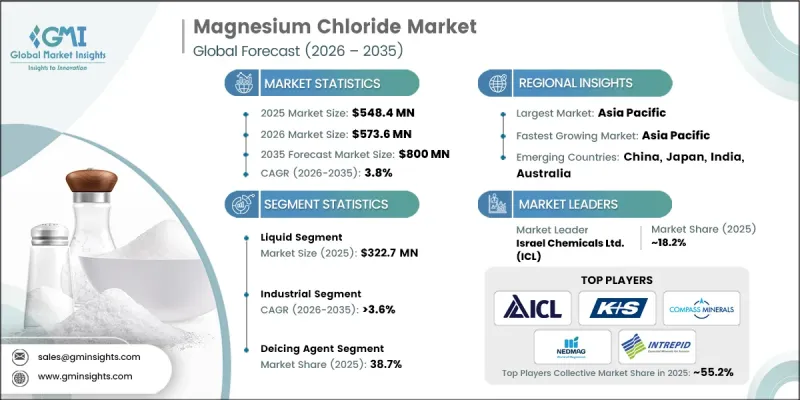
The Global Magnesium Chloride Market was valued at USD 548.4 million in 2025 and is estimated to grow at a CAGR of 3.8% to reach USD 800 million by 2035.
Growth in the magnesium chloride market is driven by its essential role in infrastructure-related applications, where it is used for dust suppression, soil stabilization, and specialized construction materials. Ongoing urban expansion and infrastructure maintenance activities are sustaining consistent demand, particularly in regions with high construction intensity. Industrial applications further contribute to market expansion, as magnesium chloride is utilized in metal production and chemical processing operations. Seasonal demand patterns also support market growth, especially in regions where it is applied for temperature-related surface management. Additionally, the agricultural sector is contributing to demand by incorporating magnesium chloride into soil management practices aimed at improving crop productivity. Increasing focus on balanced nutrient application and soil health is further strengthening its adoption, positioning the global magnesium chloride market as a stable and essential segment within the broader industrial materials landscape.
| Market Scope | |
|---|---|
| Start Year | 2025 |
| Forecast Year | 2026-2035 |
| Start Value | $548.4 Million |
| Forecast Value | $800 Million |
| CAGR | 3.8% |
The magnesium chloride market continues to benefit from expanding industrial and agricultural applications. Growing operational requirements across various sectors are driving the need for reliable and efficient material solutions. Its versatility and functional performance support its integration into diverse processes, contributing to sustained market development.
The liquid segment accounted for USD 322.7 million in 2025 and is expected to grow at a CAGR of 3.4% from 2026 to 2035. This segment holds a strong position due to its ease of application and effectiveness across multiple end-use scenarios. Liquid magnesium chloride offers advantages such as uniform distribution and immediate performance, making it a preferred choice for large-scale operational use. Its handling efficiency and adaptability support its continued demand across infrastructure and industrial applications.
The deicing agent segment was valued at USD 212.1 million in 2025, representing a 38.7% share of the magnesium chloride market, and is projected to grow at a CAGR of 3.6% during the forecast period. This segment maintains a prominent position due to its effectiveness in maintaining surface safety under challenging environmental conditions. Its performance characteristics, including extended action and reduced material impact, contribute to its widespread adoption. Consistent seasonal demand and established usage practices continue to support stable growth within this segment.
North America Magnesium Chloride Market reached USD 137 million in 2025 and is expected to experience steady growth over the forecast period. The region demonstrates mature market characteristics, supported by ongoing infrastructure maintenance and consistent demand across industrial and agricultural applications. The United States plays a central role in driving regional demand, supported by established systems and operational requirements. Continued usage across multiple sectors contributes to the stable consumption of magnesium chloride throughout the region.
Key companies operating in the Global Magnesium Chloride Market include Compass Minerals International, Inc., DEUSA International GmbH, Intrepid Potash, Inc., Israel Chemicals Ltd. (ICL), K+S Aktiengesellschaft, Nedmag B.V, Weifang Yuze Chemical Co., Ltd, Alkim Alkali Kimya A.S., Weifang Haibin Chemical Co., Ltd, Shandong Haihua Group Co., Ltd, and others. Companies in the Magnesium Chloride Market are adopting strategic initiatives to strengthen their competitive position and expand their market presence. A key focus is placed on optimizing production processes to improve efficiency and ensure consistent product quality. Manufacturers are investing in advanced processing technologies to enhance performance and reduce operational costs. Strategic partnerships and collaborations are being pursued to expand distribution networks and improve market reach. Companies are also focusing on diversifying product offerings to meet specific application requirements across industries. Strengthening supply chain capabilities and ensuring reliable product availability further support market growth.
Table of Contents
Chapter 1 Methodology
- 1.1 Market scope and definition
- 1.2 Research design
- 1.2.1 Research approach
- 1.2.2 Data collection methods
- 1.3 Data mining sources
- 1.3.1 Global
- 1.3.2 Regional/Country
- 1.4 Base estimates and calculations
- 1.4.1 Base year calculation
- 1.4.2 Key trends for market estimation
- 1.5 Primary research and validation
- 1.5.1 Primary sources
- 1.6 Forecast model
- 1.7 Research assumptions and limitations
Chapter 2 Executive Summary
- 2.1 Industry 360° synopsis
- 2.2 Key market trends
- 2.2.1 Regional
- 2.2.2 Product Form
- 2.2.3 Grade
- 2.2.4 Application
- 2.3 TAM Analysis, 2026-2035
- 2.4 CXO perspectives: Strategic imperatives
Chapter 3 Industry Insights
- 3.1 Industry ecosystem analysis
- 3.1.1 Supplier Landscape
- 3.1.2 Profit Margin
- 3.1.3 Value addition at each stage
- 3.1.4 Factor affecting the value chain
- 3.1.5 Disruptions
- 3.2 Industry impact forces
- 3.2.1 Growth drivers
- 3.2.2 Industry pitfalls and challenges
- 3.2.3 Market opportunities
- 3.3 Growth potential analysis
- 3.4 Regulatory landscape
- 3.4.1 North America
- 3.4.2 Europe
- 3.4.3 Asia Pacific
- 3.4.4 Latin America
- 3.4.5 Middle East & Africa
- 3.5 Porter’s analysis
- 3.6 PESTEL analysis
- 3.7 Price trends
- 3.7.1 By region
- 3.7.2 By product
- 3.8 Future market trends
- 3.9 Technology and Innovation landscape
- 3.9.1 Current technological trends
- 3.9.2 Emerging technologies
- 3.10 Patent Landscape
- 3.11 Trade statistics
- 3.11.1 Major importing countries
- 3.11.2 Major exporting countries
- 3.12 Sustainability and Environmental Aspects
- 3.12.1 Sustainable Practices
- 3.12.2 Waste Reduction Strategies
- 3.12.3 Energy Efficiency in Production
- 3.12.4 Eco-friendly Initiatives
- 3.13 Carbon Footprint Considerations
Chapter 4 Competitive Landscape, 2025
- 4.1 Introduction
- 4.2 Company market share analysis
- 4.2.1 By region
- 4.2.1.1 North America
- 4.2.1.2 Europe
- 4.2.1.3 Asia Pacific
- 4.2.1.4 LATAM
- 4.2.1.5 MEA
- 4.2.1 By region
- 4.3 Company matrix analysis
- 4.4 Competitive analysis of major market players
- 4.5 Competitive positioning matrix
- 4.6 Key developments
- 4.6.1 Mergers & acquisitions
- 4.6.2 Partnerships & collaborations
- 4.6.3 New Product Launches
- 4.6.4 Expansion Plans
Chapter 5 Market Estimates and Forecast, By Product Form, 2022- 2035 (USD Million, Kilo Tons)
- 5.1 Key trends
- 5.2 Liquid
- 5.3 Solid
Chapter 6 Market Estimates and Forecast, By Grade, 2022 - 2035 (USD Million, Kilo Tons)
- 6.1 Key trends
- 6.2 Industrial
- 6.3 Food grade
- 6.4 Pharmaceutical Grade
- 6.5 Other
Chapter 7 Market Estimates and Forecast, By Application, 2022 - 2035 (USD Million, Kilo Tons)
- 7.1 Key trends
- 7.2 Deicing Agent
- 7.3 Dust Suppressants
- 7.4 Chemicals & Derivatives
- 7.5 Building Materials
- 7.6 Pharmaceuticals
- 7.7 Food & Feed
- 7.8 Others
Chapter 8 Market Estimates and Forecast, By Region, 2022 - 2035 (USD Million, Kilo Tons)
- 8.1 Key trends
- 8.2 North America
- 8.2.1 U.S.
- 8.2.2 Canada
- 8.3 Europe
- 8.3.1 Germany
- 8.3.2 UK
- 8.3.3 France
- 8.3.4 Italy
- 8.3.5 Spain
- 8.3.6 Rest of Europe
- 8.4 Asia Pacific
- 8.4.1 China
- 8.4.2 India
- 8.4.3 Japan
- 8.4.4 Australia
- 8.4.5 South Korea
- 8.4.6 Rest of Asia Pacific
- 8.5 Latin America
- 8.5.1 Brazil
- 8.5.2 Mexico
- 8.5.3 Argentina
- 8.5.4 Rest of Latin America
- 8.6 Middle East & Africa
- 8.6.1 Saudi Arabia
- 8.6.2 South Africa
- 8.6.3 UAE
- 8.6.4 Rest of Middle East & Africa
Chapter 9 Company Profiles
- 9.1 Compass Minerals International, Inc.
- 9.2 DEUSA International GmbH
- 9.3 Intrepid Potash, Inc.
- 9.4 Israel Chemicals Ltd. (ICL)
- 9.5 K+S Aktiengesellschaft
- 9.6 Nedmag B.V
- 9.7 Weifang Yuze Chemical Co., Ltd
- 9.8 Alkim Alkali Kimya A.S.
- 9.9 Weifang Haibin Chemical Co., Ltd
- 9.10 Shandong Haihua Group Co., Ltd

