PUBLISHER: Global Market Insights Inc. | PRODUCT CODE: 2027671

PUBLISHER: Global Market Insights Inc. | PRODUCT CODE: 2027671
Packaging Printing Market Opportunity, Growth Drivers, Industry Trend Analysis, and Forecast 2026 - 2035
The Global Packaging Printing Market was valued at USD 435.7 billion in 2025 and is estimated to grow at a CAGR of 4.8% to reach USD 690.6 billion by 2035.
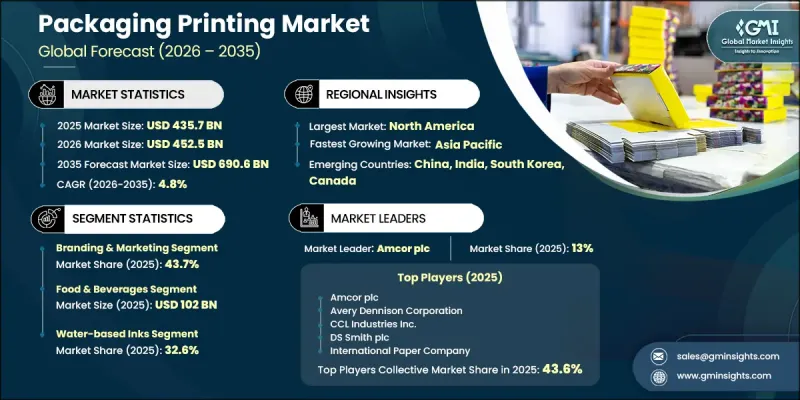
The market is expanding due to the rapid increase in product variations across consumer goods categories, which is driving the need for diverse and flexible packaging formats. The continued rise of e-commerce and integrated retail distribution models is further accelerating demand for high-volume and efficient printing solutions. In addition, growing preference for visually appealing and premium packaging is pushing manufacturers to invest in advanced printing capabilities. The shift toward environmentally responsible materials, along with the adoption of innovative ink technologies, is also reshaping the industry landscape. Technological advancements in digital printing and automated workflows are enabling faster production cycles and improved customization, supporting short-run and on-demand printing requirements. Increasing focus on compliance-driven labeling and enhanced visual communication is further strengthening demand. Overall, the packaging printing industry continues to evolve as brands prioritize differentiation, operational efficiency, and sustainability in an increasingly competitive global market environment.
| Market Scope | |
|---|---|
| Start Year | 2025 |
| Forecast Year | 2026-2035 |
| Start Value | $435.7 Billion |
| Forecast Value | $690.6 Billion |
| CAGR | 4.8% |
The branding and marketing segment held a 43.7% share in 2025. This leadership position is supported by the growing importance of packaging as a tool for product differentiation and consumer engagement. High-quality print outputs, consistent color reproduction, and visually distinctive designs are essential for strengthening brand identity and influencing purchasing behavior, which continues to drive demand for advanced printing solutions in this segment.
The food & beverages segment reached USD 102 billion in 2025. This segment maintains its leading position due to the continuous requirement for large-scale printed packaging across multiple formats. High product turnover rates, strict labeling requirements, and the need for strong visual presentation contribute to sustained demand. The global increase in consumption of packaged food products further reinforces the segment's dominance within the industry.
North America Packaging Printing Market accounted for 32.2% share in 2025. Growth in the region is supported by strong demand from sectors such as retail distribution, food processing, and healthcare, along with strict regulatory requirements for labeling and packaging standards. Increasing adoption of digital and hybrid printing technologies is enabling efficient production of customized and short-run packaging formats. Ongoing investments in sustainable packaging practices, including the use of recyclable materials and environmentally friendly inks, are also contributing to market expansion across the region.
Key companies operating in the Packaging Printing Market include Toppan Printing Company, Amcor PLC, WestRock Company, Avery Dennison Corporation, CCL Industries Inc., DS Smith PLC, International Paper Company, Huhtamaki Flexible Packaging, Constantia Flexibles Group GmbH, Mayr-Melnhof Karton AG, Quad/Graphics, WS Packaging Group, Autajon CS, Clondalkin Group Holdings BV, Trustpack UAB, Graphics Packaging Holding Company, Duncan Printing Group, and Quantum Print and Packaging Limited. Companies in the packaging printing market are focusing on strengthening their competitive position through investments in digital printing technologies and automation to improve efficiency and reduce turnaround time. They are expanding capabilities in short-run and customized printing to meet evolving brand requirements and increasing SKU diversity. Strategic collaborations with consumer goods companies are helping firms secure long-term contracts and enhance service offerings. Businesses are also prioritizing sustainability by adopting eco-friendly inks, recyclable substrates, and energy-efficient production processes. In addition, companies are investing in advanced color management systems and high-resolution printing technologies to enhance visual quality.
Table of Contents
Chapter 1 Methodology and Scope
- 1.1 Market scope and definition
- 1.2 Research design
- 1.2.1 Research approach
- 1.2.2 Data collection methods
- 1.3 Data mining sources
- 1.3.1 Global
- 1.3.2 Regional/Country
- 1.4 Base estimates and calculations
- 1.4.1 Base year calculation
- 1.4.2 Key trends for market estimation
- 1.5 Primary research and validation
- 1.5.1 Primary sources
- 1.6 Forecast model
- 1.7 Research assumptions and limitations
Chapter 2 Executive Summary
- 2.1 Industry 360° synopsis, 2022 - 2035
- 2.2 Key market trends
- 2.2.1 Printing technology trends
- 2.2.2 Packaging format trends
- 2.2.3 End-user trends
- 2.2.4 Ink type trends
- 2.2.5 Print application trends
- 2.2.6 Regional trends
- 2.3 TAM Analysis, 2026-2035
- 2.4 CXO perspectives: Strategic imperatives
Chapter 3 Industry Insights
- 3.1 Industry ecosystem analysis
- 3.1.1 Supplier Landscape
- 3.1.2 Profit Margin
- 3.1.3 Cost structure
- 3.1.4 Value addition at each stage
- 3.1.5 Factor affecting the value chain
- 3.1.6 Disruptions
- 3.2 Industry impact forces
- 3.2.1 Growth drivers
- 3.2.1.1 Rapid SKU proliferation driving short-run digital printing demand
- 3.2.1.2 E-commerce growth increasing corrugated and flexible print volumes
- 3.2.1.3 Premiumization boosting high-quality gravure and flexo printing adoption
- 3.2.1.4 Regulatory labeling requirements increasing multi-layer printed information
- 3.2.1.5 Shift toward sustainable packaging requiring advanced ink technologies
- 3.2.2 Industry pitfalls and challenges
- 3.2.2.1 Volatile raw material prices impacting ink and substrate costs
- 3.2.2.2 High capital investment for digital and hybrid printing equipment
- 3.2.3 Market opportunities
- 3.2.3.1 Expansion of digital printing for variable data personalization
- 3.2.3.2 Growth in sustainable inks and recyclable substrate printing solutions
- 3.2.1 Growth drivers
- 3.3 Growth potential analysis
- 3.4 Regulatory landscape
- 3.4.1 North America
- 3.4.2 Europe
- 3.4.3 Asia Pacific
- 3.4.4 Latin America
- 3.4.5 Middle East & Africa
- 3.5 Porter’s analysis
- 3.6 PESTEL analysis
- 3.7 Technology and Innovation landscape
- 3.7.1 Current technological trends
- 3.7.2 Emerging technologies
- 3.8 Price trends
- 3.8.1 By region
- 3.8.2 By product
- 3.9 Pricing Strategies
- 3.10 Emerging Business Models
- 3.11 Compliance Requirements
- 3.12 Patent and IP analysis
Chapter 4 Competitive Landscape, 2025
- 4.1 Introduction
- 4.2 Company market share analysis
- 4.2.1 By region
- 4.2.1.1 North America
- 4.2.1.2 Europe
- 4.2.1.3 Asia Pacific
- 4.2.1.4 Latin America
- 4.2.1.5 Middle East & Africa
- 4.2.2 Market concentration analysis
- 4.2.1 By region
- 4.3 Competitive benchmarking of key players
- 4.3.1 Financial performance comparison
- 4.3.1.1 Revenue
- 4.3.1.2 Profit margin
- 4.3.1.3 R&D
- 4.3.2 Product portfolio comparison
- 4.3.2.1 Product range breadth
- 4.3.2.2 Technology
- 4.3.2.3 Innovation
- 4.3.3 Geographic presence comparison
- 4.3.3.1 Global footprint analysis
- 4.3.3.2 Service network coverage
- 4.3.3.3 Market penetration by region
- 4.3.4 Competitive positioning matrix
- 4.3.4.1 Leaders
- 4.3.4.2 Challengers
- 4.3.4.3 Followers
- 4.3.4.4 Niche players
- 4.3.5 Strategic outlook matrix
- 4.3.1 Financial performance comparison
- 4.4 Key developments
- 4.4.1 Mergers and acquisitions
- 4.4.2 Partnerships and collaborations
- 4.4.3 Technological advancements
- 4.4.4 Expansion and investment strategies
- 4.4.5 Digital transformation initiatives
- 4.5 Emerging/ startup competitors landscape
Chapter 5 Market Estimates and Forecast, By Printing Technology, 2022 - 2035 (USD Million)
- 5.1 Key trends
- 5.2 Flexography printing
- 5.3 Digital printing
- 5.4 Gravure printing
- 5.5 Offset/lithography printing
- 5.6 Screen printing
- 5.7 Hybrid printing
- 5.8 Decoration & finishing techniques
- 5.9 Others
Chapter 6 Market Estimates and Forecast, By Packaging Format, 2022 - 2035 (USD Million)
- 6.1 Key trends
- 6.2 Flexible packaging
- 6.2.1 Films
- 6.2.2 Pouches (stand-up, flat, sachets)
- 6.2.3 Wraps & overwraps
- 6.2.4 Laminates
- 6.3 Folding cartons
- 6.3.1 Paperboard cartons
- 6.3.2 Specialty cartons
- 6.4 Corrugated packaging
- 6.4.1 Corrugated boxes
- 6.4.2 Corrugated displays & pop materials
- 6.5 Labels & sleeves
- 6.5.1 Pressure-sensitive labels (PSL)
- 6.5.2 Shrink sleeves
- 6.5.3 In-mold labels
- 6.5.4 Wrap-around labels
Chapter 7 Market Estimates and Forecast, By End-User, 2022 - 2035 (USD Million)
- 7.1 Key trends
- 7.2 Food & beverages
- 7.3 Personal care & cosmetics
- 7.4 Pharmaceuticals
- 7.5 Durables & household products
- 7.6 Chemicals
- 7.7 Automotive
- 7.8 Others
Chapter 8 Market Estimates and Forecast, By Ink Type, 2022 - 2035 (USD Million)
- 8.1 Key trends
- 8.2 Water-based inks
- 8.3 Solvent-based inks
- 8.4 UV-curable inks
- 8.5 Electron beam (EB) curable inks
- 8.6 Others
Chapter 9 Market Estimates and Forecast, By Print Application, 2022 - 2035 (USD Million)
- 9.1 Key trends
- 9.2 Branding & marketing
- 9.3 Regulatory & compliance
- 9.4 Security, anti-counterfeiting & track-and-trace
Chapter 10 Market Estimates and Forecast, By Region, 2022 - 2035 (USD Million)
- 10.1 Key trends
- 10.2 North America
- 10.2.1 U.S.
- 10.2.2 Canada
- 10.3 Europe
- 10.3.1 Germany
- 10.3.2 UK
- 10.3.3 France
- 10.3.4 Spain
- 10.3.5 Italy
- 10.3.6 Netherlands
- 10.4 Asia Pacific
- 10.4.1 China
- 10.4.2 India
- 10.4.3 Japan
- 10.4.4 Australia
- 10.4.5 South Korea
- 10.5 Latin America
- 10.5.1 Brazil
- 10.5.2 Mexico
- 10.5.3 Argentina
- 10.6 Middle East and Africa
- 10.6.1 South Africa
- 10.6.2 Saudi Arabia
- 10.6.3 UAE
Chapter 11 Company Profiles
- 11.1 Global Key Players
- 11.1.1 Amcor PLC
- 11.1.2 Avery Dennison Corporation
- 11.1.3 CCL Industries Inc.
- 11.1.4 International Paper Company
- 11.1.5 WestRock Company
- 11.1.6 Toppan Printing Company
- 11.1.7 Huhtamaki Flexible Packaging
- 11.2 Regional key players
- 11.2.1 North America
- 11.2.1.1 Graphic Packaging Holding Company
- 11.2.1.2 Quad/Graphics
- 11.2.1.3 WS Packaging Group
- 11.2.2 Asia Pacific
- 11.2.2.1 Quantum Print and Packaging Limited
- 11.2.3 Europe
- 11.2.3.1 DS Smith PLC
- 11.2.3.2 Constantia Flexibles Group GmbH
- 11.2.3.3 Mayr-Melnhof Karton AG
- 11.2.3.4 Clondalkin Group Holdings BV
- 11.2.3.5 Autajon CS
- 11.2.3.6 Trustpack UAB
- 11.2.1 North America
- 11.3 Niche Players/Disruptors
- 11.3.1 Duncan Printing Group

