PUBLISHER: Global Market Insights Inc. | PRODUCT CODE: 2038276

PUBLISHER: Global Market Insights Inc. | PRODUCT CODE: 2038276
Compute-In-Memory (CIM) Chip Market Opportunity, Growth Drivers, Industry Trend Analysis, and Forecast 2026 - 2035
The Global Compute-In-Memory (CIM) Chip Market was valued at USD 500 million in 2025 and is estimated to grow at a CAGR of 38.4% to reach USD 12.8 billion by 2035.
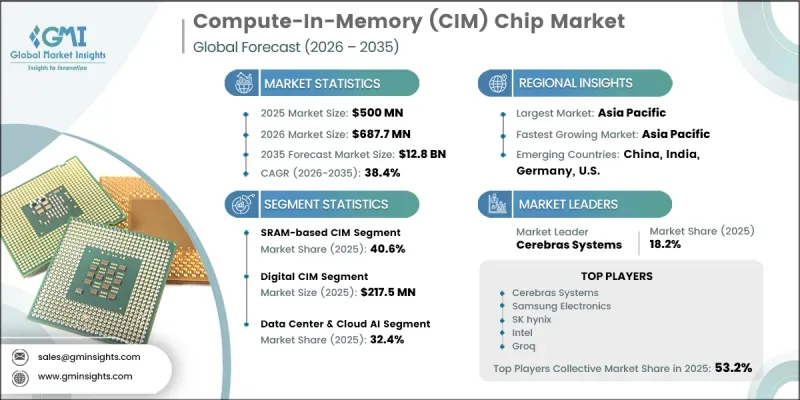
Market growth is driven by the rising need for higher computing efficiency as data volumes and processing demands continue to increase across modern digital environments. The rapid adoption of artificial intelligence, expansion of data-intensive workloads, and growing deployment of edge and embedded systems are accelerating the shift toward memory-centric computing architectures. Limitations of traditional processor-based designs, particularly in handling latency and energy consumption, are further encouraging the adoption of compute-in-memory technologies.
| Market Scope | |
|---|---|
| Start Year | 2025 |
| Forecast Year | 2026-2035 |
| Start Value | $500 Million |
| Forecast Value | $12.8 Billion |
| CAGR | 38.4% |
The compute-in-memory chip market is also gaining traction due to increasing pressure to reduce energy consumption in large-scale computing environments. As artificial intelligence workloads continue to expand, power usage across data infrastructure is rising significantly, prompting a transition toward more efficient computing models. The growing shift toward edge and embedded computing, where systems must operate within strict power and latency constraints, is further supporting demand. As data processing increasingly moves closer to the source, conventional cloud-dependent models are becoming less efficient. The transition toward memory-centric architectures, combined with advances in memory technologies and increasing visibility of processor bottlenecks, is collectively strengthening market adoption and long-term growth potential.
The SRAM-based CIM segment held a 40.6% share in 2025, driven by its high-speed performance, low latency, and strong compatibility with advanced semiconductor processes. These architectures are widely used in artificial intelligence accelerators and high-performance computing environments where consistent and rapid data processing is essential. Their maturity and seamless integration with existing CMOS technologies continue to support large-scale commercial deployment, reinforcing their dominant position.
The digital CIM segment reached USD 217.5 million in 2025, supported by its high accuracy, scalability, and ease of integration with established digital computing frameworks. These architectures are widely preferred in enterprise and data center environments where reliability and programmability are critical. Strong alignment with conventional semiconductor design processes has enabled broader adoption, sustaining the segment's leadership in the market.
North America Compute-In-Memory (CIM) Chip Market accounted for 31.4% share in 2025. Regional growth is supported by strong adoption of advanced computing technologies across data centers, artificial intelligence development ecosystems, and high-performance research environments. Increasing focus on energy-efficient computing and the need to support large-scale AI workloads are accelerating interest in memory-centric architectures. Technology developers and large-scale infrastructure operators in the region are actively investing in next-generation computing solutions to address performance and power efficiency challenges.
Key players operating in the Compute-In-Memory (CIM) Chip Market include Intel, NVIDIA, Samsung Electronics, SK hynix, Micron Technology, IBM, Graphcore, Cerebras Systems, Groq, Lightmatter, Mythic, d-Matrix, EnCharge AI, Untether AI, and Rain Neuromorphics. Companies in the Compute-In-Memory (CIM) Chip Market are focusing on advancing memory-centric architectures, enhancing energy efficiency, and improving processing speed for AI-driven applications. Significant investments in research and development are being directed toward optimizing SRAM and emerging memory technologies for large-scale deployment. Strategic partnerships with cloud providers, semiconductor manufacturers, and AI solution developers are helping companies accelerate commercialization. Firms are also prioritizing scalable chip designs and integration with existing semiconductor ecosystems to improve adoption. Additionally, continuous innovation in chip architecture, combined with efforts to address latency and power constraints, is enabling companies to strengthen their competitive position and expand their presence in high-performance computing and edge AI markets.
Table of Contents
Chapter 1 Methodology and Scope
- 1.1 Market scope and definition
- 1.2 Research design
- 1.2.1 Research approach
- 1.2.2 Data collection methods
- 1.3 Data mining sources
- 1.3.1 Global
- 1.3.2 Regional/Country
- 1.4 Base estimates and calculations
- 1.4.1 Base year calculation
- 1.4.2 Key trends for market estimation
- 1.5 Primary research and validation
- 1.5.1 Primary sources
- 1.6 Forecast model
- 1.7 Research assumptions and limitations
Chapter 2 Executive Summary
- 2.1 Industry 360° synopsis, 2022 - 2035
- 2.2 Key market trends
- 2.2.1 Memory technology type trends
- 2.2.2 Architecture type trends
- 2.2.3 Application trends
- 2.2.4 End-user industry trends
- 2.2.5 Regional trends
- 2.3 TAM Analysis, 2026-2035
- 2.4 CXO perspectives: Strategic imperatives
Chapter 3 Industry Insights
- 3.1 Industry ecosystem analysis
- 3.1.1 Supplier Landscape
- 3.1.2 Profit Margin
- 3.1.3 Cost structure
- 3.1.4 Value addition at each stage
- 3.1.5 Factor affecting the value chain
- 3.1.6 Disruptions
- 3.2 Industry impact forces
- 3.2.1 Growth drivers
- 3.2.1.1 Rapid growth of artificial intelligence and machine learning workloads
- 3.2.1.2 Rising demand for energy-efficient computing
- 3.2.1.3 Increasing deployment of edge and embedded computing devices
- 3.2.1.4 Limitations of Traditional CPU and GPU based architectures
- 3.2.1.5 Advancements in memory technologies enabling in memory computation
- 3.2.2 Industry pitfalls and challenges
- 3.2.2.1 High design complexity and limited standardization of compute-in-memory architectures
- 3.2.2.2 Reliability and accuracy concerns in large scale in memory computation
- 3.2.3 Market opportunities
- 3.2.3.1 Integration of computer-in-memory chips into next-generation data-center architectures
- 3.2.3.2 Adoption of computer in memory solutions in safety-critical and regulated industries
- 3.2.1 Growth drivers
- 3.3 Growth potential analysis
- 3.4 Regulatory landscape
- 3.4.1 North America
- 3.4.2 Europe
- 3.4.3 Asia Pacific
- 3.4.4 Latin America
- 3.4.5 Middle East & Africa
- 3.5 Porter's analysis
- 3.6 PESTEL analysis
- 3.7 Technology and Innovation landscape
- 3.7.1 Current technological trends
- 3.7.2 Emerging technologies
- 3.8 Price trends
- 3.8.1 By region
- 3.8.2 By product
- 3.9 Pricing Strategies
- 3.10 Emerging Business Models
- 3.11 Compliance Requirements
- 3.12 Patent and IP analysis
Chapter 4 Competitive Landscape, 2025
- 4.1 Introduction
- 4.2 Company market share analysis
- 4.2.1 By region
- 4.2.1.1 North America
- 4.2.1.2 Europe
- 4.2.1.3 Asia Pacific
- 4.2.1.4 Latin America
- 4.2.1.5 Middle East & Africa
- 4.2.2 Market concentration analysis
- 4.2.1 By region
- 4.3 Competitive benchmarking of key players
- 4.3.1 Financial performance comparison
- 4.3.1.1 Revenue
- 4.3.1.2 Profit margin
- 4.3.1.3 R&D
- 4.3.2 Product portfolio comparison
- 4.3.2.1 Product range breadth
- 4.3.2.2 Technology
- 4.3.2.3 Innovation
- 4.3.3 Geographic presence comparison
- 4.3.3.1 Global footprint analysis
- 4.3.3.2 Service network coverage
- 4.3.3.3 Market penetration by region
- 4.3.4 Competitive positioning matrix
- 4.3.4.1 Leaders
- 4.3.4.2 Challengers
- 4.3.4.3 Followers
- 4.3.4.4 Niche players
- 4.3.5 Strategic outlook matrix
- 4.3.1 Financial performance comparison
- 4.4 Key developments
- 4.4.1 Mergers and acquisitions
- 4.4.2 Partnerships and collaborations
- 4.4.3 Technological advancements
- 4.4.4 Expansion and investment strategies
- 4.4.5 Digital transformation initiatives
- 4.5 Emerging/ startup competitors landscape
Chapter 5 Market Estimates and Forecast, By Memory Technology Type, 2022 - 2035 (USD Million)
- 5.1 Key trends
- 5.2 SRAM-based CIM
- 5.3 DRAM-based CIM
- 5.4 Flash-based CIM
- 5.5 Others
Chapter 6 Market Estimates and Forecast, By Architecture Type, 2022 - 2035 (USD Million)
- 6.1 Key trends
- 6.2 Analog CIM
- 6.3 Digital CIM
- 6.4 Hybrid CIM
Chapter 7 Market Estimates and Forecast, By Application, 2022 - 2035 (USD Million)
- 7.1 Key trends
- 7.2 Edge AI
- 7.3 Data center & cloud AI
- 7.4 IoT & embedded
- 7.5 HPC & industrial automation
- 7.6 Others
Chapter 8 Market Estimates and Forecast, By End-User Industry, 2022 - 2035 (USD Million)
- 8.1 Key trends
- 8.2 IT & telecom
- 8.3 Automotive
- 8.4 Consumer electronics
- 8.5 Healthcare
- 8.6 Industrial
- 8.7 Others
Chapter 9 Market Estimates and Forecast, By Region, 2022 - 2035 (USD Million)
- 9.1 Key trends
- 9.2 North America
- 9.2.1 U.S.
- 9.2.2 Canada
- 9.3 Europe
- 9.3.1 Germany
- 9.3.2 UK
- 9.3.3 France
- 9.3.4 Spain
- 9.3.5 Italy
- 9.3.6 Russia
- 9.4 Asia Pacific
- 9.4.1 China
- 9.4.2 India
- 9.4.3 Japan
- 9.4.4 Australia
- 9.4.5 South Korea
- 9.5 Latin America
- 9.5.1 Brazil
- 9.5.2 Mexico
- 9.5.3 Argentina
- 9.6 Middle East and Africa
- 9.6.1 South Africa
- 9.6.2 Saudi Arabia
- 9.6.3 UAE
Chapter 10 Company Profiles
- 10.1 Global Key Players
- 10.1.1 Cerebras Systems
- 10.1.2 Samsung Electronics
- 10.1.3 SK hynix
- 10.1.4 Intel
- 10.1.5 Groq
- 10.2 Regional key players
- 10.2.1 North America
- 10.2.1.1 Mythic
- 10.2.1.2 d-Matrix
- 10.2.1.3 EnCharge AI
- 10.2.1.4 Untether AI
- 10.2.1.5 Lightmatter
- 10.2.1.6 IBM
- 10.2.1.7 Micron Technology
- 10.2.1.8 NVIDIA
- 10.2.2 Europe
- 10.2.2.1 Graphcore
- 10.2.1 North America
- 10.3 Niche Players/Disruptors
- 10.3.1 Rain Neuromorphics

