PUBLISHER: Global Market Insights Inc. | PRODUCT CODE: 2038292

PUBLISHER: Global Market Insights Inc. | PRODUCT CODE: 2038292
North America Emergency Shower and Eyewash Station Market Opportunity, Growth Drivers, Industry Trend Analysis, and Forecast 2026 - 2035
North America Emergency Shower and Eyewash Station Market was valued at USD 360 million in 2025 and is estimated to grow at a CAGR of 4.2% to reach USD 534.8 million by 2035.
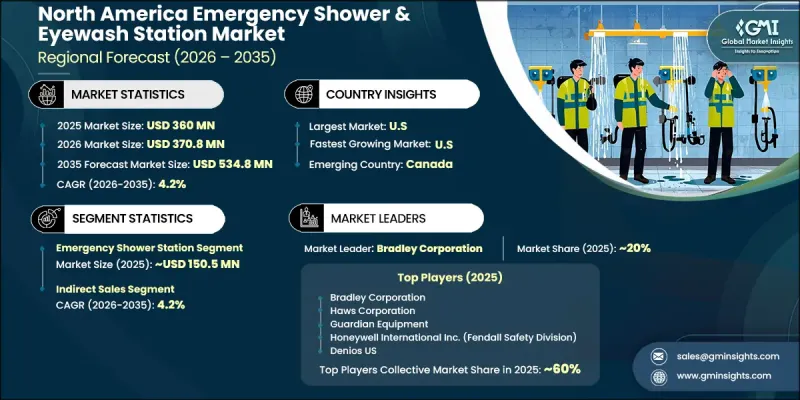
Market expansion is driven by rising awareness of workplace safety among employers, employees, and regulatory authorities across the region. Industries are placing a stronger focus on safeguarding personnel from hazardous exposure by investing in reliable emergency response infrastructure. Increasing alignment with regulatory frameworks such as OSHA, ANSI Z358.1, and CSA standards is encouraging organizations to enhance safety preparedness and ensure compliance. Companies are also strengthening internal safety protocols through improved training initiatives, stricter audits, and proactive risk management practices. Growing concerns related to legal liabilities and workplace incidents are further emphasizing the importance of immediate decontamination solutions. Despite these efforts, exposure to harmful substances continues to present operational risks due to widespread industrial chemical usage, reinforcing consistent demand for emergency shower and eyewash systems.
| Market Scope | |
|---|---|
| Start Year | 2025 |
| Forecast Year | 2026-2035 |
| Start Value | $360 Million |
| Forecast Value | $534.8 Million |
| CAGR | 4.2% |
The emergency shower station segment generated USD 150.5 million in 2025 and is expected to grow at a CAGR of 4.4% from 2026 to 2035. These systems are widely adopted across industries that involve direct exposure to hazardous substances, as they provide rapid response to extensive contamination incidents. Compared to eyewash units, emergency showers are designed to handle broader exposure scenarios, making them essential in facilities managing significant volumes of hazardous materials. Strengthened enforcement of safety regulations is encouraging widespread installation of compliant systems near high-risk zones, supporting injury prevention and reducing operational liabilities.
The indirect distribution channel held a share of 73.7% in 2025 and is anticipated to grow at a CAGR of 4.2% through 2035. This channel enables end users to access a diverse product portfolio while simplifying procurement and ensuring regulatory compliance. Organizations increasingly prefer distributors that provide bundled safety solutions along with technical expertise, installation support, maintenance services, and compliance guidance. This integrated approach allows businesses to implement comprehensive safety systems rather than relying on standalone equipment.
U.S. Emergency Shower and Eyewash Station Market reached USD 281.4 million in 2025 and is forecast to grow at a CAGR of 4.2% from 2026 to 2035. Strong demand is supported by the presence of multiple high-risk industries that require effective decontamination solutions. Strict enforcement of workplace safety standards and consistent adherence to regulatory guidelines are driving both new installations and system upgrades. The frequency of workplace exposure incidents has further encouraged organizations to invest in advanced emergency response systems to reduce risk, ensure compliance, and maintain operational continuity.
Key companies operating in the North America Emergency Shower And Eyewash Station Industry include Bradley Corporation, Haws Corporation, Honeywell International Inc., Guardian Equipment, Hughes Safety Showers Ltd., Speakman Company, Justrite Safety Group, Denios US, Dragerwerk AG, Encon Safety Products, Aqua Safety Showers International, B-L-S Industries, Inc., FSP-Tech, Safety Manufacturing (Acorn Safety), and Sir Safety System S.p.A. Companies in the North America Emergency Shower And Eyewash Station Market are focusing on expanding product innovation, enhancing compliance with evolving safety standards, and strengthening distribution networks. Manufacturers are investing in advanced designs that improve durability, ease of use, and rapid activation to ensure effective emergency response. Strategic partnerships with distributors and safety solution providers are helping companies expand market reach and offer integrated safety packages. Firms are also emphasizing after-sales services such as inspection, maintenance, and training support to build long-term customer relationships.
Table of Contents
Chapter 1 Methodology & Scope
- 1.1 Market scope and definition
- 1.2 Research design
- 1.2.1 Research approach
- 1.2.2 Data collection methods
- 1.3 Data mining sources
- 1.3.1 Global
- 1.3.2 Regional/Country
- 1.4 Base estimates and calculations
- 1.4.1 Base year calculation
- 1.4.2 Key trends for market estimation
- 1.5 Primary research and validation
- 1.5.1 Primary sources
- 1.6 Forecast model
- 1.7 Research assumptions and limitations
Chapter 2 Executive Summary
- 2.1 Industry 360° synopsis
- 2.2 Key market trends
- 2.2.1 Regional
- 2.2.2 Product type
- 2.2.3 Material
- 2.2.4 End-use industry
- 2.2.5 Distribution channel
Chapter 3 Industry Insights
- 3.1 Industry ecosystem analysis
- 3.1.1 Supplier landscape
- 3.1.2 Profit margin
- 3.1.3 Value addition at each stage
- 3.1.4 Factor affecting the value chain
- 3.2 Industry impact forces
- 3.2.1 Growth drivers
- 3.2.1.1 Rising safety awareness of workers and the need for proper emergency response
- 3.2.1.2 Increase in workplace accidents related to chemical exposure
- 3.2.1.3 Technological advancements and product innovation
- 3.2.2 Industry pitfalls & challenges
- 3.2.2.1 Changing environments/lack of plumbed water
- 3.2.2.2 Lack of flow control to the eye or eye/face wash
- 3.2.1 Growth drivers
- 3.3 Growth potential analysis
- 3.4 Future market trends
- 3.5 Technology and innovation landscape
- 3.5.1 Current technological trends
- 3.5.2 Emerging technologies
- 3.6 Porter's analysis
- 3.7 PESTEL analysis
- 3.8 Trade data analysis - HS Code: 8481.80 (taps, cocks, valves)
- 3.8.1 Import/export volume & value trends
- 3.8.2 Key trade corridors & tariff impact
- 3.8.3 Country of origin analysis for emergency safety equipment
- 3.8.4 Trade policy impact on North America market
- 3.9 Impact of AI & generative AI on the market
- 3.9.1 AI-driven disruption of existing business models
- 3.9.2 GenAI use cases & adoption roadmap by segment
- 3.9.3 Risks, limitations & regulatory considerations
Chapter 4 Competitive Landscape, 2025
- 4.1 Introduction
- 4.2 Company market share analysis
- 4.3 Company matrix analysis
- 4.4 Competitive analysis of major market players
- 4.5 Competitive positioning matrix
- 4.6 Key developments
- 4.6.1 Mergers & acquisitions
- 4.6.2 Partnerships & collaborations
- 4.6.3 New product launches
- 4.6.4 Expansion plans
Chapter 5 Market Estimates & Forecast, By Product Type, 2022 - 2035, (USD Million) (Thousand Units)
- 5.1 Key trends
- 5.2 Emergency shower station
- 5.2.1 Indoor
- 5.2.1.1 Floor mounted
- 5.2.1.2 Ceiling mounted
- 5.2.1.3 Others
- 5.2.2 Outdoor
- 5.2.2.1 Free standing booth
- 5.2.2.2 Free standing shower
- 5.2.1 Indoor
- 5.3 Emergency eye wash station
- 5.3.1 Plumbed-In
- 5.3.1.1 Wall mounted
- 5.3.1.2 Pedestal mounted
- 5.3.1.3 Others
- 5.3.2 Portable & self-contained
- 5.3.2.1 Wall mounted self-contained
- 5.3.2.2 Portable self-contained unit
- 5.3.1 Plumbed-In
- 5.4 Combination units
Chapter 6 Market Estimates & Forecast, By Material, 2022 - 2035, (USD Million) (Thousand Units)
- 6.1 Key trends
- 6.2 Stainless steel
- 6.3 Plastic
- 6.4 Others
Chapter 7 Market Estimates & Forecast, By End Use Industry, 2022 - 2035, (USD Million) (Thousand Units)
- 7.1 Key trends
- 7.2 Healthcare & pharmaceutical
- 7.3 Chemical & biotechnology
- 7.4 Oil and gas
- 7.5 Mining & exploration
- 7.6 Electronics
- 7.7 Others (construction etc.)
Chapter 8 Market Estimates & Forecast, By Distribution Channel, 2022 - 2035, (USD Million) (Thousand Units)
- 8.1 Key trends
- 8.2 Direct sales
- 8.3 Indirect sales
Chapter 9 Market Estimates & Forecast, By Country, 2022 - 2035, (USD Million) (Thousand Units)
- 9.1 Key trends
- 9.2 U.S.
- 9.3 Canada
Chapter 10 Company Profiles
- 10.1 Aqua Safety Showers International
- 10.2 B-L-S Industries, Inc.
- 10.3 Bradley Corporation
- 10.4 Denios US
- 10.5 Dragerwerk AG
- 10.6 Encon Safety Products
- 10.7 FSP-Tech
- 10.8 Guardian Equipment
- 10.9 Haws Corporation
- 10.10 Honeywell International Inc. (Fendall Safety Division)
- 10.11 Hughes Safety Showers Ltd.
- 10.12 Justrite Safety Group
- 10.13 Safety Manufacturing (Acorn Safety)
- 10.14 Sir Safety System S.p.A.
- 10.15 Speakman Company

