PUBLISHER: Global Market Insights Inc. | PRODUCT CODE: 2038302

PUBLISHER: Global Market Insights Inc. | PRODUCT CODE: 2038302
North America Ice Cream Maker Market Opportunity, Growth Drivers, Industry Trend Analysis, and Forecast 2026 - 2035
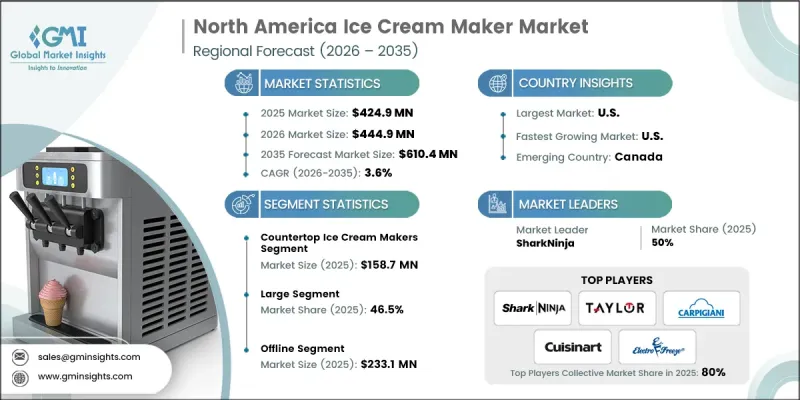
North America Ice Cream Maker Market was valued at USD 424.9 million in 2025 and is estimated to grow at a CAGR of 3.6% to reach USD 610.4 million by 2035.
Market expansion is supported by a growing preference among consumers for greater control, ingredient awareness, and customization in food preparation. Households are increasingly shifting toward preparing frozen desserts at home to better manage ingredient composition, portion sizes, and dietary considerations. Ice cream makers enable users to tailor recipes based on individual preferences, which has strengthened their appeal among health-focused consumers and those with specific nutritional requirements. In addition, home-based food preparation is evolving into a more engaging and creative activity, encouraging wider adoption of these appliances. The ability to experiment with diverse ingredients and textures is transforming frozen desserts into a personalized culinary experience rather than a standard purchase. This shift in consumer behavior continues to reinforce steady demand for ice cream makers across North America, supporting long-term market growth.
| Market Scope | |
|---|---|
| Start Year | 2025 |
| Forecast Year | 2026-2035 |
| Start Value | $424.9 Million |
| Forecast Value | $610.4 Million |
| CAGR | 3.6% |
The countertop ice cream makers segment reached USD 158.7 million in 2025. These appliances have become increasingly popular due to their ease of use and seamless integration into everyday kitchen routines. Their compact design and convenience make them a preferred option for consumers seeking to prepare customized frozen desserts at home. Users value the flexibility to adjust ingredients and create products that align with their dietary goals, contributing to the sustained demand for countertop models.
The large-capacity segment accounted for 46.5% share in 2025. Machines with capacities exceeding 5 liters are designed for producing higher volumes in a single cycle, making them suitable for users requiring greater output. These units offer efficiency by reducing the need for repeated preparation cycles while maintaining consistency in texture and flavor. Their ability to support bulk preparation has contributed to their growing adoption among consumers seeking convenience and efficiency in home-based food production.
U.S. Ice Cream Maker Market held a 87.3% share, generating USD 370.9 million in 2025. Market growth in the country is being driven by increasing interest in preparing personalized frozen desserts at home, along with a rising focus on ingredient transparency. Consumers are showing a stronger inclination toward managing dietary preferences and making customized food choices. The growing popularity of home cooking and content sharing has further contributed to the appeal of ice cream makers, encouraging wider adoption across households.
Key participants in the North America Ice Cream Maker Market include Carpigiani, Taylor Company, Breville Group, KitchenAid, SharkNinja, Cuisinart, Electro Freeze, Hamilton Beach, Stoelting, SaniServ, Emery Thompson, Bravo North America, Musso (Lello), Whynter, Dash, Zoku, Nostalgia Products, Euro Cuisine, Spaceman USA, Donper USA, and Cuisipro / Donvier. Companies operating in the North America Ice Cream Maker Market are focusing on product innovation, brand differentiation, and expanded distribution strategies to strengthen their market position. Manufacturers are introducing advanced features such as faster processing times, improved energy efficiency, and enhanced usability to attract a broader consumer base. Many players are also emphasizing compact designs and multifunctional capabilities to align with evolving consumer preferences. Strategic partnerships with retailers and e-commerce platforms are helping companies expand their reach and improve product accessibility. In addition, firms are investing in marketing initiatives that highlight customization, convenience, and health-conscious benefits.
Table of Contents
Chapter 1 Methodology and Scope
- 1.1 Market scope and definition
- 1.2 Research design
- 1.2.1 Research approach
- 1.2.2 Data collection methods
- 1.3 Data mining sources
- 1.3.1 Regional/Country
- 1.4 Base estimates and calculations
- 1.4.1 Base year calculation
- 1.4.2 Key trends for market estimation
- 1.5 Primary research and validation
- 1.5.1 Primary sources
- 1.6 Forecast model
- 1.7 Research assumptions and limitations
Chapter 2 Executive Summary
- 2.1 Industry 360° synopsis
- 2.2 Key market trends
- 2.2.1 Country
- 2.2.2 Type
- 2.2.3 Body frame material
- 2.2.4 Operation
- 2.2.5 Capacity
- 2.2.6 Price
- 2.2.7 End use
- 2.2.8 Distribution channel
Chapter 3 Industry Insights
- 3.1 Industry ecosystem analysis
- 3.1.1 Supplier landscape
- 3.1.2 Profit margin
- 3.1.3 Value addition at each stage
- 3.1.4 Factor affecting the value chain
- 3.2 Industry impact forces
- 3.2.1 Growth drivers
- 3.2.1.1 Rising demand for homemade & customizable desserts
- 3.2.1.2 Premiumization of kitchen appliances
- 3.2.1.3 Rise of hobby cooking & food content
- 3.2.2 Industry pitfalls & challenges
- 3.2.2.1 High entry cost for better experience
- 3.2.2.2 Crowded small appliance shelf
- 3.2.3 Opportunities
- 3.2.3.1 Health & lifestyle-specific branding
- 3.2.3.2 Design-led & smart appliance evolution
- 3.2.1 Growth drivers
- 3.3 Growth potential analysis
- 3.4 Future market trends
- 3.5 Technology and innovation landscape
- 3.5.1 Current technological trends
- 3.5.2 Emerging technologies
- 3.6 Regulatory framework
- 3.6.1 United States Regulations
- 3.6.1.1 FDA Food Contact Materials Standards
- 3.6.1.2 Energy Efficiency Standards (DOE)
- 3.6.1.3 Electrical Safety Standards (UL, ETL)
- 3.6.2 Canada Regulations
- 3.6.2.1 Health Canada Food Contact Standards
- 3.6.2.2 Canadian Electrical Code (CEC)
- 3.6.2.3 Energy Efficiency Regulations (NRCan)
- 3.6.3 Labeling & Consumer Safety Requirements
- 3.6.4 Environmental & Recycling Regulations
- 3.6.5 Regulatory Impact on Market Entry & Product Development
- 3.6.1 United States Regulations
- 3.7 Pricing analysis, 2025 (driven by primary research)
- 3.7.1 Historical price trend analysis (2022-2025)
- 3.7.2 Pricing strategy by player type (premium / value / cost-plus)
- 3.7.3 Price sensitivity analysis by consumer segment
- 3.7.4 Regional price variations (US vs. Canada)
- 3.7.5 Impact of material costs on retail pricing
- 3.7.6 Discount & promotional pricing strategies
- 3.7.7 Price-performance positioning matrix
- 3.8 Porter's analysis
- 3.9 PESTEL analysis
- 3.10 Consumer behavior analysis
- 3.10.1 Purchasing patterns
- 3.10.2 Preference analysis
- 3.10.3 Regional variations in consumer behavior
- 3.10.4 Impact of e-commerce on buying decisions
- 3.11 Trade data analysis (driven by paid database) (HS Code 8418.69)
- 3.11.1 Import/export volume & value trends
- 3.11.2 Key trade corridors & tariff impact analysis
- 3.11.3 North America trade flows
- 3.12 Impact of AI & generative AI on the market
- 3.12.1 AI-driven disruption of existing business models
- 3.12.2 GenAI use cases & adoption roadmap by segment
- 3.12.2.1 Smart recipe generation & customization
- 3.12.2.2 Predictive maintenance & iot integration
- 3.12.2.3 AI-powered customer service & support
- 3.12.2.4 Supply chain optimization & demand forecasting
- 3.12.3 Risks, limitations & regulatory considerations
- 3.12.4 Competitive landscape impact - AI adopters vs. Traditional players
- 3.13 Distribution infrastructure & channel penetration landscape (driven by primary research)
- 3.13.1 Channel coverage by region & format (e-commerce vs. Traditional retail)
- 3.13.2 Last-mile infrastructure gaps & emerging channel shifts
- 3.13.3 Online marketplace penetration & seller concentration
- 3.13.4 Offline retail footprint by store type
- 3.13.5 Omnichannel integration strategies
Chapter 4 Competitive Landscape, 2025
- 4.1 Introduction
- 4.2 Company market share analysis
- 4.2.1 By country
- 4.2.1.1 U.S.
- 4.2.1.2 Canada
- 4.2.1 By country
- 4.3 Company matrix analysis
- 4.4 Competitive analysis of major market players
- 4.5 Competitive positioning matrix
- 4.6 Key developments
- 4.6.1 Mergers & acquisitions
- 4.6.2 Partnerships & collaborations
- 4.6.3 New product launches
- 4.6.4 Expansion plans
Chapter 5 Market Estimates and Forecast, By Type, 2022 - 2035 (USD Million) (Million Units)
- 5.1 Key trends
- 5.2 Countertop ice cream makers
- 5.3 Portable ice cream makers
- 5.4 Hand-cranked ice cream makers
- 5.5 Frozen yogurt makers
- 5.6 Others (slushie machines, gelato makers, etc.)
Chapter 6 Market Estimates and Forecast, By Body Frame Material, 2022 - 2035 (USD Million) (Million Units)
- 6.1 Key trends
- 6.2 Metallic
- 6.3 Non-Metallic
Chapter 7 Market Estimates and Forecast, By Operation, 2022 - 2035 (USD Million) (Million Units)
- 7.1 Key trends
- 7.2 Automatic
- 7.3 Manual
Chapter 8 Market Estimates and Forecast, By Capacity, 2022 - 2035 (USD Million) (Million Units)
- 8.1 Key trends
- 8.2 Small (1-2 Liters)
- 8.3 Medium (3-5 Liters)
- 8.4 Large (5+ Liters)
Chapter 9 Market Estimates and Forecast, By Price, 2022 - 2035 (USD Million) (Million Units)
- 9.1 Key trends
- 9.2 Low
- 9.3 Medium
- 9.4 High
Chapter 10 Market Estimates and Forecast, By End Use Industry, 2022 - 2035 (USD Million) (Million Units)
- 10.1 Key trends
- 10.2 Household use
- 10.3 Commercial use
- 10.4 Ice cream parlors
- 10.5 HoReCa
- 10.6 Fast food chains
- 10.7 Others (catering services, etc.)
Chapter 11 Market Estimates and Forecast, By Distribution Channel, 2022 - 2035 (USD Million) (Million Units)
- 11.1 Key trends
- 11.2 Online
- 11.2.1 E-commerce
- 11.2.2 Company website
- 11.3 Offline
- 11.3.1 Supermarket/hypermarket
- 11.3.2 Electronic stores
- 11.3.3 Convenience stores
Chapter 12 Market Estimates and Forecast, By Region, 2022 - 2035 (USD Million) (Million Units)
- 12.1 Key trends
- 12.2 U.S.
- 12.3 Canada
Chapter 13 Company Profiles
- 13.1 Global players
- 13.1.1 Carpigiani
- 13.1.2 Taylor Company
- 13.1.3 Breville Group
- 13.1.4 KitchenAid
- 13.1.5 SharkNinja
- 13.1.6 Cuisinart
- 13.1.7 Electro Freeze
- 13.2 Regional players
- 13.2.1 Hamilton Beach
- 13.2.2 Stoelting
- 13.2.3 SaniServ
- 13.2.4 Emery Thompson
- 13.2.5 Bravo North America
- 13.2.6 Musso (Lello)
- 13.2.7 Whynter
- 13.3 Emerging players
- 13.3.1 Dash
- 13.3.2 Zoku
- 13.3.3 Nostalgia Products
- 13.3.4 Euro Cuisine
- 13.3.5 Spaceman USA
- 13.3.6 Donper USA
- 13.3.7 Cuisipro/Donvier

