PUBLISHER: Global Market Insights Inc. | PRODUCT CODE: 2038311

PUBLISHER: Global Market Insights Inc. | PRODUCT CODE: 2038311
North America Haircare Devices Market Opportunity, Growth Drivers, Industry Trend Analysis, and Forecast 2026 - 2035
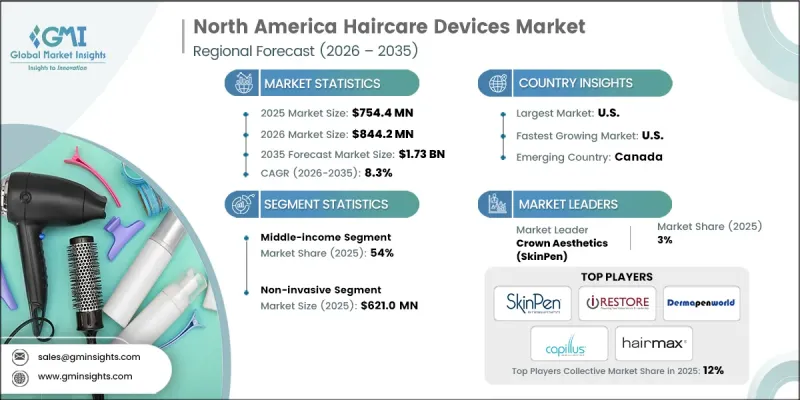
North America Haircare Devices Market was valued at USD 754.4 million in 2025 and is estimated to grow at a CAGR of 8.3% to reach USD 1.73 billion by 2035.
Evolving daily routines and time constraints are encouraging consumers to adopt devices that simplify grooming while delivering consistent results. A growing focus on maintaining healthy and well-styled hair is sustaining long-term demand across the region. At the same time, rapid digital influence and expanding beauty-focused communities are shaping purchasing decisions and accelerating trend adoption. Manufacturers are responding with advanced technologies and user-centric designs that enhance performance while minimizing potential damage. The integration of modern features and improved usability is helping bridge the gap between professional and at-home styling experiences. Additionally, increasing awareness around hair health and long-term care is reinforcing demand for devices that align with wellness-oriented lifestyles, further supporting market expansion.
| Market Scope | |
|---|---|
| Start Year | 2025 |
| Forecast Year | 2026-2035 |
| Start Value | $754.4 Million |
| Forecast Value | $1.73 Billion |
| CAGR | 8.3% |
Market trends across the North America haircare devices industry are shaped by changing consumer behavior, lifestyle shifts, and strong influence from digital platforms that accelerate the spread of beauty trends. Companies are focusing on innovation by developing lightweight, efficient, and easy-to-use devices that integrate advanced technologies designed to enhance hair quality and reduce damage. These developments are attracting both individual users seeking salon-quality outcomes at home and professional service providers requiring durable, high-performance tools. The growing emphasis on mindful beauty practices is also contributing to demand, as consumers increasingly prioritize solutions that support long-term hair health while maintaining styling efficiency.
The middle-income segment accounted for 54% share in 2025, making it the largest and fastest-growing consumer group. This segment reflects a balanced spending approach, where consumers prioritize practical and reliable grooming solutions without shifting toward premium pricing. Increasing emphasis on routine grooming and self-care is driving consistent demand for effective and accessible devices. Consumers within this group are aligning their purchasing behavior with broader lifestyle trends that emphasize well-maintained appearance and regular personal care, contributing significantly to overall market growth.
The non-invasive segment held a share of 82% in 2025, generating USD 621 million. Growth in this segment is supported by rising preference for solutions that integrate seamlessly into daily routines without requiring recovery time. These devices offer convenience, efficiency, and ease of use, making them highly appealing to consumers seeking practical grooming solutions. The increasing adoption of non-invasive technologies reflects a broader shift toward safe and time-efficient personal care approaches, reinforcing their strong position within the market.
U.S. Haircare Devices Market accounted for 73% share in 2025, generating USD 549.8 million. The country continues to lead the regional market due to strong consumer awareness, a well-established grooming culture, and widespread adoption of styling tools across both personal and professional settings. A robust beauty ecosystem, supported by salons, digital platforms, and extensive retail networks, contributes to high product visibility and sustained demand. Continuous innovation and strong consumer engagement are expected to maintain the country's leadership position throughout the forecast period.
Key companies operating in the North America Haircare Devices Market include Lumenis, Candela Medical (Syneron Candela), Venus Concept Inc., Revian (PhotonMD Inc.), Theradome, HairMax (Lexington International LLC), iRestore (Freedom Laser Therapy Inc.), Capillus (Curallux LLC), Kiierr International LLC, Illumiflow, LaserCap Company (Transdermal Cap), DermapenWorld, Eclipse Aesthetics (MicroPen), Crown Aesthetics (SkinPen / Bellus Medical), and Sunetics International. Companies in the North America Haircare Devices Market are strengthening their competitive position by prioritizing innovation, product differentiation, and advanced technology integration. They are investing in research and development to enhance device performance, safety, and ease of use while addressing evolving consumer expectations. Expanding product portfolios to cater to diverse consumer needs and price segments is a key strategy. Brands are also leveraging digital platforms, influencer collaborations, and targeted marketing to increase visibility and engagement. Strengthening distribution through both e-commerce and retail channels is improving accessibility.
Table of Contents
Chapter 1 Research Methodology
- 1.1 Research approach
- 1.2 Quality Commitments
- 1.2.1 GMI AI policy & data integrity commitment
- 1.2.1.1 Source consistency protocol
- 1.2.1 GMI AI policy & data integrity commitment
- 1.3 Research Trail & Confidence Scoring
- 1.3.1 Research Trail Components
- 1.3.2 Scoring Components
- 1.4 Data Collection
- 1.4.1 Partial list of primary sources
- 1.5 Data mining sources
- 1.5.1 Paid sources
- 1.5.1.1 Sources, by region
- 1.5.1 Paid sources
- 1.6 Base estimates and calculations
- 1.6.1 Base year calculation for any one approach
- 1.7 Forecast model
- 1.7.1 Quantified market impact analysis
- 1.7.1.1 Mathematical impact of growth parameters on forecast
- 1.7.1 Quantified market impact analysis
- 1.8 Research transparency addendum
- 1.8.1 Source attribution framework
- 1.8.2 Quality assurance metrics
- 1.8.3 Our commitment to trust
Chapter 2 Executive Summary
- 2.1 Industry 360° synopsis, 2022 - 2035
- 2.2 Key Trends
- 2.2.1 Country
- 2.2.2 Technology type
- 2.2.3 Invasiveness classification
- 2.2.4 Application
- 2.2.5 Customer income
- 2.2.6 Consumer group
- 2.2.7 Age group
- 2.2.8 Distribution channel
Chapter 3 Industry Insights
- 3.1 Industry ecosystem analysis
- 3.1.1 Value chain analysis
- 3.1.1.1 Manufacturing & import stage (cost structure)
- 3.1.1.2 Distribution & wholesale margins
- 3.1.1.3 Retail channel margins (salon/spa markup)
- 3.1.1.4 Value capture by channel type
- 3.1.2 Factors affecting the value chain
- 3.1.3 Profit margin analysis
- 3.1.4 Key Stakeholder Relationships & Influence Flows
- 3.1.5 Channel Partner Dynamics
- 3.1.1 Value chain analysis
- 3.2 Impact forces
- 3.2.1 Growth drivers
- 3.2.2 Industry pitfalls & challenges
- 3.2.3 Opportunities
- 3.3 Growth potential analysis
- 3.4 Regulatory landscape (solution core)
- 3.4.1 FDA classification of hair care devices (Class I, II, III)
- 3.4.2 State level cosmetology and medical device regulations
- 3.4.3 Licensing requirements by channel type (hair salon vs. medical spa)
- 3.4.4 Safety and efficacy standards (laser devices, invasive devices)
- 3.4.5 Upcoming regulatory changes and compliance roadmap
- 3.5 Porter's analysis
- 3.6 PESTEL analysis
- 3.7 Trade data analysis (driven by paid database)
- 3.7.1 Import volume and value trends (HS code 8516.32 - hair care apparatus)
- 3.7.2 Key sourcing countries and trade corridors
- 3.7.3 Tariff impact analysis
- 3.8 Impact of AI and generative AI on the hair care devices market
- 3.8.1 AI driven disruption: personalized diagnostics, treatment recommendation engines
- 3.8.2 GenAI use cases: virtual try on, scalp condition imaging analysis
- 3.8.3 Regulatory risks and adoption barriers
- 3.9 Pharmaceutical alternatives & substitution dynamics
- 3.9.1 Hair care pharmaceutical market overview
- 3.9.2 Device vs drug competitive dynamics
- 3.9.3 Substitution vs complementarity analysis
- 3.9.4 Competitive threat assessment for device market
- 3.9.5 Strategic implications for device market entrants
Chapter 4 Competitive Landscape, 2025
- 4.1 Introduction
- 4.2 Company market share analysis
- 4.2.1 U.S.
- 4.2.2 Canada
- 4.3 Company matrix analysis
- 4.4 Competitive analysis of major market players
- 4.5 Competitive positioning matrix
- 4.6 Key developments
- 4.6.1 Mergers & acquisitions
- 4.6.2 Partnerships & collaborations
- 4.6.3 New product launches
- 4.6.4 Expansion plans
Chapter 5 Market Estimates & Forecast, By Technology Type, 2022 - 2035, (USD Million) (Thousand Units)
- 5.1 Key trends
- 5.2 Laser devices
- 5.2.1 Low-level laser therapy (LLLT) devices
- 5.2.2 High-intensity laser devices
- 5.3 Fine bubble technology devices
- 5.4 Microneedling and needle-based devices
- 5.4.1 Manual microneedling devices
- 5.4.2 Automated microneedling devices
- 5.5 Steamer and thermal devices
- 5.6 LED light therapy devices
- 5.7 Multi-technology devices
- 5.8 Other technologies
Chapter 6 Market Estimates & Forecast, By Invasiveness Classification, 2022 - 2035, (USD Million) (Thousand Units)
- 6.1 Key trends
- 6.2 Non-invasive devices
- 6.3 Minimally invasive devices
- 6.4 Invasive devices
Chapter 7 Market Estimates & Forecast, By Customer Income, 2022 - 2035, (USD Million) (Thousand Units)
- 7.1 Key trends
- 7.2 Low-income segment
- 7.3 Middle-income segment
- 7.4 High-income segment
Chapter 8 Market Estimates & Forecast, By Consumer Group, 2022 - 2035, (USD Million) (Thousand Units)
- 8.1 Key trends
- 8.2 Male
- 8.3 Female
Chapter 9 Market Estimates & Forecast, By Age Group, 2022 - 2035, (USD Million) (Thousand Units)
- 9.1 Key trends
- 9.2 Under 18 years
- 9.3 18-30 years
- 9.4 31-45 years
- 9.5 46-60 years
- 9.6 60+ years
Chapter 10 Market Estimates & Forecast, By Application, 2022 - 2035, (USD Million) (Thousand Units)
- 10.1 Key trends
- 10.2 Hair growth and hair loss treatment devices
- 10.3 Scalp health and dandruff treatment devices
- 10.4 Hair coloring and styling support devices
- 10.5 Hair strengthening and repair devices
Chapter 11 Market Estimates & Forecast, By Distribution Channel, 2022 - 2035, (USD Million) (Thousand Units)
- 11.1 Key trends
- 11.2 Professional hair salons
- 11.2.1 Independent hair salons
- 11.2.2 Chain hair salons
- 11.3 Medical spas
- 11.3.1 Standalone medical spas
- 11.3.2 Physician-affiliated medical spas
- 11.4 Head spa salons
- 11.5 Dermatology clinics
- 11.6 Direct-to-consumer channels
- 11.6.1 E-commerce
- 11.6.2 Retail stores
Chapter 12 Market Estimates & Forecast, By Country, 2022 - 2035, (USD Million) (Thousand Units)
- 12.1 Key trends
- 12.2 U.S.
- 12.3 Canada
Chapter 13 Company Profiles (Business Overview, Financial Data, Product Landscape, Strategic Outlook, SWOT Analysis)
- 13.1 HairMax (Lexington International LLC)
- 13.2 Capillus (Curallux LLC)
- 13.3 Theradome
- 13.4 iRestore (Freedom Laser Therapy Inc.)
- 13.5 Revian (PhotonMD Inc.)
- 13.6 Crown Aesthetics (SkinPen / Bellus Medical)
- 13.7 DermapenWorld
- 13.8 Lumenis
- 13.9 Venus Concept Inc.
- 13.10 Kiierr International LLC
- 13.11 Sunetics International
- 13.12 LaserCap Company (Transdermal Cap)
- 13.13 Illumiflow
- 13.14 Candela Medical (Syneron Candela)
- 13.15 Eclipse Aesthetics (MicroPen)

