
PUBLISHER: Global Market Insights Inc. | PRODUCT CODE: 2038315

PUBLISHER: Global Market Insights Inc. | PRODUCT CODE: 2038315
North America Striking Tools Market Opportunity, Growth Drivers, Industry Trend Analysis, and Forecast 2026 - 2035
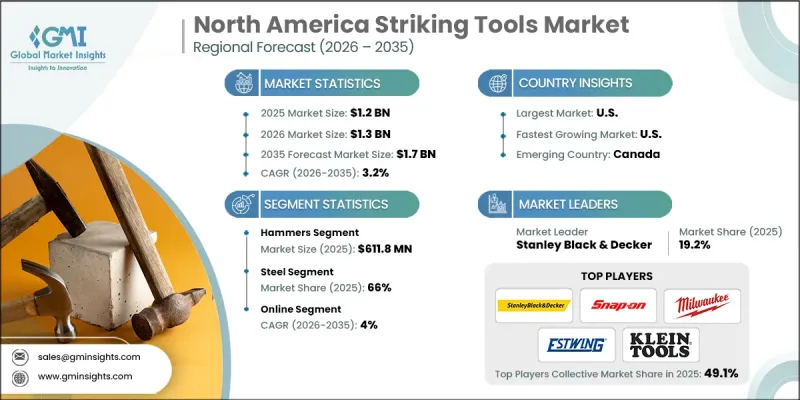
North America Striking Tools Market was valued at USD 1.2 billion in 2025 and is estimated to grow at a CAGR of 3.2% to reach USD 1.7 billion by 2035.
Increasing urban development and ongoing infrastructure investments are significantly contributing to the higher consumption of striking tools. At the same time, advancements in manufacturing processes are enabling the production of tools that are lighter, stronger, and more durable, enhancing overall efficiency and usability. Improvements in ergonomic design are also playing a key role in minimizing user fatigue and boosting productivity. Additionally, the growing interest among consumers in hands-on activities is driving demand, as more individuals engage in personal projects that require reliable tools. The market is also benefiting from broader product availability and improved accessibility via digital sales channels, enabling buyers to evaluate features and pricing more easily. These combined factors are reinforcing the importance of striking tools across professional and personal applications throughout North America.
| Market Scope | |
|---|---|
| Start Year | 2025 |
| Forecast Year | 2026-2035 |
| Start Value | $1.2 Billion |
| Forecast Value | $1.7 Billion |
| CAGR | 3.2% |
The automotive industry continues to influence the North America striking tools market, as these tools remain essential in various production and maintenance processes. Ongoing developments within the sector are contributing to sustained demand, with evolving manufacturing requirements shaping future market dynamics. These changes are expected to support consistent growth over the coming years.
The rise of online retail platforms has further strengthened the North America striking tools market by expanding product visibility and accessibility. Consumers can now explore a wide range of tools, compare specifications, and make informed purchasing decisions more efficiently. This shift has encouraged manufacturers to enhance their online presence and adopt competitive pricing strategies to attract a broader customer base.
In 2025, the hammer segment reached USD 611.8 million and is anticipated to grow at a CAGR of 3.4% during 2026-2035. Growth in this segment is supported by increasing construction activities and ongoing repair and upgrade projects. Demand is also being driven by the need for specialized tools across various applications, along with rising interest in personal projects. Product innovations focused on improved grip, reduced vibration, and enhanced durability are further supporting segment expansion.
By material, the steel segment accounted for 66% share in 2025 and is expected to grow at a CAGR of 3.4% from 2026 to 2035. Steel remains the preferred choice due to its strength, durability, and resistance to wear under repeated impact. Its performance characteristics make it highly suitable for demanding industrial applications, reinforcing its dominance within the market.
United States Striking Tools Market held an 89% share, generating USD 1.1 billion in 2025. Strong demand from industrial sectors continues to support market expansion, along with ongoing infrastructure development and modernization initiatives. The increasing use of advanced tools designed to enhance efficiency and workplace safety is further contributing to market growth. The presence of established manufacturers across the country also plays a significant role in sustaining industry momentum.
Key companies operating in the North America Striking Tools Market include Fiskars Group, Stanley Black & Decker, Snap-on Tools, Milwaukee Tool, Gedore, Truper Herramientas, Peddinghaus, Council Tool Company, Estwing Manufacturing Company, Vaughan & Bushnell Manufacturing, Klein Tools, Nupla Corporation, Crescent Tools, Roughneck Tools, Collins Company, Stiletto Tools, Warwood Tool Company, Snow & Nealley, Kendo Tools, Knipex Tools, and Hardcore Hammers. Companies in the North America Striking Tools Market are focusing on product innovation, strategic partnerships, and distribution expansion to strengthen their competitive position. They are investing in advanced materials and ergonomic designs to enhance performance and user comfort. Many firms are expanding their digital sales channels to reach a wider audience and improve customer engagement. Collaborations with distributors and retailers are helping increase market penetration. In addition, manufacturers are prioritizing brand differentiation through quality improvements and product diversification.
Table of Contents
Chapter 1 Methodology and scope
- 1.1 Research approach
- 1.2 Quality Commitments
- 1.2.1 GMI AI policy & data integrity commitment
- 1.2.1.1 Source consistency protocol
- 1.2.1 GMI AI policy & data integrity commitment
- 1.3 Research Trail & Confidence Scoring
- 1.3.1 Research Trail Components
- 1.3.2 Scoring Components
- 1.4 Data Collection
- 1.4.1 Partial list of primary sources
- 1.5 Data mining sources
- 1.5.1 Paid sources
- 1.5.1.1 Sources, by region
- 1.5.1 Paid sources
- 1.6 Base estimates and calculations
- 1.6.1 Base year calculation for any one approach
- 1.7 Forecast model
- 1.7.1 Quantified market impact analysis
- 1.7.1.1 Mathematical impact of growth parameters on forecast
- 1.7.1 Quantified market impact analysis
- 1.8 Research transparency addendum
- 1.8.1 Source attribution framework
- 1.8.2 Quality assurance metrics
- 1.8.3 Our commitment to trust
Chapter 2 Executive summary
- 2.1 Industry 360° synopsis
- 2.2 Key market trends
- 2.2.1 Regional
- 2.2.2 Product Type
- 2.2.3 Material
- 2.2.4 Price
- 2.2.5 End User
- 2.2.6 Distribution Channel
Chapter 3 Industry insights
- 3.1 Industry ecosystem analysis
- 3.1.1 Supplier landscape
- 3.1.2 Profit margin
- 3.1.3 Value addition at each stage
- 3.1.4 Factor affecting the value chain
- 3.1.5 Disruptions
- 3.2 Industry impact forces
- 3.2.1 Growth drivers
- 3.2.2 Industry pitfalls & challenges
- 3.2.3 Opportunities
- 3.3 Growth potential analysis
- 3.4 Future market trends
- 3.5 Technology and innovation landscape
- 3.5.1 Current technological trends
- 3.5.2 Emerging technologies
- 3.6 Pricing analysis, 2025
- 3.6.1 By country
- 3.6.2 Historical price trend analysis
- 3.6.3 Pricing strategy by player type
- 3.6.4 Regional Price Variation
- 3.6.5 Impact of Raw Material Costs on Pricing
- 3.7 Regulatory framework
- 3.7.1 Regulatory landscape
- 3.7.2 Safety Standards & Certifications (ANSI, OSHA)
- 3.7.3 Environmental Regulations
- 3.7.4 Import/Export Compliance
- 3.7.5 Product Liability & Quality Standards
- 3.8 Supply Chain Analysis
- 3.8.1 Supplier Landscape
- 3.8.2 Raw Material Sourcing (Steel, Wood, Fiberglass, Aluminum)
- 3.8.3 Supply Chain Disruptions & Mitigation Strategies
- 3.8.4 Logistics & Distribution Networks
- 3.8.5 Inventory Management Trends
- 3.9 Trade Data Analysis (HS Code - 8205) (Driven by paid database)
- 3.9.1 North America Import/Export Volume & Value Trends
- 3.9.2 U.S. Import Sources
- 3.9.3 Canada Import/Export Dynamics
- 3.9.4 USMCA Trade Flows (U.S.-Canada-Mexico Corridors)
- 3.9.5 Tariff Impact Analysis
- 3.9.6 Import Dependency by Product Category
- 3.10 Impact of AI & generative AI on the market
- 3.10.1 AI-driven disruption of traditional business models
- 3.10.2 GenAI use cases & adoption roadmap by customer segment
- 3.10.3 Risks, limitations & regulatory considerations
- 3.10.4 AI-enabled smart home ecosystem integration
- 3.11 Porter's five forces analysis
- 3.12 PESTEL analysis
- 3.13 Consumer behavior analysis
- 3.13.1 Purchasing patterns
- 3.13.2 Preference analysis
- 3.13.3 Regional variations in consumer behavior
- 3.13.4 Impact of e-commerce on buying decisions
Chapter 4 Competitive landscape, 2025
- 4.1 Introduction
- 4.2 Company market share analysis
- 4.2.1 U.S.
- 4.2.2 Canada
- 4.3 Company matrix analysis
- 4.4 Competitive analysis of major market players
- 4.5 Competitive positioning matrix
- 4.6 Key developments
- 4.6.1 Mergers & acquisitions
- 4.6.2 Partnerships & collaborations
- 4.6.3 New product launches
- 4.6.4 Expansion plans
Chapter 5 Market Estimates & Forecast, By Product Type, 2022 - 2035 ($Billion, Thousand Units)
- 5.1 Key trends
- 5.2 Hammers
- 5.2.1 Claw hammers
- 5.2.2 Ball peen hammers
- 5.2.3 Sledgehammers
- 5.2.4 Dead blow hammers
- 5.2.5 Others (framing, masonry, etc.)
- 5.3 Picks and axes
- 5.4 Mallets
- 5.4.1 Rubber mallets
- 5.4.2 Wood mallets
- 5.4.3 Soft-faced mallets
- 5.5 Chisels and Punches
- 5.5.1 Cold chisels
- 5.5.2 Wood chisels
- 5.5.3 Punches (center, pin, drift)
- 5.6 Diggers
- 5.7 Others (tampers etc.)
Chapter 6 Market Estimates & Forecast, By Material, 2022 - 2035 ($Billion, Thousand Units)
- 6.1 Key trends
- 6.2 Steel
- 6.3 Wood
- 6.4 Fiberglass
- 6.5 Plastic
- 6.6 Aluminium
- 6.7 Others (composite materials etc.)
Chapter 7 Market Estimates & Forecast, By Price Range, 2022 - 2035 ($Billion, Thousand Units)
- 7.1 Key trends
- 7.2 Low (below $50)
- 7.3 Medium ($50 -$100)
- 7.4 High ($101 and above)
Chapter 8 Market Estimates & Forecast, By End Users, 2022 - 2035 ($Billion, Thousand Units)
- 8.1 Key trends
- 8.2 DIY and homeowners
- 8.2.1 Home improvement applications
- 8.2.2 General maintenance & repair
- 8.3 Professionals
- 8.4 Industrial
- 8.4.1 Construction
- 8.4.2 Automotive
- 8.4.3 Manufacturing and metalworking
- 8.4.4 Others (woodworking etc.)
Chapter 9 Market Estimates & Forecast, By Distribution Channel, 2022 - 2035 ($Billion, Thousand Units)
- 9.1 Key trends
- 9.2 Online
- 9.2.1 E-commerce
- 9.2.2 Company websites
- 9.3 Offline
- 9.3.1 Supermarkets/hypermarkets
- 9.3.2 Specialty stores
- 9.3.3 Others (home improvement stores etc.)
Chapter 10 Market Estimates & Forecast, By Country, 2022 - 2035 ($Billion, Thousand Units)
- 10.1 Key trends
- 10.2 U.S.
- 10.3 Canada
Chapter 11 Company Profiles
- 11.1 Top Global Players
- 11.1.1 Fiskars Group
- 11.1.2 Gedore
- 11.1.3 Milwaukee Tool
- 11.1.4 Peddinghaus
- 11.1.5 Snap-on Tools
- 11.1.6 Stanley Black & Decker
- 11.1.7 Truper Herramientas
- 11.2 Regional Key Players
- 11.2.1 Council Tool Company
- 11.2.2 Crescent Tools
- 11.2.3 Estwing Manufacturing Company
- 11.2.4 Klein Tools
- 11.2.5 Nupla Corporation
- 11.2.6 Roughneck Tools
- 11.2.7 Vaughan & Bushnell Manufacturing
- 11.3 Emerging and Specialized Players
- 11.3.1 Collins Company
- 11.3.2 Hardcore Hammers
- 11.3.3 Kendo Tools
- 11.3.4 Knipex Tools
- 11.3.5 Snow & Nealley
- 11.3.6 Stiletto Tools
- 11.3.7 Warwood Tool Company

