
PUBLISHER: Global Market Insights Inc. | PRODUCT CODE: 2038318

PUBLISHER: Global Market Insights Inc. | PRODUCT CODE: 2038318
LED Driver IC Market Opportunity, Growth Drivers, Industry Trend Analysis, and Forecast 2026 - 2035
The Global LED Driver IC Market was valued at USD 4.7 billion in 2025 and is estimated to grow at a CAGR of 9.4% to reach USD 11.6 billion by 2035.
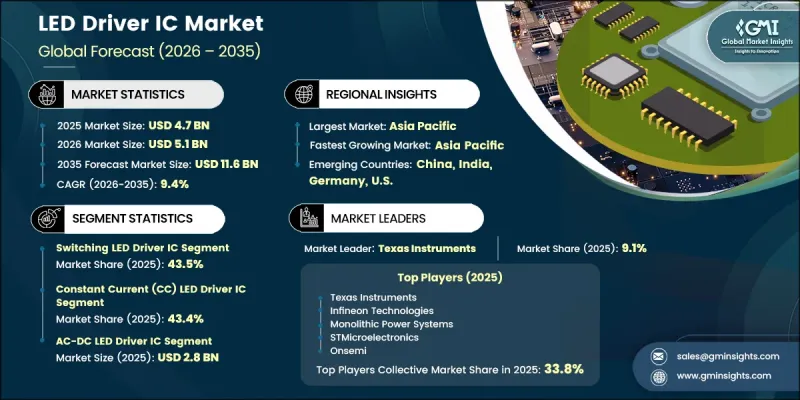
Growth in the LED driver IC industry is fueled by the widespread adoption of advanced LED technologies that offer improved efficiency and longer operational life. Increasing integration of LED-based systems into a broad range of applications is also supporting market expansion. At the same time, ongoing innovation in intelligent lighting systems and the development of new application areas are strengthening demand for advanced driver IC solutions. The ability of these components to regulate power effectively, enhance performance, and extend product durability is making them essential in modern lighting ecosystems, contributing significantly to the long-term expansion of the LED driver IC market.
| Market Scope | |
|---|---|
| Start Year | 2025 |
| Forecast Year | 2026-2035 |
| Start Value | $4.7 Billion |
| Forecast Value | $11.6 Billion |
| CAGR | 9.4% |
The LED driver IC industry is gaining momentum due to the global transition toward energy-efficient lighting systems. Regulatory frameworks promoting energy conservation are accelerating the shift away from conventional lighting technologies, increasing the need for efficient driver ICs that ensure stable performance and optimized power usage. These regulations are encouraging manufacturers to design lighting systems that meet strict efficiency, durability, and sustainability standards, further supporting market growth across various end-use sectors.
The linear LED driver IC segment is expected to register a CAGR of 10.7% during 2026-2035. This growth is driven by increasing demand for compact, cost-effective, and low-power solutions. Their streamlined design, reliable performance, and ease of implementation make them well-suited for modern lighting applications, particularly where space efficiency and thermal management are critical factors.
The hybrid and programmable LED driver IC segment is projected to grow at a CAGR of 10.4% through 2035. Rising demand for adaptable lighting systems with advanced control capabilities is supporting the expansion of this segment. These driver ICs enable flexible configurations, dynamic control features, and enhanced functionality, making them increasingly important in evolving lighting environments.
North America LED Driver IC Market accounted for 28.5% share in 2025, supported by rapid adoption of advanced lighting technologies and ongoing infrastructure upgrades. The region is experiencing strong demand for high-performance lighting systems driven by modernization initiatives and increased focus on energy efficiency. Continued investment in next-generation lighting solutions and supportive regulatory initiatives is further strengthening market growth across North America.
Key players operating in the Global LED driver IC market include Analog Devices, Texas Instruments, Infineon Technologies, STMicroelectronics, onsemi, NXP Semiconductors, Renesas Electronics, ROHM Semiconductor, Microchip Technology, Diodes Incorporated, Monolithic Power Systems, Skyworks Solutions, Silergy Corp, Richtek Technology, and Power Integrations. Companies in the Global LED driver IC market are focusing on innovation, strategic partnerships, and portfolio expansion to strengthen their competitive position. They are investing in advanced semiconductor technologies to improve efficiency, reduce power consumption, and enhance performance capabilities. Collaborations with lighting manufacturers and technology providers are helping companies expand their market reach and integrate solutions into next-generation systems. Many players are also targeting emerging markets to capitalize on the growing demand for energy-efficient lighting.
Table of Contents
Chapter 1 Methodology and Scope
- 1.1 Market scope and definition
- 1.2 Research design
- 1.2.1 Research approach
- 1.2.2 Data collection methods
- 1.3 Data mining sources
- 1.3.1 Global
- 1.3.2 Regional/Country
- 1.4 Base estimates and calculations
- 1.4.1 Base year calculation
- 1.4.2 Key trends for market estimation
- 1.5 Primary research and validation
- 1.5.1 Primary sources
- 1.6 Forecast model
- 1.7 Research assumptions and limitations
Chapter 2 Executive Summary
- 2.1 Industry 360° synopsis, 2022 - 2035
- 2.2 Key market trends
- 2.2.1 Topology type trends
- 2.2.2 Power source type trends
- 2.2.3 Output regulation type trends
- 2.2.4 Power rating trends
- 2.2.5 Integration level trends
- 2.2.6 Application trends
- 2.2.7 End-user trends
- 2.2.8 Regional trends
- 2.3 TAM Analysis, 2026-2035
- 2.4 CXO perspectives: Strategic imperatives
Chapter 3 Industry Insights
- 3.1 Industry ecosystem analysis
- 3.1.1 Supplier Landscape
- 3.1.2 Profit Margin
- 3.1.3 Cost structure
- 3.1.4 Value addition at each stage
- 3.1.5 Factor affecting the value chain
- 3.1.6 Disruptions
- 3.2 Industry impact forces
- 3.2.1 Growth drivers
- 3.2.1.1 Rising adoption of LED lighting in residential, commercial, and industrial spaces
- 3.2.1.2 Expansion of LED use in automotive lighting and mobility applications
- 3.2.1.3 Government energy efficiency regulations
- 3.2.1.4 Expansion of consumer electronics and display backlighting
- 3.2.1.5 Increasing use of LEDs in high-growth sectors such as horticulture, healthcare, and UV sterilization
- 3.2.2 Industry pitfalls and challenges
- 3.2.2.1 High cost of advanced LED driver IC designs
- 3.2.2.2 Supply chain dependence on limited semiconductor foundries
- 3.2.3 Market opportunities
- 3.2.3.1 Growth of smart cities and connected lighting infrastructure
- 3.2.3.2 Rising adoption of mini-LED and micro-LED technologies
- 3.2.1 Growth drivers
- 3.3 Growth potential analysis
- 3.4 Regulatory landscape
- 3.4.1 North America
- 3.4.2 Europe
- 3.4.3 Asia Pacific
- 3.4.4 Latin America
- 3.4.5 Middle East & Africa
- 3.5 Porter's analysis
- 3.6 PESTEL analysis
- 3.7 Technology and Innovation landscape
- 3.7.1 Current technological trends
- 3.7.2 Emerging technologies
- 3.8 Price trends
- 3.8.1 By region
- 3.8.2 By product
- 3.9 Pricing Strategies
- 3.10 Emerging Business Models
- 3.11 Compliance Requirements
- 3.12 Patent and IP analysis
Chapter 4 Competitive Landscape, 2025
- 4.1 Introduction
- 4.2 Company market share analysis
- 4.2.1 By region
- 4.2.1.1 North America
- 4.2.1.2 Europe
- 4.2.1.3 Asia Pacific
- 4.2.1.4 Latin America
- 4.2.1.5 Middle East & Africa
- 4.2.2 Market concentration analysis
- 4.2.1 By region
- 4.3 Competitive benchmarking of key players
- 4.3.1 Financial performance comparison
- 4.3.1.1 Revenue
- 4.3.1.2 Profit margin
- 4.3.1.3 R&D
- 4.3.2 Product portfolio comparison
- 4.3.2.1 Product range breadth
- 4.3.2.2 Technology
- 4.3.2.3 Innovation
- 4.3.3 Geographic presence comparison
- 4.3.3.1 Global footprint analysis
- 4.3.3.2 Service network coverage
- 4.3.3.3 Market penetration by region
- 4.3.4 Competitive positioning matrix
- 4.3.4.1 Leaders
- 4.3.4.2 Challengers
- 4.3.4.3 Followers
- 4.3.4.4 Niche players
- 4.3.5 Strategic outlook matrix
- 4.3.1 Financial performance comparison
- 4.4 Key developments
- 4.4.1 Mergers and acquisitions
- 4.4.2 Partnerships and collaborations
- 4.4.3 Technological advancements
- 4.4.4 Expansion and investment strategies
- 4.4.5 Digital transformation initiatives
- 4.5 Emerging/ startup competitors landscape
Chapter 5 Market Estimates and Forecast, By Topology Type, 2022 - 2035 (USD Million)
- 5.1 Key trends
- 5.2 Linear LED driver IC
- 5.3 Switching LED driver IC
- 5.4 Isolated switching
Chapter 6 Market Estimates and Forecast, By Power Source Type, 2022 - 2035 (USD Million)
- 6.1 Key trends
- 6.2 AC-DC LED driver IC
- 6.3 DC-DC LED driver IC
Chapter 7 Market Estimates and Forecast, By Output Regulation Type, 2022 - 2035 (USD Million)
- 7.1 Key trends
- 7.2 Constant current (CC) LED driver IC
- 7.3 Constant voltage (CV) LED driver IC
- 7.4 Hybrid & programmable LED driver IC
Chapter 8 Market Estimates and Forecast, By Power Rating, 2022 - 2035 (USD Million)
- 8.1 Key trends
- 8.2 Low power (<5W)
- 8.3 Medium power (5W-50W)
- 8.4 High power (>50W)
Chapter 9 Market Estimates and Forecast, By Integration Level, 2022 - 2035 (USD Million)
- 9.1 Key trends
- 9.2 Basic driver IC
- 9.3 Integrated driver IC with protection
- 9.4 Smart & intelligent driver IC
Chapter 10 Market Estimates and Forecast, By Application, 2022 - 2035 (USD Million)
- 10.1 Key trends
- 10.2 General lighting
- 10.3 Automotive lighting
- 10.4 Display backlighting
- 10.5 Signage & advertising
- 10.6 Others
Chapter 11 Market Estimates and Forecast, By End-User, 2022 - 2035 (USD Million)
- 11.1 Key trends
- 11.2 Lighting OEMs
- 11.3 Automotive OEMs & tier-1 suppliers
- 11.4 Consumer electronics manufacturers
- 11.5 Display & signage manufacturers
- 11.6 Contract manufacturers & ODMs
- 11.7 Others
Chapter 12 Market Estimates and Forecast, By Region, 2022 - 2035 (USD Million)
- 12.1 Key trends
- 12.2 North America
- 12.2.1 U.S.
- 12.2.2 Canada
- 12.3 Europe
- 12.3.1 Germany
- 12.3.2 UK
- 12.3.3 France
- 12.3.4 Spain
- 12.3.5 Italy
- 12.3.6 Russia
- 12.4 Asia Pacific
- 12.4.1 China
- 12.4.2 India
- 12.4.3 Japan
- 12.4.4 Australia
- 12.4.5 South Korea
- 12.5 Latin America
- 12.5.1 Brazil
- 12.5.2 Mexico
- 12.5.3 Argentina
- 12.6 Middle East and Africa
- 12.6.1 South Africa
- 12.6.2 Saudi Arabia
- 12.6.3 UAE
Chapter 13 Company Profiles
- 13.1 Global Key Players
- 13.1.1 Texas Instruments
- 13.1.2 Infineon Technologies
- 13.1.3 Monolithic Power Systems
- 13.1.4 STMicroelectronics
- 13.1.5 onsemi
- 13.2 Regional key players
- 13.2.1 North America
- 13.2.1.1 Analog Devices
- 13.2.1.2 Microchip Technology
- 13.2.1.3 Power Integrations
- 13.2.1.4 Diodes Incorporated
- 13.2.1.5 Skyworks Solutions
- 13.2.2 Asia Pacific
- 13.2.2.1 Renesas Electronics
- 13.2.2.2 Silergy Corp
- 13.2.2.3 Richtek Technology
- 13.2.3 Europe
- 13.2.3.1 NXP Semiconductors
- 13.2.3.2 ROHM Semiconductor
- 13.2.1 North America

