PUBLISHER: Global Market Insights Inc. | PRODUCT CODE: 2038323

PUBLISHER: Global Market Insights Inc. | PRODUCT CODE: 2038323
Commercial Cleaning Market Opportunity, Growth Drivers, Industry Trend Analysis, and Forecast 2026 - 2035
The Global Commercial Cleaning Market was valued at USD 67.2 billion in 2025 and is estimated to grow at a CAGR of 7.6% to reach USD 140.4 billion by 2035.
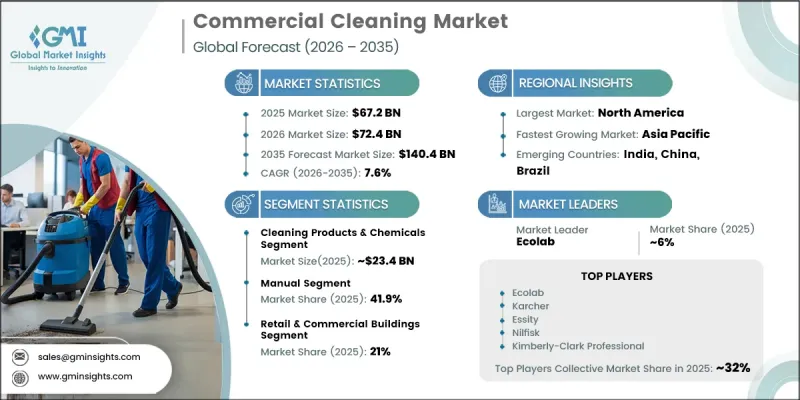
The industry is gaining momentum through the integration of advanced technologies and automation across cleaning operations. Businesses are placing greater importance on maintaining hygienic, sanitized environments to align with evolving customer expectations and regulatory standards. This shift is accelerating the demand for more efficient and innovative cleaning solutions. The rise of robotic cleaning equipment, powered by artificial intelligence and machine learning, is transforming operational efficiency by enabling autonomous navigation and precision-based cleaning. These systems can analyze environments, optimize cleaning routes, and function independently, making them highly effective across a variety of commercial settings. Technological innovation continues to serve as a major catalyst for industry expansion, reshaping how cleaning services are delivered while improving productivity and consistency across the sector.
| Market Scope | |
|---|---|
| Start Year | 2025 |
| Forecast Year | 2026-2035 |
| Start Value | $67.2 Billion |
| Forecast Value | $140.4 Billion |
| CAGR | 7.6% |
The cleaning products and chemicals segment generated USD 23.4 billion in 2025 and is expected to grow at a CAGR of 8.2% from 2026 through 2035. This segment remains a core component of the market due to its essential role in everyday cleaning processes. It includes a broad portfolio of consumable solutions such as disinfectants, detergents, degreasers, and surface treatment agents that are required for both general maintenance and specialized sanitation needs. Demand for these products remains steady due to their continuous usage in environments that require frequent and thorough cleaning. The recurring nature of these supplies ensures consistent revenue generation, reinforcing the segment's strong position within the overall market landscape.
The manual cleaning segment accounted for 41.9% share in 2025, owing to its flexibility and cost efficiency. This segment involves hands-on cleaning tasks that require attention to detail and adaptability, which automated systems may not fully achieve. Manual methods remain widely utilized because they allow for targeted cleaning and immediate response to varying conditions. Despite advancements in automation, human-driven cleaning continues to play a crucial role in maintaining cleanliness standards, particularly where precision and situational judgment are required.
United States Commercial Cleaning Market reached USD 19.4 billion in 2025 and is forecasted to grow at a CAGR of 7.5% between 2026 and 2035, leading the North American region. The country's strong market position is supported by extensive commercial infrastructure, strict regulatory frameworks, and a well-established culture of outsourcing cleaning services. High standards for hygiene and safety continue to drive consistent demand, along with the adoption of environmentally responsible cleaning solutions and evolving workplace policies that emphasize health and sanitation compliance.
Key companies operating in the Global Commercial Cleaning Market include Tennant Company, Karcher, Nilfisk, Hako, IPC Group, Ecolab, Diversey, Rubbermaid Commercial Products, Kimberly-Clark Professional, 3M Commercial Solutions, Essity, Georgia-Pacific Professional, Fimap, Columbus, Minuteman International, Betco Corporation, Aebi Schmidt, Windsor, Sanitaire Commercial, Spartan Chemical, Vikan, Gaussian Robotics, Avidbots, LionsBot, and ICE Cobotics. Companies in the Commercial Cleaning Market are focusing on innovation, strategic partnerships, and geographic expansion to strengthen their competitive position. Many players are investing heavily in research and development to introduce advanced cleaning technologies, including AI-powered and autonomous equipment. Firms are also forming collaborations and distribution alliances to enhance market reach and improve supply chain efficiency. Sustainability initiatives, such as eco-friendly product development and reduced chemical usage, are becoming central to brand positioning. Additionally, companies are expanding service portfolios and offering integrated cleaning solutions to meet diverse client needs.
Table of Contents
Chapter 1 Methodology & Scope
- 1.1 Market scope & definitions
- 1.2 Research design
- 1.2.1 Research approach
- 1.2.2 Data collection methods
- 1.3 Base estimates and calculations
- 1.3.1 Base year calculation
- 1.3.2 Market estimates & forecasts parameters
- 1.4 Forecast Model
- 1.4.1 Key trends for market estimates
- 1.4.2 Quantified market impact analysis
- 1.4.2.1 Mathematical impact of growth parameters on forecast
- 1.4.3 Scenario analysis framework
- 1.5 Primary research and validation
- 1.5.1 Some of the primary sources (but not limited to)
- 1.6 Data mining sources
- 1.6.1 Paid Sources
- 1.7 Primary research and validation
- 1.7.1 Primary sources
- 1.8 Research Trail & confidence scoring
- 1.8.1 Research trail components
- 1.8.2 Scoring components
- 1.9 Research transparency addendum
- 1.9.1 Source attribution framework
- 1.9.2 Quality assurance metrics
- 1.9.3 Our commitment to trust
- 1.10 Market Definitions
Chapter 2 Executive Summary
- 2.1 Industry 360° synopsis
- 2.2 Key market trends
- 2.2.1 Regional
- 2.2.2 Product type
- 2.2.3 Mode of Operation
- 2.2.4 End use industry
Chapter 3 Industry Insights
- 3.1 Industry ecosystem analysis
- 3.1.1 Component suppliers
- 3.1.2 Manufacturing hubs
- 3.1.3 Distribution network structure
- 3.1.4 Supply chain vulnerabilities & risk factors
- 3.1.5 Vertical integration trends
- 3.1.6 Profit margin
- 3.1.7 Value addition at each stage
- 3.1.8 Factor affecting the value chain
- 3.2 Industry impact forces
- 3.2.1 Growth drivers
- 3.2.1.1 Rising hygiene standards and infection control awareness
- 3.2.1.2 Labor shortage and rising labor costs driving automation adoption
- 3.2.1.3 Sustainability and green cleaning product demand
- 3.2.2 Challenges & restraints
- 3.2.2.1 High initial capital investment for robotic/automated equipment
- 3.2.2.2 Slow adoption in price-sensitive markets
- 3.2.3 Opportunities
- 3.2.3.1 Growing demand for hygiene & health standards
- 3.2.3.2 Expansion of specialized & eco-friendly cleaning services
- 3.2.1 Growth drivers
- 3.3 Growth potential analysis
- 3.4 Future market trends
- 3.5 Technology and innovation landscape
- 3.5.1 Current technological trends
- 3.5.2 Emerging technologies
- 3.6 Price trends
- 3.6.1 By region
- 3.6.2 By product
- 3.6.3 Historical price trend analysis
- 3.6.4 Pricing strategy by player type
- 3.7 Regulatory landscape
- 3.7.1 Global regulatory standards
- 3.7.2 Europe
- 3.7.2.1 Equipment Safety Standards (EN Standards)
- 3.7.2.2 Chemical Product Regulations
- 3.7.2.3 Environmental and Waste Management Requirements
- 3.7.3 Country specific regulatory scenario
- 3.7.3.1 Germany
- 3.7.3.2 UK
- 3.7.3.3 France
- 3.7.3.4 Italy
- 3.7.3.5 Spain
- 3.7.4 Asia Pacific
- 3.7.4.1 China
- 3.7.4.1.1 GB Standards
- 3.7.4.1.2 CCC Certification
- 3.7.4.1.3 Environmental Protection Law
- 3.7.4.2 India
- 3.7.4.3 Japan
- 3.7.4.4 South Korea
- 3.7.4.1 China
- 3.7.5 ASEAN Harmonization Efforts
- 3.7.6 North America
- 3.7.6.1 United States
- 3.7.6.1.1 OSHA Requirements
- 3.7.6.1.2 EPA DfE Program
- 3.7.6.2 State-Level Regulations
- 3.7.6.3 Canada
- 3.7.6.1 United States
- 3.7.7 Emerging Regulatory Trends
- 3.7.8 Autonomous equipment safety standards
- 3.7.9 Data privacy for IoT-enabled cleaning systems
- 3.7.10 Carbon footprint and ESG Disclosure Requirements
- 3.8 Major market trends and disruptions
- 3.9 Technological and innovation landscape
- 3.9.1 Current technological trends
- 3.9.2 Emerging technologies
- 3.10 Pricing analysis, 2025
- 3.10.1 By region
- 3.10.2 Historical Price Trend Analysis (Driven by Primary Research)
- 3.10.3 Pricing Strategy by Player Type (Premium / Value / Cost-Plus) (Driven by Primary Research)
- 3.10.4 Regional Price Variance Analysis
- 3.11 Future market trends
- 3.12 Trade data analysis (driven by paid database) (HS Code 998533)
- 3.12.1 Import/Export Volume & Value Trends
- 3.12.2 Equipment Trade Flows
- 3.12.3 Product Trade Flows
- 3.12.4 Regional Import/Export Concentration
- 3.12.5 Key Trade Corridors & Tariff Impact (Driven by Primary Research)
- 3.13 Impact of AI & generative AI on the market
- 3.13.1 AI-driven disruption of existing business models
- 3.13.2 GenAI use cases & adoption roadmap by segment
- 3.13.3 Risks, limitations & regulatory considerations
- 3.14 Porter's analysis
- 3.15 PESTEL analysis
- 3.16 Infrastructure & deployment landscape
- 3.16.1 Deployment penetration by region & end-user segment
- 3.16.2 Automated/robotic equipment penetration rates
- 3.16.3 Facility type adoption
- 3.16.4 Scalability constraints & infrastructure investment trends
- 3.17 Buyer Behavior & Procurement Analysis (Driven by Primary Research)
- 3.17.1 Decision-Making Unit (DMU) Structure
- 3.17.1.1 Key Decision Makers by End-User Type
- 3.17.1.2 Influencer Roles
- 3.17.1.3 Approval Hierarchy and Budget Authority
- 3.17.1.4 Differences Across Organization Sizes
- 3.17.2 Purchase Criteria & Vendor Evaluation Process
- 3.17.3 Buy vs. Lease/Rental Preferences
- 3.17.4 Equipment Replacement Cycles & Upgrade
- 3.17.4.1 Average Equipment Lifespan by Type
- 3.17.4.2 Replacement
- 3.17.5 Procurement Behavior Variations by End-User Industry
- 3.17.1 Decision-Making Unit (DMU) Structure
Chapter 4 Competitive Landscape, 2025
- 4.1 Introduction
- 4.2 Company market share analysis
- 4.2.1 By Region
- 4.2.1.1 North America
- 4.2.1.2 Europe
- 4.2.1.3 Asia Pacific
- 4.2.1.4 Latin America
- 4.2.1.5 Middle East & Africa
- 4.2.1 By Region
- 4.3 Company matrix analysis
- 4.4 Competitive analysis of major market players
- 4.5 Competitive positioning matrix
- 4.6 Key developments
- 4.6.1 Mergers & acquisitions
- 4.6.2 Partnerships & collaborations
- 4.6.3 New product launches
- 4.6.4 Expansion plans
Chapter 5 Market Estimates & Forecast, By Product Type, 2022 - 2035, (USD Billion) (Thousand Units)
- 5.1 Key trends
- 5.2 Floor scrubbers
- 5.2.1 Walk-behind floor scrubbers
- 5.2.2 Ride-on floor scrubbers
- 5.2.3 Compact floor scrubbers
- 5.2.4 Industrial heavy-duty floor scrubbers
- 5.3 Floor sweepers
- 5.3.1 Walk-behind floor sweepers
- 5.3.2 Ride-on floor sweepers
- 5.3.3 Compact floor sweepers
- 5.3.4 Industrial heavy-duty floor sweepers
- 5.4 Industrial vacuums
- 5.4.1 Dry vacuums
- 5.4.2 Wet vacuums
- 5.4.3 Wet-dry combination vacuums
- 5.5 Pressure washers & steam cleaners
- 5.5.1 Electric pressure washers
- 5.5.2 Gas-powered pressure washers
- 5.5.3 Hot water pressure washers
- 5.5.4 Steam cleaners
- 5.6 Carpet cleaning equipment
- 5.6.1 Carpet extractors
- 5.6.2 Carpet shampooers
- 5.6.3 Bonnet cleaners
- 5.6.4 Dry carpet cleaning machines
- 5.7 Specialty cleaning equipment
- 5.7.1 Floor polishers & buffers
- 5.7.2 Window cleaning equipment
- 5.7.3 Escalator cleaners
- 5.7.4 UV disinfection equipment
- 5.7.5 Others (pool cleaners, restroom sanitation equipment)
- 5.8 Cleaning products & chemicals
- 5.8.1 Disinfectants & sanitizers
- 5.8.2 Degreasers
- 5.8.3 Floor cleaners & maintainers
- 5.8.4 Glass & surface cleaners
- 5.8.5 All-purpose cleaners
- 5.8.6 Specialty cleaners (carpet, bathroom, kitchen, outdoor)
- 5.8.7 Eco-friendly/green cleaning products
- 5.9 Cleaning tools & supplies
- 5.9.1 Mops & buckets
- 5.9.2 Brooms & dustpans
- 5.9.3 Wipes & cloths
- 5.9.4 Paper products (tissue, towels)
- 5.9.5 Others (trolleys, carts, brushes)
Chapter 6 Market Estimates & Forecast, By Mode of Operation, 2022 - 2035, (USD Billion) (Thousand Units)
- 6.1 Key trends
- 6.2 Manual cleaning equipment
- 6.3 Semi-automated cleaning equipment
- 6.4 Fully automated cleaning equipment
- 6.4.1 Indoor robotic cleaning equipment
- 6.4.2 Outdoor robotic cleaning equipment
Chapter 7 Market Estimates & Forecast, By End Use Industry, 2022 - 2035, (USD Billion) (Thousand Units)
- 7.1 Key trends
- 7.2 Healthcare
- 7.3 Hospitality
- 7.4 Retail & commercial buildings
- 7.5 Manufacturing & industrial facilities
- 7.6 Education
- 7.7 Transportation
- 7.8 Warehousing & logistics
- 7.9 Food & beverage processing
- 7.10 Government & public infrastructure
- 7.11 Others
Chapter 8 Market Estimates & Forecast, By Region, 2022 - 2035, (USD Billion) (Thousand Units)
- 8.1 Key trends
- 8.2 North America
- 8.2.1 U.S.
- 8.2.2 Canada
- 8.3 Europe
- 8.3.1 Germany
- 8.3.2 UK
- 8.3.3 France
- 8.3.4 Italy
- 8.3.5 Spain
- 8.4 Asia Pacific
- 8.4.1 China
- 8.4.2 India
- 8.4.3 Japan
- 8.4.4 South Korea
- 8.4.5 Australia
- 8.5 Latin America
- 8.5.1 Brazil
- 8.5.2 Mexico
- 8.5.3 Argentina
- 8.6 MEA
- 8.6.1 Saudi Arabia
- 8.6.2 UAE
- 8.6.3 South Africa
Chapter 9 Company Profiles
- 9.1 Global Players
- 9.1.1 Tennant Company
- 9.1.2 Karcher
- 9.1.3 Nilfisk
- 9.1.4 Hako
- 9.1.5 IPC Group
- 9.1.6 Ecolab
- 9.1.7 Diversey
- 9.1.8 Rubbermaid Commercial Products
- 9.1.9 Kimberly-Clark Professional
- 9.1.10 3M Commercial Solutions
- 9.1.11 Essity
- 9.1.12 Georgia-Pacific Professional
- 9.2 Regional Players
- 9.2.1 Fimap
- 9.2.2 Columbus
- 9.2.3 Minuteman International
- 9.2.4 Betco Corporation
- 9.2.5 Aebi Schmidt
- 9.2.6 Windsor
- 9.2.7 Sanitaire Commercial
- 9.2.8 Spartan Chemical
- 9.2.9 Vikan
- 9.3 Emerging Players
- 9.3.1 Gaussian Robotics
- 9.3.2 Avidbots
- 9.3.3 LionsBot
- 9.3.4 ICE Cobotics

