PUBLISHER: Global Market Insights Inc. | PRODUCT CODE: 2038327

PUBLISHER: Global Market Insights Inc. | PRODUCT CODE: 2038327
Optical Neural Network Processor Market Opportunity, Growth Drivers, Industry Trend Analysis, and Forecast 2026 - 2035
The Global Optical Neural Network Processor Market was valued at USD 438.6 million in 2025 and is estimated to grow at a CAGR of 30.3% to reach USD 5.9 billion by 2035.
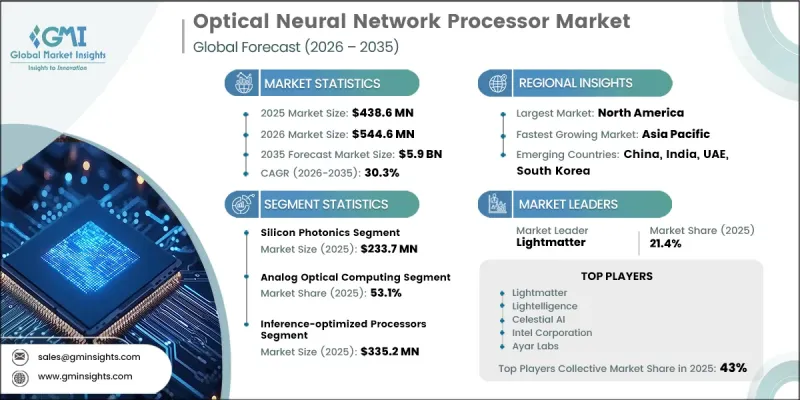
The market is gaining strong momentum as demand rises for faster and more energy-efficient artificial intelligence processing solutions. Conventional electronic processors are increasingly challenged by the growing complexity and computational intensity of modern AI workloads, particularly in terms of power consumption and scalability. In response, optical neural network processors are emerging as a high-performance alternative, offering ultra-fast data transmission, inherent parallelism, and significantly reduced energy usage. These capabilities make them highly suitable for large-scale deployment in data-intensive environments. Additionally, the rapid expansion of AI infrastructure and continuous investment in advanced computing architectures are reinforcing market growth. The increasing integration of photonics-based technologies is also reshaping processing capabilities, enabling improved bandwidth, reduced latency, and enhanced efficiency, which collectively support the broader adoption of optical computing solutions across high-performance environments.
| Market Scope | |
|---|---|
| Start Year | 2025 |
| Forecast Year | 2026-2035 |
| Start Value | $438.6 Million |
| Forecast Value | $5.9 Billion |
| CAGR | 30.3% |
The rising adoption of photonics technologies in advanced computing systems is playing a key role in accelerating the growth of the optical neural network processor market. As data volumes continue to expand at an unprecedented pace, traditional electronic interconnects are becoming less efficient in handling bandwidth demands, speed requirements, and power consumption constraints, further strengthening the shift toward optical-based processing solutions.
The silicon photonics segment generated USD 233.7 million in 2025, driven by its ability to enable high-speed data transmission, lower latency, and efficient computational performance. Its compatibility with existing semiconductor manufacturing processes enhances scalability and cost efficiency, making it a preferred choice for advanced computing applications. Increasing demand for high-performance data processing capabilities continues to reinforce its dominant position in the global market.
The analog optical computing segment accounted for 53.1% share in 2025, supported by its capability to perform parallel computations at the speed of light. This approach significantly improves efficiency in complex mathematical operations while maintaining lower energy consumption. Its advantages in speed and power efficiency are contributing to its growing adoption across emerging computing frameworks.
North America Optical Neural Network Processor Market held a 46.6% share in 2025, supported by strong technological innovation and early adoption of advanced computing solutions. The region benefits from a well-established semiconductor ecosystem, high investment in artificial intelligence development, and continuous demand for next-generation processing technologies, all of which are driving sustained market expansion.
Key players operating in the Global Optical Neural Network Processor Market include Tekscan Inc, Interlink Electronics Inc, FlexEnable Limited, KWJ Engineering Inc, TE Connectivity Ltd, FUJIFILM Holdings Corporation, Canatu Oy, BeBop Sensors Inc, Isorg SA, Thin Film Electronics ASA, T+Ink Inc, SynTouch LLC, Plastic Logic Limited, Peratech Holdco Limited, ElastiSense, NextInput Inc, Flexpoint Sensor Systems Inc, and Sensitronics LLC. Companies in the Global Optical Neural Network Processor Market are strengthening their position through continuous innovation, strategic partnerships, and investments in advanced photonics technologies. They are prioritizing research and development to improve processing speed, energy efficiency, and scalability of optical computing solutions. Collaborations with semiconductor manufacturers and AI-focused enterprises are enabling faster commercialization and broader adoption. Firms are also expanding their product portfolios to address evolving high-performance computing requirements. In addition, efforts toward integrating optical processors with existing computing architectures are enhancing compatibility and deployment flexibility.
Table of Contents
Chapter 1 Methodology and Scope
- 1.1 Market scope and definition
- 1.2 Research design
- 1.2.1 Research approach
- 1.2.2 Data collection methods
- 1.3 Data mining sources
- 1.3.1 Global
- 1.3.2 Regional/Country
- 1.4 Base estimates and calculations
- 1.4.1 Base year calculation
- 1.4.2 Key trends for market estimation
- 1.5 Primary research and validation
- 1.5.1 Primary sources
- 1.6 Forecast model
- 1.7 Research assumptions and limitations
Chapter 2 Executive Summary
- 2.1 Industry 360° synopsis, 2022 - 2035
- 2.2 Key market trends
- 2.2.1 Platform technology type trends
- 2.2.2 Computing paradigm trends
- 2.2.3 Workload optimization trends
- 2.2.4 Application area trends
- 2.2.5 End-user industry trends
- 2.2.6 Regional trends
- 2.3 TAM Analysis, 2026-2035
- 2.4 CXO perspectives: Strategic imperatives
Chapter 3 Industry Insights
- 3.1 Industry ecosystem analysis
- 3.1.1 Supplier Landscape
- 3.1.2 Profit Margin
- 3.1.3 Cost structure
- 3.1.4 Value addition at each stage
- 3.1.5 Factor affecting the value chain
- 3.1.6 Disruptions
- 3.2 Industry impact forces
- 3.2.1 Growth drivers
- 3.2.1.1 Increasing demand for high-speed and energy-efficient AI processing
- 3.2.1.2 Rising adoption of photonics in data centers and high-performance computing
- 3.2.1.3 Growing need to overcome limitations of traditional electronic processors
- 3.2.1.4 Expansion of artificial intelligence and machine learning workloads
- 3.2.1.5 Advancements in optical computing and integrated photonics technologies
- 3.2.2 Industry pitfalls and challenges
- 3.2.2.1 High development and implementation costs
- 3.2.2.2 Complexity in integration with existing semiconductor infrastructure
- 3.2.3 Market opportunities
- 3.2.3.1 Growing investments in photonics-based computing technologies
- 3.2.3.2 Increasing adoption in next-generation data centers and cloud infrastructure
- 3.2.1 Growth drivers
- 3.3 Growth potential analysis
- 3.4 Regulatory landscape
- 3.4.1 North America
- 3.4.2 Europe
- 3.4.3 Asia Pacific
- 3.4.4 Latin America
- 3.4.5 Middle East & Africa
- 3.5 Porter's analysis
- 3.6 PESTEL analysis
- 3.7 Technology and Innovation landscape
- 3.7.1 Current technological trends
- 3.7.2 Emerging technologies
- 3.8 Price trends (Based on paid Database)
- 3.8.1 Historical Price Analysis (2022-2025)
- 3.8.2 Price Trend Drivers
- 3.8.3 Regional Price Variations
- 3.8.4 Price Forecast (2026-2035)
- 3.9 Trade Data Analysis (Driven by Primary Research)
- 3.9.1 Import/Export Volume & Value Trends
- 3.9.2 Key Trade Corridors & Tariff Impact
- 3.10 Impact of AI & Generative AI on the Market
- 3.10.1 AI-Driven Disruption of Existing Business Models
- 3.10.2 GenAI Use Cases & Adoption Roadmap by Segment
- 3.10.3 Risks, Limitations & Regulatory Considerations
- 3.11 Capacity & Production Landscape (Driven by Primary Research)
- 3.11.1 Installed Capacity by Region & Key Producer
- 3.11.2 Capacity Utilization Rates & Expansion Pipelines
Chapter 4 Competitive Landscape, 2025
- 4.1 Introduction
- 4.2 Company market share analysis
- 4.2.1 By region
- 4.2.1.1 North America
- 4.2.1.2 Europe
- 4.2.1.3 Asia Pacific
- 4.2.1.4 Latin America
- 4.2.1.5 Middle East & Africa
- 4.2.2 Market concentration analysis
- 4.2.1 By region
- 4.3 Competitive analysis of major market players
- 4.4 Competitive positioning matrix
- 4.5 Key developments
- 4.5.1 Mergers & acquisitions
- 4.5.2 Partnerships & collaborations
- 4.5.3 New product launches
- 4.5.4 Expansion plans and funding
- 4.6 Company tier benchmarking
- 4.6.1 Tier classification criteria & qualifying thresholds
- 4.6.2 Tier positioning matrix by revenue, geography & innovation Introduction
Chapter 5 Market Estimates and Forecast, By Technology, 2022 - 2035 (USD Million & Units)
- 5.1 Key trends
- 5.2 Silicon photonics
- 5.3 Hybrid photonic-electronic integration
- 5.4 Free-space optics
- 5.5 Emerging photonic materials
Chapter 6 Market Estimates and Forecast, By Computing Paradigm, 2022 - 2035 (USD Million & Units)
- 6.1 Key trends
- 6.2 Analog optical computing
- 6.3 Digital optical computing
- 6.4 Neuromorphic optical computing
Chapter 7 Market Estimates and Forecast, By Workload Optimization, 2022 - 2035 (USD Million & Units)
- 7.1 Key trends
- 7.2 Inference-optimized processors
- 7.3 Training-optimized processors
Chapter 8 Market Estimates and Forecast, By Application, 2022 - 2035 (USD Million & Units)
- 8.1 Key trends
- 8.2 AI/ML acceleration
- 8.3 Image recognition & computer vision
- 8.4 Natural language processing
- 8.5 Signal processing
- 8.6 Others
Chapter 9 Market Estimates and Forecast, By End-use Industry, 2022 - 2035 (USD Million & Units)
- 9.1 Key trends
- 9.2 Data centers & cloud providers
- 9.3 Telecommunications
- 9.4 Automotive
- 9.5 Aerospace & defense
- 9.6 Healthcare & life sciences
- 9.7 Edge computing & IoT
- 9.8 Others
Chapter 10 Market Estimates and Forecast, By Region, 2022 - 2035 (USD Million & Units)
- 10.1 Key trends
- 10.2 North America
- 10.2.1 U.S.
- 10.2.2 Canada
- 10.3 Europe
- 10.3.1 Germany
- 10.3.2 UK
- 10.3.3 France
- 10.3.4 Spain
- 10.3.5 Italy
- 10.3.6 Netherlands
- 10.3.7 Rest of Europe
- 10.4 Asia Pacific
- 10.4.1 China
- 10.4.2 India
- 10.4.3 Japan
- 10.4.4 Australia
- 10.4.5 South Korea
- 10.4.6 Rest of Asia Pacific
- 10.5 Latin America
- 10.5.1 Brazil
- 10.5.2 Mexico
- 10.5.3 Argentina
- 10.5.4 Rest of Latin America
- 10.6 Middle East and Africa
- 10.6.1 South Africa
- 10.6.2 Saudi Arabia
- 10.6.3 UAE
- 10.6.4 Rest of MEA
Chapter 11 Company Profiles
- 11.1 Global Key Players
- 11.1.1 Intel Corporation
- 11.1.2 IBM Corporation
- 11.1.3 Lightmatter
- 11.1.4 Lightelligence
- 11.1.5 Celestial AI
- 11.2 Regional players
- 11.2.1 Luminous Computing
- 11.2.2 Ayar Labs
- 11.2.3 Xanadu Quantum Technologies
- 11.2.4 Optalysys
- 11.2.5 iPronics
- 11.2.6 OpenLight
- 11.3 Niche players
- 11.3.1 PhotonicX AI
- 11.3.2 SiEPIC
- 11.3.3 Photon Bridge
- 11.3.4 Mixx Technologies
- 11.3.5 Neurophos

