PUBLISHER: Global Market Insights Inc. | PRODUCT CODE: 2038329

PUBLISHER: Global Market Insights Inc. | PRODUCT CODE: 2038329
Brain-Inspired Computing Processor Market Opportunity, Growth Drivers, Industry Trend Analysis, and Forecast 2026 - 2035
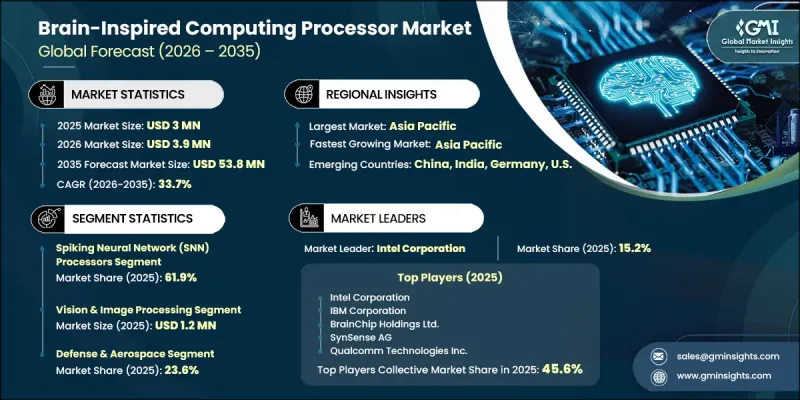
The Global Brain-Inspired Computing Processor Market was valued at USD 3 million in 2025 and is estimated to grow at a CAGR of 33.7% to reach USD 53.8 million by 2035.
The brain-inspired computing processor industry is gaining momentum due to rising emphasis on lowering energy consumption in artificial intelligence workloads and increasing deployment of intelligence closer to data sources. The growing need for adaptive and autonomous computing systems, along with continuous advancements in neuromorphic chip design and learning frameworks, is further accelerating market expansion. In addition, the increasing adoption of event-driven sensing technologies that demand real-time and low-latency processing capabilities is strengthening the relevance of these processors. As computing paradigms shift toward efficiency and responsiveness, brain-inspired architectures are emerging as a key enabler for next-generation AI systems, supporting scalable deployment across diverse applications while addressing performance and power constraints.
| Market Scope | |
|---|---|
| Start Year | 2025 |
| Forecast Year | 2026-2035 |
| Start Value | $3 Million |
| Forecast Value | $53.8 Million |
| CAGR | 33.7% |
The brain-inspired computing processor market is driven by the surge in energy demands associated with artificial intelligence operations in large-scale computing environments. Organizations are increasingly transitioning toward edge-based and on-device intelligence to minimize latency, reduce data transfer, and improve operational efficiency. During this evolution, companies have prioritized ultra-low power consumption and real-time responsiveness, which has enhanced the commercial viability of neuromorphic technologies. Advancements in architecture design and tighter integration with event-based sensing systems have significantly improved overall system efficiency, thereby accelerating adoption across advanced AI use cases.
The spiking neural network processors segment accounted for 61.9% share in 2025, supported by the growing preference for energy-efficient and event-driven computing frameworks in early neuromorphic implementations. These processors are widely utilized for real-time processing tasks and edge intelligence applications due to their low power requirements and ability to mimic biological neural behavior. Increasing deployment in pilot programs and commercial edge AI solutions continues to reinforce the segment's dominant position.
The vision and image processing segment reached USD 1.2 million in 2025, driven by rising adoption in applications requiring continuous perception and rapid data interpretation. These processors are gaining traction due to their ability to deliver fast response times and energy-efficient processing of visual data streams. Their effectiveness in handling complex visual workloads supports growing demand across advanced sensing and imaging systems.
North America Brain-Inspired Computing Processor Market accounted for 31.4% share in 2025, driven by strong investment in advanced artificial intelligence research and early adoption of edge computing technologies. The region benefits from a robust ecosystem of technology developers, research institutions, and system integrators focused on deploying energy-efficient and real-time AI solutions. Increasing support from both public and private sectors for semiconductor innovation and advanced computing infrastructure is further strengthening regional market growth.
Prominent players operating in the Global Brain-Inspired Computing Processor Industry include Intel Corporation, IBM Corporation, BrainChip Holdings Ltd., SynSense AG, Innatera Nanosystems, Qualcomm Technologies Inc., Samsung Electronics, Hewlett Packard Enterprise, Applied Brain Research, General Vision Inc., GrAI Matter Labs, HRL Laboratories, CEA-Leti, SK Hynix, and Vicarious FPC. Companies operating in the Global Brain-Inspired Computing Processor Market are focusing on strategic collaborations, research partnerships, and technology innovation to strengthen their competitive positioning. They are investing heavily in neuromorphic chip development, enhancing energy efficiency, and improving real-time processing capabilities to meet evolving AI demands. Firms are also prioritizing integration with edge computing platforms and event-driven sensing systems to expand application areas. In addition, partnerships with research institutions and semiconductor manufacturers enable faster commercialization and scaling of advanced architectures.
Table of Contents
Chapter 1 Methodology and Scope
- 1.1 Market scope and definition
- 1.2 Research design
- 1.2.1 Research approach
- 1.2.2 Data collection methods
- 1.3 Data mining sources
- 1.3.1 Global
- 1.3.2 Regional/Country
- 1.4 Base estimates and calculations
- 1.4.1 Base year calculation
- 1.4.2 Key trends for market estimation
- 1.5 Primary research and validation
- 1.5.1 Primary sources
- 1.6 Forecast model
- 1.7 Research assumptions and limitations
Chapter 2 Executive Summary
- 2.1 Industry 360° synopsis, 2022 - 2035
- 2.2 Key market trends
- 2.2.1 Architecture type trends
- 2.2.2 Application trends
- 2.2.3 End-user industry trends
- 2.2.4 Regional trends
- 2.3 TAM Analysis, 2026-2035
- 2.4 CXO perspectives: Strategic imperatives
Chapter 3 Industry Insights
- 3.1 Industry ecosystem analysis
- 3.1.1 Supplier Landscape
- 3.1.2 Profit Margin
- 3.1.3 Cost structure
- 3.1.4 Value addition at each stage
- 3.1.5 Factor affecting the value chain
- 3.1.6 Disruptions
- 3.2 Industry impact forces
- 3.2.1 Growth drivers
- 3.2.1.1 Rising demand for energy-efficient AI processing
- 3.2.1.2 Rapid expansion of edge and on-device intelligence
- 3.2.1.3 Increasing adoption of autonomous and adaptive systems
- 3.2.1.4 Advancements in neuromorphic algorithms and hardware architectures
- 3.2.1.5 Growing integration with event-based and bio-inspired sensors
- 3.2.2 Industry pitfalls and challenges
- 3.2.2.1 High development complexity and cost of neuromorphic hardware
- 3.2.2.2 Limited standardization and compatibility with existing AI ecosystems
- 3.2.3 Market opportunities
- 3.2.3.1 Adoption of brain-inspired processors in continuously operating industrial and infrastructure systems
- 3.2.3.2 Expansion of brain-inspired computing into defense, aerospace, and mission-critical applications
- 3.2.1 Growth drivers
- 3.3 Growth potential analysis
- 3.4 Regulatory landscape
- 3.4.1 North America
- 3.4.2 Europe
- 3.4.3 Asia Pacific
- 3.4.4 Latin America
- 3.4.5 Middle East & Africa
- 3.5 Porter's analysis
- 3.6 PESTEL analysis
- 3.7 Technology and Innovation landscape
- 3.7.1 Current technological trends
- 3.7.2 Emerging technologies
- 3.8 Price trends
- 3.8.1 By region
- 3.8.2 By product
- 3.9 Pricing Strategies
- 3.10 Emerging Business Models
- 3.11 Compliance Requirements
- 3.12 Patent and IP analysis
Chapter 4 Competitive Landscape, 2025
- 4.1 Introduction
- 4.2 Company market share analysis
- 4.2.1 By region
- 4.2.1.1 North America
- 4.2.1.2 Europe
- 4.2.1.3 Asia Pacific
- 4.2.1.4 Latin America
- 4.2.1.5 Middle East & Africa
- 4.2.2 Market concentration analysis
- 4.2.1 By region
- 4.3 Competitive benchmarking of key players
- 4.3.1 Financial performance comparison
- 4.3.1.1 Revenue
- 4.3.1.2 Profit margin
- 4.3.1.3 R&D
- 4.3.2 Product portfolio comparison
- 4.3.2.1 Product range breadth
- 4.3.2.2 Technology
- 4.3.2.3 Innovation
- 4.3.3 Geographic presence comparison
- 4.3.3.1 Global footprint analysis
- 4.3.3.2 Service network coverage
- 4.3.3.3 Market penetration by region
- 4.3.4 Competitive positioning matrix
- 4.3.4.1 Leaders
- 4.3.4.2 Challengers
- 4.3.4.3 Followers
- 4.3.4.4 Niche players
- 4.3.5 Strategic outlook matrix
- 4.3.1 Financial performance comparison
- 4.4 Key developments
- 4.4.1 Mergers and acquisitions
- 4.4.2 Partnerships and collaborations
- 4.4.3 Technological advancements
- 4.4.4 Expansion and investment strategies
- 4.4.5 Digital transformation initiatives
- 4.5 Emerging/ startup competitors landscape
Chapter 5 Market Estimates and Forecast, By Architecture Type, 2022 - 2035 (USD Million)
- 5.1 Key trends
- 5.2 Spiking neural network (SNN) processors
- 5.3 Hybrid neuromorphic accelerators
Chapter 6 Market Estimates and Forecast, By Application, 2022 - 2035 (USD Million)
- 6.1 Key trends
- 6.2 Vision & image processing
- 6.3 Audio & speech processing
- 6.4 Sensor fusion & edge analytics
- 6.5 Robotics & autonomous systems
Chapter 7 Market Estimates and Forecast, By End-User Industry, 2022 - 2035 (USD Million)
- 7.1 Key trends
- 7.2 Consumer electronics
- 7.3 Automotive & transportation
- 7.4 Industrial automation & manufacturing
- 7.5 Healthcare & medical devices
- 7.6 Defense & aerospace
- 7.7 Telecommunications
- 7.8 Others
Chapter 8 Market Estimates and Forecast, By Region, 2022 - 2035 (USD Million)
- 8.1 Key trends
- 8.2 North America
- 8.2.1 U.S.
- 8.2.2 Canada
- 8.3 Europe
- 8.3.1 Germany
- 8.3.2 UK
- 8.3.3 France
- 8.3.4 Spain
- 8.3.5 Italy
- 8.3.6 Russia
- 8.4 Asia Pacific
- 8.4.1 China
- 8.4.2 India
- 8.4.3 Japan
- 8.4.4 Australia
- 8.4.5 South Korea
- 8.5 Latin America
- 8.5.1 Brazil
- 8.5.2 Mexico
- 8.5.3 Argentina
- 8.6 Middle East and Africa
- 8.6.1 South Africa
- 8.6.2 Saudi Arabia
- 8.6.3 UAE
Chapter 9 Company Profiles
- 9.1 Global Key Players
- 9.1.1 Intel Corporation
- 9.1.2 IBM Corporation
- 9.1.3 BrainChip Holdings Ltd.
- 9.1.4 SynSense AG
- 9.1.5 Qualcomm Technologies Inc.
- 9.2 Regional key players
- 9.2.1 North America
- 9.2.1.1 Hewlett Packard Enterprise
- 9.2.1.2 Applied Brain Research
- 9.2.1.3 General Vision Inc.
- 9.2.1.4 HRL Laboratories
- 9.2.1.5 Vicarious FPC
- 9.2.2 Asia Pacific
- 9.2.2.1 Samsung Electronics
- 9.2.2.2 SK Hynix
- 9.2.3 Europe
- 9.2.3.1 GrAI Matter Labs
- 9.2.3.2 CEA-Leti
- 9.2.3.3 Innatera Nanosystems
- 9.2.1 North America

