PUBLISHER: Global Market Insights Inc. | PRODUCT CODE: 2038332

PUBLISHER: Global Market Insights Inc. | PRODUCT CODE: 2038332
MEMS Microphone Market Opportunity, Growth Drivers, Industry Trend Analysis, and Forecast 2026 - 2035
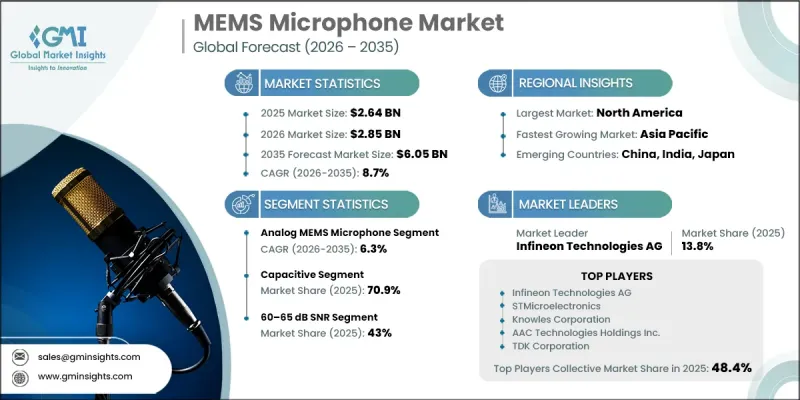
The Global MEMS Microphone Market was valued at USD 2.64 billion in 2025 and is estimated to grow at a CAGR of 8.7% to reach USD 6.05 billion by 2035.
The industry is experiencing expansion driven by the increasing demand for high-performance audio sensing technologies across a broad range of sectors. Growing reliance on compact and efficient sound capture components is supporting widespread adoption, particularly as digital ecosystems continue to evolve. Advancements in MEMS technology have significantly enhanced acoustic performance, enabling superior sound quality, improved sensitivity, and reduced power consumption. The rise of connected environments and the growing integration of voice-enabled functionalities are further accelerating demand. These microphones play a critical role in enabling seamless audio interaction, contributing to advancements in intelligent systems and interactive technologies. The market outlook remains highly positive, supported by continuous innovation and the growing importance of advanced audio solutions in modern electronic ecosystems.
| Market Scope | |
|---|---|
| Start Year | 2025 |
| Forecast Year | 2026-2035 |
| Start Value | $2.64 Billion |
| Forecast Value | $6.05 Billion |
| CAGR | 8.7% |
Expansion of the MEMS microphone industry is strongly linked to the rising adoption of connected devices and the increasing integration of advanced audio capabilities. The proliferation of compact electronic devices has encouraged manufacturers to incorporate multiple microphones within a single system to improve sound detection and enhance user interaction. This trend is further supported by the development of energy-efficient components that deliver improved signal-to-noise ratios and optimized acoustic output. Semiconductor companies are focusing on designing ultra-low power solutions that enable extended battery performance while maintaining high audio fidelity. These technological advancements are expected to play a key role in supporting the next generation of compact and high-performance electronic applications.
The analog MEMS microphone segment is anticipated to register a CAGR of 6.3% throughout the forecast period. This segment continues to gain traction due to its compatibility with lightweight and power-efficient devices that require reliable audio input. Manufacturers are increasingly developing advanced microphone solutions designed to offer enhanced sensitivity and reduced noise interference. These innovations contribute to improved sound clarity while minimizing energy consumption. The ability to support sophisticated audio processing capabilities further strengthens the position of this segment, particularly in applications where efficient power utilization is essential.
The capacitive MEMS microphone segment accounted for 70.9% share in 2025 and is expected to maintain its leadership position over the forecast timeline. These microphones are widely recognized for delivering consistent audio performance characterized by high sensitivity and minimal distortion. Their strong compatibility with digital processing systems allows for seamless integration into modern electronic architectures. The growing emphasis on voice-enabled functionality and multi-microphone configurations is expected to sustain demand for capacitive solutions. Their reliability, performance consistency, and scalability continue to make them a preferred choice for large-scale production and deployment.
North America MEMS Microphone Market held a 31.1% share in 2025, reflecting its strong position within the industry. Market expansion in the region is being driven by increased adoption of connected technologies and advanced audio interfaces. Key sectors are incorporating MEMS microphones to improve sound capture capabilities and enable more efficient human-machine interactions. Public and private sector initiatives supporting digital infrastructure and technological innovation are further contributing to market growth. Continuous investment in advanced processing technologies and the rising demand for high-quality audio solutions are expected to sustain regional leadership over the coming years.
Key companies operating within the Global MEMS Microphone Market include AAC Technologies Holdings Inc., Knowles Corporation, STMicroelectronics, TDK Corporation, Infineon Technologies AG, Robert Bosch GmbH, Hosiden Corporation, BSE Co., Ltd., Gettop Acoustic Co., Ltd., DB Unlimited, Same Sky, Sanico Electronics Co., Ltd, Sound Components Limited, Sonion A/S, and Syntiant. Leading players in the MEMS Microphone Market are prioritizing innovation, strategic partnerships, and product differentiation to reinforce their competitive positioning. Companies are heavily investing in research and development to introduce advanced solutions with improved acoustic performance and lower power consumption. Expanding production capabilities and strengthening supply chain networks are key focus areas to meet growing global demand. Organizations are also forming collaborations with technology providers to accelerate the integration of next-generation audio features. Additionally, emphasis on miniaturization, enhanced durability, and cost optimization enables manufacturers to address diverse application requirements. Continuous efforts toward expanding geographic presence and improving distribution channels further support long-term market growth and brand visibility.
Table of Contents
Chapter 1 Methodology and Scope
- 1.1 Market scope and definition
- 1.2 Research design
- 1.2.1 Research approach
- 1.2.2 Data collection methods
- 1.3 Data mining sources
- 1.3.1 Global
- 1.3.2 Regional/Country
- 1.4 Base estimates and calculations
- 1.4.1 Base year calculation
- 1.4.2 Key trends for market estimation
- 1.5 Primary research and validation
- 1.5.1 Primary sources
- 1.6 Forecast model
- 1.7 Research assumptions and limitations
Chapter 2 Executive Summary
- 2.1 Industry 360° synopsis, 2022 - 2035
- 2.2 Key market trends
- 2.2.1 Product type trends
- 2.2.2 Technology trends
- 2.2.3 SNR Range trends
- 2.2.4 Application trends
- 2.2.5 Regional trends
- 2.3 CXO perspectives: Strategic imperatives
Chapter 3 Industry Insights
- 3.1 Industry ecosystem analysis
- 3.1.1 Supplier Landscape
- 3.1.2 Profit Margin
- 3.1.3 Cost structure
- 3.1.4 Value addition at each stage
- 3.1.5 Factor affecting the value chain
- 3.1.6 Disruptions
- 3.2 Industry impact forces
- 3.2.1 Growth drivers
- 3.2.1.1 Rising Adoption of Voice-Enabled Smart Devices
- 3.2.1.2 Increasing Integration in Smartphones and Wearables
- 3.2.1.3 Expansion of IoT and Smart Home Ecosystems
- 3.2.1.4 Growing Demand in Automotive Voice and In-Cabin Systems
- 3.2.1.5 Advancements in Miniaturization and Audio Performance Technologies
- 3.2.2 Industry pitfalls and challenges
- 3.2.2.1 Intense Price Competition and Margin Pressure
- 3.2.2.2 Design Complexity and Sensitivity to Environmental Noise Interference
- 3.2.3 Market opportunities
- 3.2.3.1 Expansion into AR/VR and immersive audio devices
- 3.2.3.2 Adoption in healthcare and medical devices
- 3.2.1 Growth drivers
- 3.3 Growth potential analysis
- 3.4 Regulatory landscape
- 3.4.1 North America
- 3.4.2 Europe
- 3.4.3 Asia Pacific
- 3.4.4 Latin America
- 3.4.5 Middle East & Africa
- 3.5 Porter's analysis
- 3.6 PESTEL analysis
- 3.7 Technology and Innovation landscape
- 3.7.1 Current technological trends
- 3.7.2 Emerging technologies
- 3.8 Price trends
- 3.8.1 By region
- 3.8.2 By product
- 3.9 Pricing Strategies
- 3.10 Emerging Business Models
- 3.11 Compliance Requirements
- 3.12 Patent and IP analysis
Chapter 4 Competitive Landscape, 2025
- 4.1 Introduction
- 4.2 Company market share analysis
- 4.2.1 By region
- 4.2.1.1 North America
- 4.2.1.2 Europe
- 4.2.1.3 Asia Pacific
- 4.2.1.4 Latin America
- 4.2.1.5 Middle East & Africa
- 4.2.2 Market concentration analysis
- 4.2.1 By region
- 4.3 Competitive benchmarking of key players
- 4.3.1 Financial performance comparison
- 4.3.1.1 Revenue
- 4.3.1.2 Profit margin
- 4.3.1.3 R&D
- 4.3.2 Product portfolio comparison
- 4.3.2.1 Product range breadth
- 4.3.2.2 Technology
- 4.3.2.3 Innovation
- 4.3.3 Geographic presence comparison
- 4.3.3.1 Global footprint analysis
- 4.3.3.2 Service network coverage
- 4.3.3.3 Market penetration by region
- 4.3.4 Competitive positioning matrix
- 4.3.4.1 Leaders
- 4.3.4.2 Challengers
- 4.3.4.3 Followers
- 4.3.4.4 Niche players
- 4.3.1 Financial performance comparison
- 4.4 Key developments
- 4.4.1 Mergers and acquisitions
- 4.4.2 Partnerships and collaborations
- 4.4.3 Technological advancements
- 4.4.4 Expansion and investment strategies
- 4.4.5 Digital transformation initiatives
- 4.5 Emerging/ startup competitors landscape
Chapter 5 Market Estimates and Forecast, By Product Type, 2022 - 2035 (USD Million)
- 5.1 Key trends
- 5.2 Analog MEMS Microphones
- 5.3 Digital MEMS Microphones
Chapter 6 Market Estimates and Forecast, By Technology, 2022 - 2035 (USD Million)
- 6.1 Key trends
- 6.2 Capacitive
- 6.3 Piezoelectric
Chapter 7 Market Estimates and Forecast, By SNR Range, 2022 - 2035 (USD Million)
- 7.1 Key trends
- 7.2 < 60 dB
- 7.3 60-65 dB
- 7.4 > 65 dB
Chapter 8 Market Estimates and Forecast, By Application, 2022 - 2035 (USD Million)
- 8.1 Key trends
- 8.2 Consumer Electronics
- 8.2.1 Smartphones & tablets
- 8.2.2 Laptops & PCs
- 8.2.3 Wearables
- 8.2.4 Others
- 8.3 Automotive & Transportation
- 8.3.1 In-car voice recognition
- 8.3.2 Noise cancellation / cabin sensing
- 8.3.3 Telematics
- 8.3.4 Others
- 8.4 Healthcare
- 8.4.1 Hearing aids
- 8.4.2 Medical diagnostic devices
- 8.4.3 Others
- 8.5 Aerospace & Defense
- 8.5.1 Communication systems
- 8.5.2 Voice / acoustic sensing
- 8.5.3 Others
- 8.6 Others
Chapter 9 Market Estimates and Forecast, By Region, 2022 - 2035 (USD Million)
- 9.1 Key trends
- 9.2 North America
- 9.2.1 U.S.
- 9.2.2 Canada
- 9.3 Europe
- 9.3.1 Germany
- 9.3.2 UK
- 9.3.3 France
- 9.3.4 Spain
- 9.3.5 Italy
- 9.3.6 Netherlands
- 9.4 Asia Pacific
- 9.4.1 China
- 9.4.2 India
- 9.4.3 Japan
- 9.4.4 Australia
- 9.4.5 South Korea
- 9.5 Latin America
- 9.5.1 Brazil
- 9.5.2 Mexico
- 9.5.3 Argentina
- 9.6 Middle East and Africa
- 9.6.1 South Africa
- 9.6.2 Saudi Arabia
- 9.6.3 UAE
Chapter 10 Company Profiles
- 10.1 Global Key Players
- 10.1.1 STMicroelectronics
- 10.1.2 Infineon Technologies AG
- 10.1.3 Knowles Corporation
- 10.1.4 AAC Technologies Holdings Inc.
- 10.1.5 TDK Corporation
- 10.1.6 Robert Bosch GmbH
- 10.2 Regional Players
- 10.2.1 Sonion A/S
- 10.2.2 Hosiden Corporation
- 10.2.3 BSE Co., Ltd.
- 10.2.4 Sound Components Limited
- 10.2.5 Syntiant
- 10.3 Local Players
- 10.3.1 Same Sky
- 10.3.2 Sanico Electronics Co., Ltd
- 10.3.3 Gettop Acoustic Co., Ltd
- 10.3.4 DB Unlimited

