PUBLISHER: Global Market Insights Inc. | PRODUCT CODE: 2038337

PUBLISHER: Global Market Insights Inc. | PRODUCT CODE: 2038337
GPS Tracking Device Market Opportunity, Growth Drivers, Industry Trend Analysis, and Forecast 2026 - 2035
The Global GPS Tracking Device Market was valued at USD 4.2 billion in 2025 and is estimated to grow at a CAGR of 14.4% to reach USD 15.9 billion by 2035.
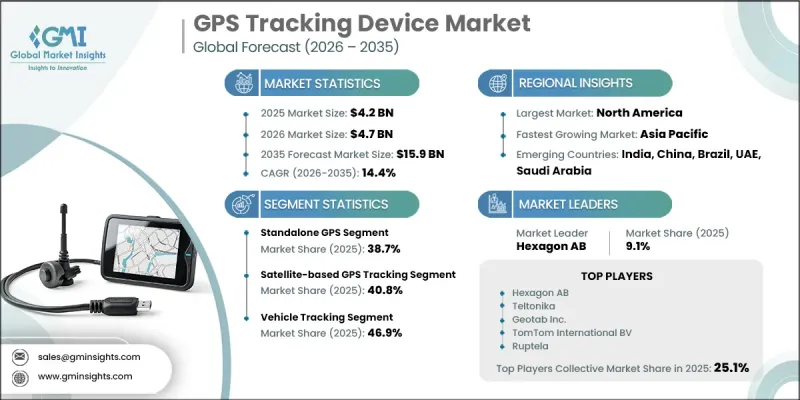
The market is witnessing growth driven by increasing dependence on real-time location tracking across logistics, transportation, retail, and healthcare industries. Rising demand for faster delivery services in e-commerce is encouraging companies to adopt advanced fleet tracking solutions to improve operational efficiency and customer experience. GPS tracking systems are increasingly being used to optimize routing, reduce transportation costs, and improve delivery timelines. In the healthcare sector, growing utilization of tracking technologies for medical logistics, emergency transport, and asset monitoring is further supporting market expansion. Concerns related to theft and loss of high-value medical goods are also accelerating the deployment of anti-theft tracking systems with real-time monitoring capabilities. Additionally, transportation and logistics operators are increasingly integrating GPS-based systems for fleet visibility, route optimization, and performance monitoring. The growing shift toward connected mobility and IoT-enabled infrastructure is further strengthening adoption, as businesses prioritize operational transparency and data-driven decision-making across their supply chain and service networks.
| Market Scope | |
|---|---|
| Start Year | 2025 |
| Forecast Year | 2026-2035 |
| Start Value | $4.2 Billion |
| Forecast Value | $15.9 Billion |
| CAGR | 14.4% |
The standalone GPS segment accounted for 38.7% share in 2025 owing to its widespread usability in navigation, outdoor operations, and basic asset monitoring applications. Its strong demand is driven by ease of use, high reliability, and the ability to function without continuous network dependency. These characteristics make it suitable for use in remote and low-connectivity environments where consistent positioning accuracy is required.
The satellite-based GPS tracking segment held a 40.8% share in 2025, supported by its ability to deliver accurate and uninterrupted tracking in remote, offshore, and geographically challenging locations. This technology is widely adopted in sectors requiring global coverage and high reliability, including maritime operations, aviation, and defense-related applications. Its effectiveness in providing continuous monitoring across long distances and inaccessible regions is driving steady demand.
North America GPS Tracking Device Market accounted for 36.1% share in 2025. The region remains a leading hub for GPS technology adoption due to its advanced digital infrastructure, strong penetration of IoT solutions, and widespread integration of tracking systems across logistics and transportation industries. Continuous investment in connected mobility technologies and the presence of established technology providers are further supporting market development across the region.
Key companies operating in the GPS Tracking Device Market include Geotab Inc., Hexagon AB, TomTom International BV, Calamp Corporation, Teltonika, Ruptela, SEEWORLD Technology, Arusnavi, and WanWayTech. Companies in the GPS Tracking Device Market are focusing on strengthening their competitive position through continuous innovation in location-based technologies and connectivity solutions. Many players are investing in advanced IoT-enabled tracking systems that offer real-time monitoring, predictive analytics, and enhanced data accuracy. Expansion of cloud-based fleet management platforms is enabling better scalability and remote accessibility for end users. Strategic partnerships with logistics, transportation, and healthcare service providers are helping companies expand their application base. Firms are also focusing on integrating AI and machine learning capabilities to improve route optimization, operational efficiency, and asset utilization. In addition, the development of energy-efficient and compact devices is supporting broader adoption across multiple industries.
Table of Contents
Chapter 1 Methodology and Scope
- 1.1 Market scope and definition
- 1.2 Research design
- 1.2.1 Research approach
- 1.2.2 Data collection methods
- 1.3 Data mining sources
- 1.3.1 Global
- 1.3.2 Regional/Country
- 1.4 Base estimates and calculations
- 1.4.1 Base year calculation
- 1.4.2 Key trends for market estimation
- 1.5 Primary research and validation
- 1.5.1 Primary sources
- 1.6 Forecast model
- 1.7 Research assumptions and limitations
Chapter 2 Executive Summary
- 2.1 Industry 360° synopsis, 2022 - 2035
- 2.2 Key market trends
- 2.2.1 Caliber trends
- 2.2.2 Product type trends
- 2.2.3 Guidance mechanism trends
- 2.2.4 End-user application trends
- 2.2.5 Regional trends
- 2.3 TAM Analysis, 2026-2035
- 2.4 CXO perspectives: Strategic imperatives
Chapter 3 Industry Insights
- 3.1 Industry ecosystem analysis
- 3.1.1 Supplier Landscape
- 3.1.2 Profit Margin
- 3.1.3 Cost structure
- 3.1.4 Value addition at each stage
- 3.1.5 Factor affecting the value chain
- 3.1.6 Disruptions
- 3.2 Industry impact forces
- 3.2.1 Growth drivers
- 3.2.1.1 Rising adoption of IoT technologies.
- 3.2.1.2 Increasing demand for fleet management solutions and operational efficiency.
- 3.2.1.3 Focus on security and surveillance.
- 3.2.1.4 Expansion of e-commerce and logistics.
- 3.2.1.5 Rising focus on operational efficiency and cost optimization in enterprises
- 3.2.2 Industry pitfalls and challenges
- 3.2.2.1 Privacy concerns and data security
- 3.2.2.2 High initial investment cost
- 3.2.3 Market opportunities
- 3.2.3.1 Growing adoption of GPS tracking in insurance telematics and usage-based policies
- 3.2.3.2 Expansion of smart city initiatives and connected infrastructure
- 3.2.1 Growth drivers
- 3.3 Growth potential analysis
- 3.4 Regulatory landscape
- 3.4.1 North America
- 3.4.2 Europe
- 3.4.3 Asia Pacific
- 3.4.4 Latin America
- 3.4.5 Middle East & Africa
- 3.5 Porter's analysis
- 3.6 PESTEL analysis
- 3.7 Technology and Innovation landscape
- 3.7.1 Current technological trends
- 3.7.2 Emerging technologies
- 3.8 Pricing Analysis (Driven by Primary Research)
- 3.8.1 Historical Price Trend Analysis
- 3.8.2 Pricing Strategy by Player Type (Premium / Value / Cost-plus)
- 3.9 Trade Data Analysis (Based on Paid Database)
- 3.9.1 Import/Export Volume & Value Trends
- 3.9.2 Key Trade Corridors & Tariff Impact
- 3.10 Impact of AI & Generative AI on the Market (Driven by Primary Research)
- 3.10.1 AI-Driven Disruption of Existing Business Models
- 3.10.2 GenAI Use Cases & Adoption Roadmap by Segment
- 3.10.3 Risks, Limitations & Regulatory Considerations
Chapter 4 Competitive Landscape, 2025
- 4.1 Introduction
- 4.2 Company market share analysis
- 4.2.1 By Region
- 4.2.1.1 North America
- 4.2.1.2 Europe
- 4.2.1.3 Asia-Pacific
- 4.2.1.4 Latin America
- 4.2.1.5 Middle East and Africa
- 4.2.2 Market Concentration Analysis
- 4.2.1 By Region
- 4.3 Competitive analysis of major market players
- 4.4 Competitive positioning matrix
- 4.5 Key developments
- 4.5.1 Mergers & acquisitions
- 4.5.2 Partnerships & collaborations
- 4.5.3 New product launches
- 4.5.4 Expansion plans and funding
- 4.6 Company tier benchmarking
- 4.6.1 Tier classification criteria & qualifying thresholds
- 4.6.2 Tier positioning matrix by revenue, geography & innovation
Chapter 5 Market Estimates and Forecast, By Type, 2022 - 2035 (USD Million)
- 5.1 Key trends
- 5.2 Standalone GPS
- 5.3 Advance tracker
- 5.4 OBD device
Chapter 6 Market Estimates and Forecast, By Technology, 2022 - 2035 (USD Million)
- 6.1 Key trends
- 6.2 Satellite-based GPS tracking
- 6.3 Cellular-based tracking
- 6.4 Hybrid tracking
Chapter 7 Market Estimates and Forecast, By Application, 2022 - 2035 (USD Million)
- 7.1 Key trends
- 7.2 Vehicle tracking
- 7.2.1 Fleet management
- 7.2.2 Car rental services
- 7.2.3 Stolen vehicle recovery
- 7.3 Asset tracking
- 7.3.1 Equipment & machinery
- 7.3.2 Cargo & freight
- 7.4 Personal tracking
- 7.4.1 Elderly & patient safety
- 7.4.2 Fitness & sports
- 7.4.3 Pet tracking
Chapter 8 Market Estimates and Forecast, By End-use Industry, 2022 - 2035 (USD Million)
- 8.1 Key trends
- 8.2 Transportation & logistics
- 8.3 Oil & gas
- 8.4 Construction & heavy equipment
- 8.5 Retail & e-commerce
- 8.6 Healthcare
- 8.7 Others
Chapter 9 Market Estimates and Forecast, By Region, 2022 - 2035 (USD Million)
- 9.1 Key trends
- 9.2 North America
- 9.2.1 U.S.
- 9.2.2 Canada
- 9.3 Europe
- 9.3.1 Germany
- 9.3.2 UK
- 9.3.3 France
- 9.3.4 Spain
- 9.3.5 Italy
- 9.3.6 Netherlands
- 9.3.7 Rest of Europe
- 9.4 Asia Pacific
- 9.4.1 China
- 9.4.2 India
- 9.4.3 Japan
- 9.4.4 Australia
- 9.4.5 South Korea
- 9.4.6 Rest of Asia Pacific
- 9.5 Latin America
- 9.5.1 Brazil
- 9.5.2 Mexico
- 9.5.3 Argentina
- 9.5.4 Rest of Latin America
- 9.6 Middle East and Africa
- 9.6.1 South Africa
- 9.6.2 Saudi Arabia
- 9.6.3 UAE
- 9.6.4 Rest of MEA
Chapter 10 Company Profiles
- 10.1 Global Players
- 10.1.1 Hexagon AB
- 10.1.2 Teltonika
- 10.1.3 Geotab Inc.
- 10.1.4 TomTom International BV
- 10.1.5 CalAmp Corporation
- 10.1.6 Queclink Wireless Solutions Co., Ltd.
- 10.2 Regional Champions
- 10.2.1 Ruptela
- 10.2.2 ATrack Technology Inc.
- 10.2.3 Navtelecom LLC
- 10.2.4 Meitrack Group
- 10.2.5 Shenzhen Jimi IoT Co., Ltd
- 10.2.6 SEEWORLD Technology
- 10.3 Emerging Players
- 10.3.1 Arusnavi
- 10.3.2 WanWayTech
- 10.3.3 Trackimo Inc.
- 10.3.4 Gosafe Company
- 10.3.5 Micodus
- 10.3.6 Eelink Communication Technology

