
PUBLISHER: Global Market Insights Inc. | PRODUCT CODE: 2038344

PUBLISHER: Global Market Insights Inc. | PRODUCT CODE: 2038344
Smart Coatings Market Opportunity, Growth Drivers, Industry Trend Analysis, and Forecast 2026 - 2035
The Global Smart Coatings Market was valued at USD 4.6 billion in 2025 and is estimated to grow at a CAGR of 14.7% to reach USD 17.8 billion by 2035.
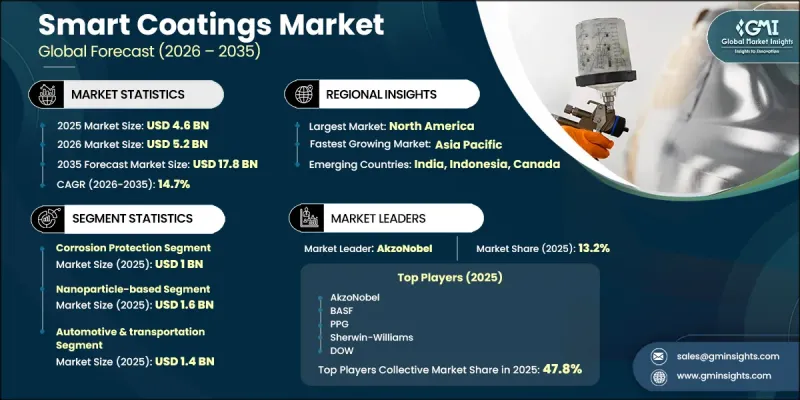
Smart coatings are engineered materials designed to react to external environmental stimuli by altering their physical or chemical behavior. These coatings incorporate functional elements such as nanoparticles, polymer modifications, and microencapsulated agents to deliver advanced features including self-healing, corrosion resistance, and anti-fouling performance. They are widely used across industries where material protection, efficiency, and long-term durability are critical. Key sectors adopting these coatings include automotive, aerospace, marine, construction, and electronics, as they help extend asset life and reduce maintenance requirements. These coatings can respond to temperature fluctuations, pH changes, mechanical stress, and microbial exposure, making them suitable for both extreme outdoor environments and controlled settings. Increasing focus on sustainable solutions is further driving demand, as smart coatings reduce environmental impact by minimizing replacement cycles and improving operational efficiency. Continuous advancements in material science and formulation technologies are enhancing product functionality, enabling precise control over performance characteristics and expanding application possibilities.
| Market Scope | |
|---|---|
| Start Year | 2025 |
| Forecast Year | 2026-2035 |
| Start Value | $4.6 Billion |
| Forecast Value | $17.8 Billion |
| CAGR | 14.7% |
The smart coatings market is also evolving due to rapid advancements in nanotechnology and material engineering. Manufacturers are increasingly focusing on improving coating performance through enhanced dispersion techniques, improved polymer systems, and advanced encapsulation methods. These innovations are enabling coatings with superior adhesion, flexibility, and multi-functional capabilities. Growing demand for high-performance protective solutions is driving continuous research and development activities aimed at improving durability and efficiency. The increasing complexity of industrial applications is further encouraging the development of coatings that can perform under diverse environmental conditions. As industries prioritize longer asset lifespans and reduced maintenance costs, smart coatings are becoming an essential part of modern surface protection strategies.
In terms of application, the corrosion protection segment accounted for USD 1 billion in 2025. This segment is growing steadily due to its critical role in protecting metal surfaces from degradation across industrial, marine, and infrastructure environments. These coatings offer both passive and active protection mechanisms, significantly extending the operational life of equipment and structures. Technological improvements, including self-healing properties and smart inhibitor release systems, enhance performance and reliability. Increasing industrial demand for long-lasting protective solutions is further supporting segment growth.
The nanoparticle-based segment captured USD 1.6 billion in 2025. Its rapid adoption is driven by its ability to improve mechanical strength, barrier efficiency, and multifunctional performance. The integration of advanced nanomaterials is enabling coatings with enhanced durability and resistance properties. Ongoing innovation in polymer modification techniques is also supporting the development of coatings with improved adhesion and flexibility. These advancements are increasing the use of nanoparticle-based formulations across multiple industrial applications.
North America Smart Coatings Market is expected to reach USD 5.7 billion by 2035. The region's growth is supported by strong demand from aerospace and automotive industries, along with increasing regulatory pressure for environmentally friendly materials. Expansion of research and development capabilities is further driving innovation in advanced coating technologies. Rising adoption of nanotechnology-based solutions and increasing focus on high-performance materials are also contributing to regional market expansion.
Key companies operating in the Global smart coatings market include BASF, AkzoNobel, PPG, Sherwin-Williams, 3M, DOW, Hempel, Nippon Paint, Saint-Gobain, Diamond Coatings, NEI Corporation, and NanoTech Materials. Companies in the smart coatings market are focusing on innovation-led growth strategies to strengthen their competitive position. They are investing heavily in research and development to enhance coating performance, durability, and responsiveness to environmental conditions. Strategic collaborations with industrial end users are helping companies expand application areas and accelerate technology adoption. Many players are also increasing production capacities and optimizing manufacturing processes to meet rising global demand. Emphasis on nanotechnology integration and advanced material engineering is enabling firms to develop next-generation multifunctional coatings.
Table of Contents
Chapter 1 Methodology & Scope
- 1.1 Market scope and definition
- 1.2 Research design
- 1.2.1 Research approach
- 1.2.2 Data collection methods
- 1.3 Data mining sources
- 1.3.1 Global
- 1.3.2 Regional/Country
- 1.4 Base estimates and calculations
- 1.4.1 Base year calculation
- 1.4.2 Key trends for market estimation
- 1.5 Primary research and validation
- 1.5.1 Primary sources
- 1.6 Forecast model
- 1.7 Research assumptions and limitations
Chapter 2 Executive Summary
- 2.1 Industry 360° synopsis
- 2.2 Key market trends
- 2.2.1 Functionality
- 2.2.2 Technology
- 2.2.3 End-use Industry
- 2.2.4 Regional
- 2.3 TAM Analysis, 2026-2035
- 2.4 CXO perspectives: Strategic imperatives
Chapter 3 Industry Insights
- 3.1 Industry ecosystem analysis
- 3.1.1 Supplier landscape
- 3.1.2 Profit margin
- 3.1.3 Value addition at each stage
- 3.1.4 Factor affecting the value chain
- 3.1.5 Disruptions
- 3.2 Industry impact forces
- 3.2.1 Growth drivers
- 3.2.2 Industry pitfalls and challenges
- 3.2.3 Market opportunities
- 3.3 Growth potential analysis
- 3.4 Regulatory landscape
- 3.4.1 North America
- 3.4.2 Europe
- 3.4.3 Asia Pacific
- 3.4.4 Latin America
- 3.4.5 Middle East & Africa
- 3.5 Porter's analysis
- 3.6 PESTEL analysis
- 3.7 Price trends
- 3.7.1 By region
- 3.7.2 By functionality
- 3.8 Future market trends
- 3.9 Technology and Innovation landscape
- 3.9.1 Current technological trends
- 3.9.2 Emerging technologies
- 3.10 Patent Landscape
- 3.11 Trade statistics (HS code)
- 3.11.1 Major importing countries
- 3.11.2 Major exporting countries
- 3.12 Sustainability and environmental aspects
- 3.12.1 Sustainable practices
- 3.12.2 Waste reduction strategies
- 3.12.3 Energy efficiency in production
- 3.12.4 Eco-friendly initiatives
- 3.13 Carbon footprint consideration
Chapter 4 Competitive Landscape, 2025
- 4.1 Introduction
- 4.2 Company market share analysis
- 4.2.1 By region
- 4.2.1.1 North America
- 4.2.1.2 Europe
- 4.2.1.3 Asia Pacific
- 4.2.1.4 LATAM
- 4.2.1.5 MEA
- 4.2.1 By region
- 4.3 Competitive analysis of major market players
- 4.4 Competitive positioning matrix
- 4.5 Key developments
- 4.5.1 Mergers & acquisitions
- 4.5.2 Partnerships & collaborations
- 4.5.3 New Product Launches
- 4.5.4 Expansion Plans
Chapter 5 Market Estimates and Forecast, By Functionality, 2022-2035 (USD Billion) (Kilo Tons)
- 5.1 Key trends
- 5.2 Corrosion Protection
- 5.3 Self-Healing
- 5.4 Anti-Fouling
- 5.5 Anti-Microbial
- 5.6 Self-Cleaning
- 5.7 Anti-Icing
- 5.8 Others
Chapter 6 Market Estimates and Forecast, By Technology, 2022-2035 (USD Billion) (Kilo Tons)
- 6.1 Key trends
- 6.2 Nanoparticle-Based
- 6.3 Polymer Matrix Modification
- 6.4 Microencapsulation-Based
- 6.5 Others
Chapter 7 Market Estimates and Forecast, By End Use Industry, 2022-2035 (USD Billion) (Kilo Tons)
- 7.1 Key trends
- 7.2 Automotive & Transportation
- 7.3 Aerospace & Defense
- 7.4 Building & Construction
- 7.5 Marine
- 7.6 Electronics & Electrical
- 7.7 Healthcare & Medical Devices
- 7.8 Others
Chapter 8 Market Estimates and Forecast, By Region, 2022-2035 (USD Billion) (Kilo Tons)
- 8.1 Key trends
- 8.2 North America
- 8.2.1 U.S.
- 8.2.2 Canada
- 8.3 Europe
- 8.3.1 Germany
- 8.3.2 UK
- 8.3.3 France
- 8.3.4 Spain
- 8.3.5 Italy
- 8.3.6 Rest of Europe
- 8.4 Asia Pacific
- 8.4.1 China
- 8.4.2 India
- 8.4.3 Japan
- 8.4.4 Australia
- 8.4.5 South Korea
- 8.4.6 Rest of Asia Pacific
- 8.5 Latin America
- 8.5.1 Brazil
- 8.5.2 Mexico
- 8.5.3 Argentina
- 8.5.4 Rest of Latin America
- 8.6 Middle East and Africa
- 8.6.1 Saudi Arabia
- 8.6.2 South Africa
- 8.6.3 UAE
- 8.6.4 Rest of Middle East and Africa
Chapter 9 Company Profiles
- 9.1 AkzoNobel
- 9.2 BASF
- 9.3 PPG
- 9.4 Diamond Coatings
- 9.5 DOW
- 9.6 Hempel
- 9.7 3M
- 9.8 NanoTech Materials
- 9.9 Saint-Gobain
- 9.10 Sherwin-Williams
- 9.11 NEI Corporation
- 9.12 Nippon Paint

