PUBLISHER: Global Market Insights Inc. | PRODUCT CODE: 2038346

PUBLISHER: Global Market Insights Inc. | PRODUCT CODE: 2038346
Rare Gas Market Opportunity, Growth Drivers, Industry Trend Analysis, and Forecast 2026 - 2035
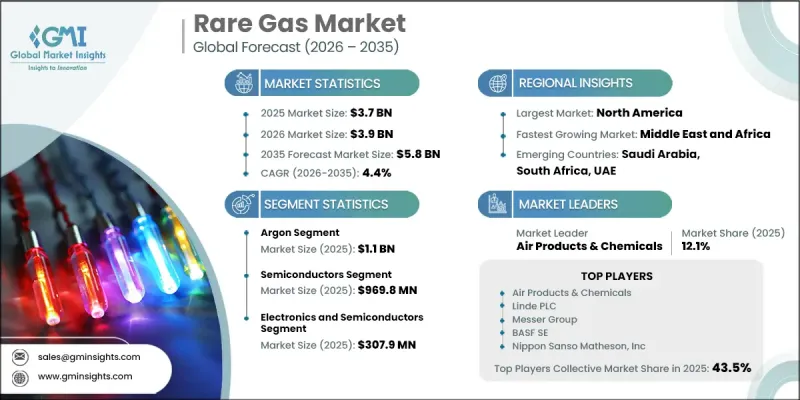
The Global Rare Gas Market was valued at USD 3.7 billion in 2025 and is estimated to grow at a CAGR of 4.4% to reach USD 5.8 billion by 2035.
Rare gases, also known as noble gases, include helium, neon, argon, krypton, xenon, and radon, all of which are characterized by extremely low chemical reactivity. Their inert behavior allows them to function effectively in environments where chemical stability and non-reactivity are essential. These gases are naturally present in the atmosphere in trace quantities and are primarily extracted through air separation units and natural gas processing techniques. Each gas has distinct physical properties such as boiling point, density, and thermal conductivity, which determine its industrial suitability across multiple applications. Helium is widely valued for its low density and cooling properties, while argon is extensively used for shielding and insulation in industrial environments. Overall, rare gases play a critical role in maintaining process stability and operational efficiency across a wide range of technical and industrial systems. Continuous advancements in cryogenic engineering and gas purification technologies have significantly improved extraction efficiency and purity levels. In addition, the integration of gas recovery and recycling systems has enabled more sustainable utilization, allowing rare gases to be reused within industrial cycles and reducing supply constraints.
| Market Scope | |
|---|---|
| Start Year | 2025 |
| Forecast Year | 2026-2035 |
| Start Value | $3.7 Billion |
| Forecast Value | $5.8 Billion |
| CAGR | 4.4% |
The argon segment accounted for USD 1.1 billion in 2025. Demand for argon continues to rise due to its excellent inert properties, which make it highly suitable for controlled manufacturing environments, metal processing operations, and various industrial applications where oxidation prevention and process stability are required.
The semiconductor segment generated USD 969.8 million in 2025. Growth in this segment is supported by increasing utilization of rare gases across advanced manufacturing and precision-driven industries, where ultra-high purity standards are essential. These gases are also used in healthcare applications for controlled medical procedures requiring inert environments. Additionally, the semiconductor industry relies heavily on high-purity rare gases to ensure accuracy and consistency during fabrication processes, supporting the production of advanced electronic components and systems.
North America Rare Gas Market is projected to grow from USD 1.1 billion in 2025 to USD 1.6 billion in 2035. Demand in the region remains strong due to widespread application across healthcare, aerospace, electronics, and scientific research sectors, all of which require high-purity gas supplies and reliable distribution networks. The United States continues to be a key consumer, driven by sustained usage of helium, argon, and other rare gases in semiconductor manufacturing, medical imaging technologies, space exploration programs, and industrial production activities.
Major players operating in the Global Rare Gas Industry include Iwatani Corporation, Messer Group, Air Products & Chemicals, Praxair, BASF SE, American Gas Products, Nippon Sanso Matheson, Inc, Axcel Gases, Ingas LLC, and Dakota Gasification Co. Companies operating in the Rare Gas Market are focusing on strengthening their market position through investments in advanced extraction technologies and high-efficiency air separation systems that improve yield and purity levels. Strategic emphasis is placed on expanding cryogenic processing capabilities and upgrading purification infrastructure to meet rising demand from high-precision industries. Many players are also prioritizing the development of sustainable gas recovery and recycling solutions to reduce waste and improve resource efficiency. Long-term supply agreements with semiconductor manufacturers, healthcare providers, and industrial clients are being used to ensure stable revenue streams. Additionally, firms are expanding global distribution networks and strengthening logistics capabilities to ensure uninterrupted supply.
Table of Contents
Chapter 1 Methodology & Scope
- 1.1 Market scope and definition
- 1.2 Research design
- 1.2.1 Research approach
- 1.2.2 Data collection methods
- 1.3 Data mining sources
- 1.3.1 Global
- 1.3.2 Regional/Country
- 1.4 Base estimates and calculations
- 1.4.1 Base year calculation
- 1.4.2 Key trends for market estimation
- 1.5 Primary research and validation
- 1.5.1 Primary sources
- 1.6 Forecast model
- 1.7 Research assumptions and limitations
Chapter 2 Executive Summary
- 2.1 Industry 360° synopsis
- 2.2 Key market trends
- 2.2.1 Type
- 2.2.2 Function
- 2.2.3 End Use
- 2.2.4 Regional
- 2.3 TAM Analysis, 2026-2035
- 2.4 CXO perspectives: Strategic imperatives
- 2.5 Future outlook and strategic recommendations
Chapter 3 Industry Insights
- 3.1 Industry ecosystem analysis
- 3.1.1 Supplier landscape
- 3.1.2 Profit margin
- 3.1.3 Value addition at each stage
- 3.1.4 Factor affecting the value chain
- 3.1.5 Disruptions
- 3.2 Industry impact forces
- 3.2.1 Growth drivers
- 3.2.1.1 Rising electronics and semiconductor manufacturing
- 3.2.1.2 Increasing demand from healthcare applications
- 3.2.1.3 Expanding industrial welding and fabrication
- 3.2.2 Pitfalls/challenge
- 3.2.2.1 Limited natural availability of rare gases
- 3.2.2.2 High storage and transportation requirements
- 3.2.3 Opportunities
- 3.2.3.1 Development of gas recycling technologies
- 3.2.3.2 Growth in advanced manufacturing applications
- 3.2.1 Growth drivers
- 3.3 Growth potential analysis
- 3.4 Regulatory landscape
- 3.4.1 North America
- 3.4.2 Europe
- 3.4.3 Asia Pacific
- 3.4.4 Latin America
- 3.4.5 Middle East & Africa
- 3.5 Porter's analysis
- 3.6 PESTEL analysis
- 3.7 Technology and innovation landscape
- 3.7.1 Current technological trends
- 3.7.2 Emerging technologies
- 3.8 Price trends
- 3.8.1 By region
- 3.8.2 By type
- 3.9 Future market trends
- 3.10 Patent landscape
- 3.11 Trade statistics (HS code)
- 3.11.1 Major importing countries
- 3.11.2 Major exporting countries
- 3.12 Sustainability and environmental aspects
- 3.12.1 Sustainable practices
- 3.12.2 Waste reduction strategies
- 3.12.3 Energy efficiency in production
- 3.12.4 Eco-friendly initiatives
- 3.13 Carbon footprint consideration
Chapter 4 Competitive Landscape, 2025
- 4.1 Introduction
- 4.2 Company market share analysis
- 4.2.1 By region
- 4.2.1.1 North America
- 4.2.1.2 Europe
- 4.2.1.3 Asia Pacific
- 4.2.1.4 LATAM
- 4.2.1.5 MEA
- 4.2.1 By region
- 4.3 Company matrix analysis
- 4.4 Competitive analysis of major market players
- 4.5 Competitive positioning matrix
- 4.6 Key developments
- 4.6.1 Mergers & acquisitions
- 4.6.2 Partnerships & collaborations
- 4.6.3 New product launches
- 4.6.4 Expansion plans
Chapter 5 Market Estimates and Forecast, By Type, 2022-2035 (USD Billion) (Kilo Tons)
- 5.1 Key trends
- 5.2 Helium
- 5.3 Neon
- 5.4 Argon
- 5.5 Krypton
- 5.6 Xenon
- 5.7 Radon
Chapter 6 Market Estimates and Forecast, By Function, 2022-2035 (USD Billion) (Kilo Tons)
- 6.1 Key trends
- 6.2 Illumination
- 6.3 Insulation
- 6.4 Scanning
- 6.5 Anaesthesia
- 6.6 Semiconductors
- 6.7 Satellites
Chapter 7 Market Estimates and Forecast, By End Use, 2022-2035 (USD Billion) (Kilo Tons)
- 7.1 Key trends
- 7.2 Healthcare
- 7.3 Lighting
- 7.4 Electronics and semiconductors
- 7.5 Manufacturing and fabrication
- 7.6 Energy and power
- 7.7 Aerospace and aviation
- 7.8 Others
Chapter 8 Market Estimates and Forecast, By Region, 2022-2035 (USD Billion) (Kilo Tons)
- 8.1 Key trends
- 8.2 North America
- 8.2.1 U.S.
- 8.2.2 Canada
- 8.3 Europe
- 8.3.1 Germany
- 8.3.2 UK
- 8.3.3 France
- 8.3.4 Spain
- 8.3.5 Italy
- 8.3.6 Rest of Europe
- 8.4 Asia Pacific
- 8.4.1 China
- 8.4.2 India
- 8.4.3 Japan
- 8.4.4 Australia
- 8.4.5 South Korea
- 8.4.6 Rest of Asia Pacific
- 8.5 Latin America
- 8.5.1 Brazil
- 8.5.2 Mexico
- 8.5.3 Argentina
- 8.5.4 Rest of Latin America
- 8.6 Middle East and Africa
- 8.6.1 Saudi Arabia
- 8.6.2 South Africa
- 8.6.3 UAE
- 8.6.4 Rest of Middle East and Africa
Chapter 9 Company Profiles
- 9.1 Air Products & Chemicals
- 9.2 American Gas Products
- 9.3 Axcel Gases
- 9.4 BASF SE
- 9.5 Dakota Gasification Co.
- 9.6 Ingas LLC
- 9.7 Iwatani Corporation
- 9.8 Nippon Sanso Matheson, Inc
- 9.9 Messer Group
- 9.10 Praxair

