PUBLISHER: Global Market Insights Inc. | PRODUCT CODE: 2038365

PUBLISHER: Global Market Insights Inc. | PRODUCT CODE: 2038365
Lead Market Opportunity, Growth Drivers, Industry Trend Analysis, and Forecast 2026 - 2035
The Global Lead Market was valued at USD 30.9 billion in 2025 and is estimated to grow at a CAGR of 3.5% to reach USD 43.1 billion by 2035.
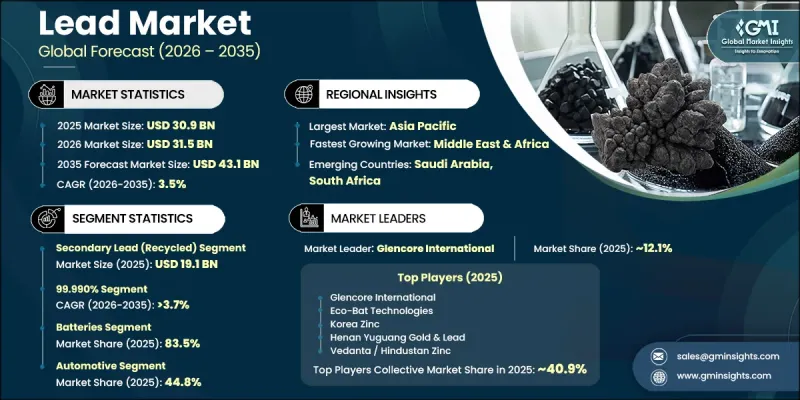
The industry continues to evolve as it remains integral to key industrial and infrastructure applications. Demand is strongly influenced by the automotive sector, where lead-based batteries are extensively utilized for ignition systems, energy storage, and backup functions. Expanding power infrastructure, telecommunications networks, and data center development are further sustaining consistent consumption levels due to the reliability and affordability of lead-based energy solutions. In addition, construction activities contribute to demand through specialized applications such as protective materials and structural enhancements. Sustainability trends are reshaping market dynamics, with circular economy principles encouraging high recycling rates and efficient resource utilization. Lead maintains a significant advantage due to its well-established recycling ecosystem, ensuring stable supply and cost control. Secondary production continues to gain prominence, supported by organized collection systems and advancements in recovery technologies. At the same time, technological shifts are influencing usage patterns, as lead-based batteries maintain relevance across hybrid mobility, grid support systems, and backup power applications, ensuring continued market stability.
| Market Scope | |
|---|---|
| Start Year | 2025 |
| Forecast Year | 2026-2035 |
| Start Value | $30.9 Billion |
| Forecast Value | $43.1 Billion |
| CAGR | 3.5% |
The recycled lead segment accounted for USD 19.1 billion in 2025 and is expected to grow at a CAGR of 3.4% through 2035. Recovered primarily from used batteries and industrial waste, this segment is gaining wider acceptance due to its economic benefits and reduced environmental impact. Advancements in recycling technologies and increased collection efficiency are strengthening supply reliability. While primary production continues to provide baseline availability, recycled lead plays a crucial role in enhancing sustainability and supporting long-term operational flexibility across industries.
The automotive sector generated USD 13.8 billion in 2025, representing a share of 44.8%, and is projected to grow at a CAGR of 3.4% through 2035. This segment remains a dominant consumer, as lead-based batteries continue to support essential vehicle functions. The ongoing reliance on conventional and hybrid vehicle systems reinforces steady demand, while improvements in battery performance and lifecycle management contribute to sustained adoption across transportation applications.
North America Lead Market recorded USD 4.1 billion in 2025. Regional demand is supported by a strong recycling infrastructure and consistent consumption across automotive, industrial equipment, and backup energy systems. The United States continues to influence regional trends through its established battery ecosystem, expanding digital infrastructure, and advanced secondary production capabilities, which collectively support stable market development.
Key companies operating in the Global Lead Market include Korea Zinc, Glencore International, Eco-Bat Technologies, Henan Yuguang Gold & Lead, Vedanta / Hindustan Zinc, Doe Run Resources, Gravita India, Penoles, Boliden, Teck Resources, Zijin Mining, East Penn Manufacturing, Nexa Resources, Campine, and KGHM Polska Miedz, among others. Companies in the lead market are focusing on strengthening their competitive position through investments in advanced recycling technologies, expansion of secondary production capacity, and optimization of supply chain networks. Strategic partnerships with battery manufacturers and waste collection systems are helping secure consistent raw material flow. Firms are also emphasizing sustainability by aligning operations with environmental regulations and improving recycling efficiency. Geographic expansion into emerging markets, along with modernization of smelting and refining processes, is enhancing production capabilities.
Table of Contents
Chapter 1 Methodology & Scope
- 1.1 Market scope and definition
- 1.2 Research design
- 1.2.1 Research approach
- 1.2.2 Data collection methods
- 1.3 Data mining sources
- 1.3.1 Global
- 1.3.2 Regional/Country
- 1.4 Base estimates and calculations
- 1.4.1 Base year calculation
- 1.4.2 Key trends for market estimation
- 1.5 Primary research and validation
- 1.5.1 Primary sources
- 1.6 Forecast model
- 1.7 Research assumptions and limitations
Chapter 2 Executive Summary
- 2.1 Industry 360° synopsis
- 2.2 Key market trends
- 2.2.1 Regional
- 2.2.2 Source
- 2.2.3 Type
- 2.2.4 Application
- 2.2.5 End Use Industry
- 2.3 TAM Analysis, 2026-2035
- 2.4 CXO perspectives: Strategic imperatives
Chapter 3 Industry Insights
- 3.1 Industry ecosystem analysis
- 3.1.1 Supplier landscape
- 3.1.2 Profit margin
- 3.1.3 Value addition at each stage
- 3.1.4 Factor affecting the value chain
- 3.1.5 Disruptions
- 3.2 Industry impact forces
- 3.2.1 Growth drivers
- 3.2.2 Industry pitfalls and challenges
- 3.2.3 Market opportunities
- 3.3 Growth potential analysis
- 3.4 Regulatory landscape
- 3.4.1 North America
- 3.4.2 Europe
- 3.4.3 Asia Pacific
- 3.4.4 Latin America
- 3.4.5 Middle East & Africa
- 3.5 Porter's analysis
- 3.6 PESTEL analysis
- 3.7 Price trends
- 3.7.1 By region
- 3.7.2 By type
- 3.8 Future market trends
- 3.9 Technology and Innovation landscape
- 3.9.1 Current technological trends
- 3.9.2 Emerging technologies
- 3.10 Patent Landscape
- 3.11 Trade statistics (HS code)
- 3.11.1 Major importing countries
- 3.11.2 Major exporting countries
- 3.12 Sustainability and environmental aspects
- 3.12.1 Sustainable practices
- 3.12.2 Waste reduction strategies
- 3.12.3 Energy efficiency in production
- 3.12.4 Eco-friendly initiatives
- 3.13 Carbon footprint consideration
Chapter 4 Competitive Landscape, 2025
- 4.1 Introduction
- 4.2 Company market share analysis
- 4.2.1 By region
- 4.2.1.1 North America
- 4.2.1.2 Europe
- 4.2.1.3 Asia Pacific
- 4.2.1.4 LATAM
- 4.2.1.5 MEA
- 4.2.1 By region
- 4.3 Company matrix analysis
- 4.4 Competitive analysis of major market players
- 4.5 Competitive positioning matrix
- 4.6 Key developments
- 4.6.1 Mergers & acquisitions
- 4.6.2 Partnerships & collaborations
- 4.6.3 New Product Launches
- 4.6.4 Expansion Plans
Chapter 5 Market Estimates and Forecast, By Source, 2022-2035 (USD Billion) (Kilo Tons)
- 5.1 Key trends
- 5.2 Primary Lead (Virgin/Mined)
- 5.3 Secondary Lead (Recycled)
Chapter 6 Market Estimates and Forecast, By Type, 2022-2035 (USD Billion) (Kilo Tons)
- 6.1 Key trends
- 6.2 99.994%
- 6.3 99.990%
- 6.4 96%
- 6.5 Others
Chapter 7 Market Estimates and Forecast, By Application, 2022-2035 (USD Billion) (Kilo Tons)
- 7.1 Key trends
- 7.2 Batteries
- 7.3 Construction
- 7.4 Plumbing
- 7.5 Bullets & Shots
- 7.6 Solders
- 7.7 Others
Chapter 8 Market Estimates and Forecast, By End Use Industry, 2022-2035 (USD Billion) (Kilo Tons)
- 8.1 Key trends
- 8.2 Automotive
- 8.3 Industrial
- 8.4 Construction
- 8.5 Energy Storage & Utilities
- 8.6 Defense & Ammunition
- 8.7 Others
Chapter 9 Market Estimates and Forecast, By Region, 2022-2035 (USD Billion) (Kilo Tons)
- 9.1 Key trends
- 9.2 North America
- 9.2.1 U.S.
- 9.2.2 Canada
- 9.3 Europe
- 9.3.1 Germany
- 9.3.2 UK
- 9.3.3 France
- 9.3.4 Spain
- 9.3.5 Italy
- 9.3.6 Rest of Europe
- 9.4 Asia Pacific
- 9.4.1 China
- 9.4.2 India
- 9.4.3 Japan
- 9.4.4 Australia
- 9.4.5 South Korea
- 9.4.6 Rest of Asia Pacific
- 9.5 Latin America
- 9.5.1 Brazil
- 9.5.2 Mexico
- 9.5.3 Argentina
- 9.5.4 Rest of Latin America
- 9.6 Middle East and Africa
- 9.6.1 Saudi Arabia
- 9.6.2 South Africa
- 9.6.3 UAE
- 9.6.4 Rest of Middle East and Africa
Chapter 10 Company Profiles
- 10.1 Glencore International
- 10.2 Eco-Bat Technologies
- 10.3 Korea Zinc
- 10.4 Henan Yuguang Gold & Lead
- 10.5 Vedanta / Hindustan Zinc
- 10.6 Doe Run Resources
- 10.7 Gravita India
- 10.8 Penoles
- 10.9 Boliden
- 10.10 Teck Resources
- 10.11 Zijin Mining
- 10.12 East Penn Manufacturing
- 10.13 Nexa Resources
- 10.14 Campine
- 10.15 KGHM Polska Miedz

