PUBLISHER: Global Market Insights Inc. | PRODUCT CODE: 2038369

PUBLISHER: Global Market Insights Inc. | PRODUCT CODE: 2038369
Satellite Ground Station Market Opportunity, Growth Drivers, Industry Trend Analysis, and Forecast 2026 - 2035
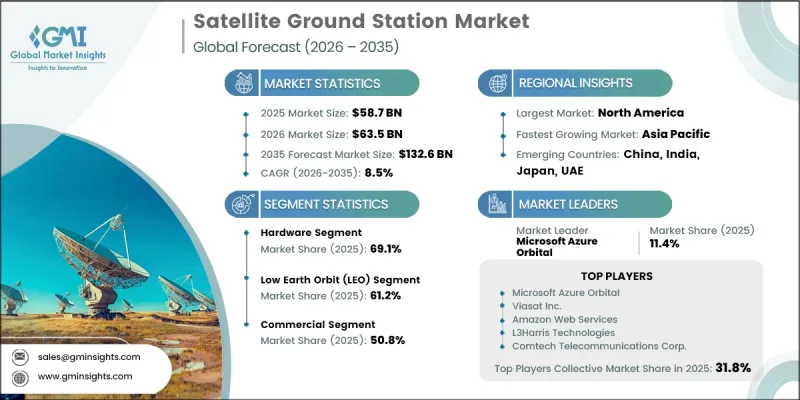
The Global Satellite Ground Station Market was valued at USD 58.7 billion in 2025 and is estimated to grow at a CAGR of 8.5% to reach USD 132.6 billion by 2035.
Market growth is driven by the increasing penetration of satellite-based broadcasting services and continuous advancements in ground station technologies that enhance communication efficiency and data processing capabilities. Rising demand for satellite-enabled remote sensing applications is also contributing significantly to expansion, alongside supportive government initiatives promoting space exploration and research activities. The rapid increase in satellite launches and the growing need for high-capacity global connectivity are further accelerating demand for advanced ground infrastructure. In addition, the expansion of Earth observation data, along with analytics-driven applications, is strengthening the importance of satellite ground stations across commercial and institutional sectors. Increasing reliance on high-definition, ultra-high-definition, and real-time content delivery is also reinforcing infrastructure requirements for signal transmission and reception. The market is further supported by growing investments in automated tracking systems, cloud-integrated ground station solutions, and scalable communication networks that enable continuous satellite monitoring and data exchange. These combined factors are positioning satellite ground stations as a critical component of modern space-based communication ecosystems worldwide.
| Market Scope | |
|---|---|
| Start Year | 2025 |
| Forecast Year | 2026-2035 |
| Start Value | $58.7 Billion |
| Forecast Value | $132.6 Billion |
| CAGR | 8.5% |
The hardware segment accounted for a share of 69.1% in 2025. This dominance is attributed to the extensive deployment of antennas, RF systems, satellite tracking technologies, and supporting infrastructure essential for reliable satellite communication operations. Hardware forms the core foundation of ground segment functionality, enabling efficient telemetry, tracking, command, and signal transmission across both geostationary and low Earth orbit satellite systems. Increasing deployment of large satellite constellations and expanding global ground networks is further strengthening demand for advanced and high-performance hardware systems.
The Low Earth Orbit segment held a 61.2% share in 2025. This leadership is driven by the rapid expansion of LEO satellite constellations used for broadband connectivity, Earth observation services, and Internet of Things applications. Due to their short orbital duration and frequent movement, LEO satellites require extensive ground station coverage and continuous tracking support. This is accelerating investment in automated, real-time monitoring technologies and advanced data processing systems to ensure uninterrupted communication and efficient satellite handover management.
North America Satellite Ground Station Market accounted for 42.6% share in 2025, supported by strong technological infrastructure and growing satellite communication requirements. Market growth in the region is driven by the rapid expansion of LEO satellite networks and increasing demand for broadband and Earth observation services across the United States and Canada. The region benefits from well-established aerospace capabilities, widespread adoption of cloud-based ground station platforms, and substantial government investment in secure satellite communication systems, strengthening its leadership in the global market.
Amazon Web Services, Microsoft Azure Orbital, L3Harris Technologies, Viasat Inc., Hughes Network Systems (EchoStar), Kongsberg Satellite Services (KSAT), Swedish Space Corporation (SSC), Gilat Satellite Networks, Atlas Space Operations, RBC Signals, Comtech Telecommunications Corp., Leaf Space, QuadSAT, Northstar Earth & Space, KLEO Connect, European Space Agency (ESA), and Japan Aerospace Exploration Agency (JAXA) are among the key players operating in the Global Satellite Ground Station Market. Companies in the Satellite Ground Station Market are focusing on expanding automated and cloud-integrated ground infrastructure to strengthen operational efficiency and scalability. They are investing in advanced tracking systems, AI-driven data processing, and real-time satellite monitoring solutions to improve communication reliability. Strategic partnerships with satellite operators and cloud service providers are enabling wider service coverage and faster deployment of ground networks. Firms are also prioritizing the development of modular and software-defined ground station architectures to reduce operational costs and increase flexibility.
Table of Contents
Chapter 1 Methodology and Scope
- 1.1 Market scope and definition
- 1.2 Research design
- 1.2.1 Research approach
- 1.2.2 Data collection methods
- 1.3 Data mining sources
- 1.3.1 Global
- 1.3.2 Regional/Country
- 1.4 Base estimates and calculations
- 1.4.1 Base year calculation
- 1.4.2 Key trends for market estimation
- 1.5 Primary research and validation
- 1.5.1 Primary sources
- 1.6 Forecast model
- 1.7 Research assumptions and limitations
Chapter 2 Executive Summary
- 2.1 Industry 360° synopsis, 2022 - 2035
- 2.2 Key market trends
- 2.2.1 Solution type trends
- 2.2.2 Platform type trends
- 2.2.3 Frequency band trends
- 2.2.4 Orbit type trends
- 2.2.5 Application trends
- 2.2.6 End-user trends
- 2.2.7 Regional trends
- 2.3 TAM Analysis, 2026-2035
- 2.4 CXO perspectives: Strategic imperatives
Chapter 3 Industry Insights
- 3.1 Industry ecosystem analysis
- 3.1.1 Supplier Landscape
- 3.1.2 Profit Margin
- 3.1.3 Cost structure
- 3.1.4 Value addition at each stage
- 3.1.5 Factor affecting the value chain
- 3.1.6 Disruptions
- 3.2 Industry impact forces
- 3.2.1 Growth drivers
- 3.2.1.1 Increased penetration of satellite-based broadcasting services.
- 3.2.1.2 Continuous technological advancements in satellite ground stations.
- 3.2.1.3 Rising satellite service demand for remote sensing applications.
- 3.2.1.4 Favorable government initiatives to support space research agencies.
- 3.2.1.5 Proliferation of Earth observation imagery and analytics solutions.
- 3.2.2 Industry pitfalls and challenges
- 3.2.2.1 Lack of regulations and government policies.
- 3.2.2.2 Constant bandwidth issues.
- 3.2.3 Market opportunities
- 3.2.3.1 AI-enabled autonomous ground station operations
- 3.2.3.2 Virtualized and shared ground station networks
- 3.2.1 Growth drivers
- 3.3 Growth potential analysis
- 3.4 Regulatory landscape
- 3.4.1 North America
- 3.4.2 Europe
- 3.4.3 Asia Pacific
- 3.4.4 Latin America
- 3.4.5 Middle East & Africa
- 3.5 Porter's analysis
- 3.6 PESTEL analysis
- 3.7 Technology and Innovation landscape
- 3.7.1 Current technological trends
- 3.7.2 Emerging technologies
- 3.8 Price trends (Based on paid Database)
- 3.8.1 Historical Price Analysis (2022-2025)
- 3.8.2 Price Trend Drivers
- 3.8.3 Regional Price Variations
- 3.8.4 Price Forecast (2026-2035)
- 3.9 Impact of AI & Generative AI on the Market
- 3.9.1 AI-Driven Disruption of Existing Business Models
- 3.9.2 GenAI Use Cases & Adoption Roadmap by Segment
- 3.9.3 Risks, Limitations & Regulatory Considerations
- 3.10 Capacity & Production Landscape (Driven by Primary Research)
- 3.10.1 Installed Capacity by Region & Key Producer
- 3.10.2 Capacity Utilization Rates & Expansion Pipelines
Chapter 4 Competitive Landscape, 2025
- 4.1 Introduction
- 4.2 Company market share analysis
- 4.2.1 By region
- 4.2.1.1 North America
- 4.2.1.2 Europe
- 4.2.1.3 Asia Pacific
- 4.2.1.4 Latin America
- 4.2.1.5 Middle East & Africa
- 4.2.2 Market concentration analysis
- 4.2.1 By region
- 4.3 Competitive benchmarking of key players
- 4.3.1 Financial performance comparison
- 4.3.1.1 Revenue
- 4.3.1.2 Profit margin
- 4.3.1.3 R&D
- 4.3.2 Product portfolio comparison
- 4.3.2.1 Product range breadth
- 4.3.2.2 Technology
- 4.3.2.3 Innovation
- 4.3.3 Geographic presence comparison
- 4.3.3.1 Global footprint analysis
- 4.3.3.2 Service network coverage
- 4.3.3.3 Market penetration by region
- 4.3.4 Competitive positioning matrix
- 4.3.4.1 Leaders
- 4.3.4.2 Challengers
- 4.3.4.3 Followers
- 4.3.4.4 Niche players
- 4.3.5 Strategic outlook matrix
- 4.3.1 Financial performance comparison
- 4.4 Key developments
- 4.4.1 Mergers and acquisitions
- 4.4.2 Partnerships and collaborations
- 4.4.3 Technological advancements
- 4.4.4 Expansion and investment strategies
- 4.4.5 Digital transformation initiatives
- 4.5 Emerging/ startup competitors landscape
Chapter 5 Market Estimates and Forecast, By Solution Type, 2022 - 2035 (USD Million)
- 5.1 Key trends
- 5.2 Hardware
- 5.2.1 Antenna systems
- 5.2.2 RF systems & timing
- 5.2.3 Baseband & recording hardware
- 5.2.4 Storage & networking units
- 5.2.5 Power & racks
- 5.3 Software
- 5.3.1 Mission control & flight dynamics
- 5.3.2 Baseband/virtual modems & waveforms
- 5.3.3 Cybersecurity & key management
- 5.3.4 Network M&C/orchestration
- 5.4 Services
- 5.4.1 Direct-to-Satellite (DTS)
- 5.4.2 Satellite ground station backhaul
- 5.4.3 Managed services & system integration
Chapter 6 Market Estimates and Forecast, By Platform Type, 2022 - 2035 (USD Million)
- 6.1 Key trends
- 6.2 Fixed
- 6.3 Portable
- 6.4 Mobile stations
Chapter 7 Market Estimates and Forecast, By Frequency Band, 2022 - 2035 (USD Million)
- 7.1 Key trends
- 7.2 L-Band
- 7.3 S-Band
- 7.4 C-Band
- 7.5 X-Band
- 7.6 Ku & Ka-Band
- 7.7 HF/VHF/UHF-Band
- 7.8 Others
Chapter 8 Market Estimates and Forecast, By Orbit Type, 2022 - 2035 (USD Million)
- 8.1 Key trends
- 8.2 Low Earth Orbit (LEO)
- 8.3 Medium Earth Orbit (MEO)
- 8.4 Geostationary Earth Orbit (GEO)
Chapter 9 Market Estimates and Forecast, By Application, 2022 - 2035 (USD Million)
- 9.1 Key trends
- 9.2 Communication
- 9.3 Earth observation
- 9.4 Navigation
- 9.5 Space research
- 9.6 Satellite telemetry, tracking and control subsystems
- 9.7 Gateway & network interconnection
- 9.8 Others
Chapter 10 Market Estimates and Forecast, By End User, 2022 - 2035 (USD Million)
- 10.1 Key trends
- 10.2 Defense
- 10.2.1 Army
- 10.2.2 Air force
- 10.2.3 Navy
- 10.3 Government
- 10.3.1 Public safety & civil agencies
- 10.3.2 Space agencies & research centers
- 10.4 Commercial
- 10.4.1 Satellite & teleport operators
- 10.4.2 Carriers & service providers
- 10.4.3 Enterprise & mobility
Chapter 11 Market Estimates and Forecast, By Region, 2022 - 2035 (USD Million)
- 11.1 Key trends
- 11.2 North America
- 11.2.1 U.S.
- 11.2.2 Canada
- 11.3 Europe
- 11.3.1 Germany
- 11.3.2 UK
- 11.3.3 France
- 11.3.4 Spain
- 11.3.5 Italy
- 11.3.6 Netherlands
- 11.4 Asia Pacific
- 11.4.1 China
- 11.4.2 India
- 11.4.3 Japan
- 11.4.4 Australia
- 11.4.5 South Korea
- 11.5 Latin America
- 11.5.1 Brazil
- 11.5.2 Mexico
- 11.5.3 Argentina
- 11.6 Middle East and Africa
- 11.6.1 South Africa
- 11.6.2 Saudi Arabia
- 11.6.3 UAE
Chapter 12 Company Profiles
- 12.1 Global Players
- 12.1.1 Kongsberg Satellite Services (KSAT)
- 12.1.2 Viasat Inc.
- 12.1.3 Amazon Web Services
- 12.1.4 Microsoft Azure Orbital
- 12.1.5 Swedish Space Corporation (SSC)
- 12.1.6 Comtech Telecommunications Corp.
- 12.1.7 L3Harris Technologies
- 12.2 Regional Players
- 12.2.1 Japan Aerospace Exploration Agency (JAXA)
- 12.2.2 European Space Agency (ESA)
- 12.2.3 Gilat Satellite Networks
- 12.2.4 Hughes Network Systems (EchoStar)
- 12.3 Emerging Players
- 12.3.1 RBC Signals
- 12.3.2 Atlas Space Operations
- 12.3.3 KLEO Connect
- 12.3.4 Leaf Space
- 12.3.5 Northstar Earth & Space
- 12.3.6 QuadSAT

