
PUBLISHER: Global Market Insights Inc. | PRODUCT CODE: 2038397

PUBLISHER: Global Market Insights Inc. | PRODUCT CODE: 2038397
Postpartum Depression Treatment Market Opportunity, Growth Drivers, Industry Trend Analysis, and Forecast 2026 - 2035
The Global Postpartum Depression (PPD) Treatment Market was valued at USD 1.05 billion in 2025 and is estimated to grow at a CAGR of 9.4% to reach USD 2.55 billion by 2035.
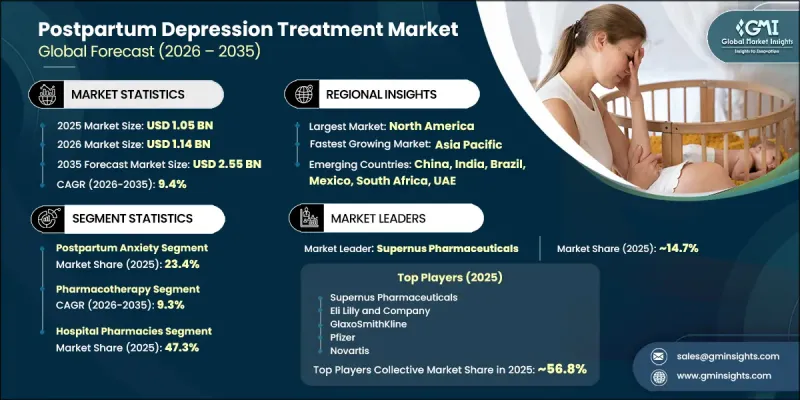
The market is experiencing growth due to rising recognition of mental health as a critical component of maternal care. Increasing incidence of postpartum depression among new mothers is significantly driving demand for effective and timely treatment options. Growing acceptance of mental health disorders and improved access to healthcare services are encouraging more women to seek medical support. Advances in therapeutic innovation have expanded treatment possibilities, improving outcomes for moderate to severe cases. Strengthening healthcare infrastructure and enhanced integration of mental health services into maternal care systems are further supporting market expansion. Public awareness initiatives and education campaigns are also reducing stigma associated with postpartum mental health conditions, enabling earlier diagnosis and intervention. The overall market outlook remains positive, supported by continuous medical advancements, improved accessibility, and increasing focus on maternal well-being.
| Market Scope | |
|---|---|
| Start Year | 2025 |
| Forecast Year | 2026-2035 |
| Start Value | $1.05 Billion |
| Forecast Value | $2.55 Billion |
| CAGR | 9.4% |
Postpartum depression is a mental health condition that affects women following childbirth and is associated with emotional, psychological, and physical changes. It can significantly impact a mother's ability to care for herself and her infant if not properly managed. Common symptoms include persistent sadness, anxiety, fatigue, irritability, difficulty in bonding with the newborn, and feelings of inadequacy. Treatment typically involves medical intervention, counseling, and supportive care aimed at improving emotional stability and overall well-being. Increasing recognition of the condition has led to greater integration of screening and treatment within maternal healthcare systems.
The pharmacotherapy segment generated USD 591 million in 2025 and is expected to grow at a CAGR of 9.3% over 2035. Growth in this segment is supported by rising demand for effective pharmaceutical interventions and improved accessibility to treatment options. Medications such as selective serotonin reuptake inhibitors and serotonin-norepinephrine reuptake inhibitors are widely used due to their proven efficacy in managing depressive and anxiety-related symptoms. The dual therapeutic benefits of these treatments have contributed to their increasing adoption, particularly in cases where co-occurring anxiety is present. Advancements in drug development and improved safety profiles are further strengthening the use of pharmacological therapies in clinical practice.
The hospital pharmacies segment accounted for 47.3% share in 2025, reflecting its strong role in the distribution of specialized treatment options. Hospital-based pharmacies serve as key access points for advanced therapies that require medical supervision during administration. Their integration with inpatient and outpatient care systems ensures coordinated treatment delivery and improved patient outcomes. The presence of trained healthcare professionals within hospital settings further supports safe and effective medication management, reinforcing the importance of this channel in the overall treatment landscape.
North America Postpartum Depression Treatment Market was valued at USD 434.6 million in 2025 supported by a high prevalence of postpartum depression and increasing awareness regarding maternal mental health. Strong healthcare infrastructure, widespread screening initiatives, and improved access to mental health services are enabling early diagnosis and treatment. The presence of well-established healthcare systems and growing emphasis on maternal care are further contributing to regional market expansion.
Key companies operating in the Global Postpartum Depression Treatment Market include Eli Lilly and Company, Pfizer, Novartis, AstraZeneca, GlaxoSmithKline, Takeda Pharmaceutical, Teva Pharmaceutical Industries, Sun Pharmaceutical Industries, Cipla, Merck, Supernus Pharmaceuticals, and Bausch Health Companies. Companies in the Postpartum Depression Treatment Market are focusing on innovation, clinical research, and strategic collaborations to strengthen their market position. Continuous investment in drug development is enabling the introduction of more effective and safer therapeutic options. Market players are expanding their clinical trial activities to improve treatment efficacy and address unmet medical needs. Strengthening partnerships with healthcare providers is enhancing awareness and adoption of treatment solutions. Companies are also working on improving accessibility through expanded distribution networks and healthcare partnerships. Emphasis on regulatory approvals and patient-centric therapies is further supporting market growth.
Table of Contents
Chapter 1 Methodology and Scope
- 1.1 Market scope and definition
- 1.2 Research approach
- 1.3 Quality commitments
- 1.3.1 GMI AI policy and data integrity commitment
- 1.3.1.1 Source consistency protocol
- 1.3.1 GMI AI policy and data integrity commitment
- 1.4 Research trail and confidence scoring
- 1.4.1 Research trail components
- 1.4.2 Scoring components
- 1.5 Data collection
- 1.5.1 Partial list of primary sources
- 1.6 Data mining sources
- 1.6.1 Paid sources
- 1.6.1.1 Sources, by region
- 1.6.1 Paid sources
- 1.7 Base estimates and calculations
- 1.7.1 Revenue share analysis
- 1.7.2 Base year calculation
- 1.8 Forecast model
- 1.9 Research transparency addendum
- 1.9.1 Source attribution framework
- 1.9.2 Quality assurance metrics
- 1.9.3 Our commitment to trust
Chapter 2 Executive Summary
- 2.1 Industry 360° synopsis
- 2.2 Key market trends
- 2.2.1 Business trends
- 2.2.2 Regional trends
- 2.2.3 Type trends
- 2.2.4 Treatment trends
- 2.2.5 Route of administration trends
- 2.2.6 Distribution channel trends
- 2.3 CXO perspectives: Strategic imperatives
Chapter 3 Industry Insights
- 3.1 Industry ecosystem analysis
- 3.2 Industry impact forces
- 3.2.1 Growth drivers
- 3.2.1.1 Increasing prevalence of postpartum depression
- 3.2.1.2 Advancements in drug development
- 3.2.1.3 Growing awareness and focus on women's health
- 3.2.2 Industry pitfalls and challenges
- 3.2.2.1 Safety concerns due to associated side effects
- 3.2.2.2 High cost of postpartum depression drugs
- 3.2.3 Market opportunities
- 3.2.3.1 Expansion of digital therapeutic solutions
- 3.2.3.2 Emergence of fast-acting and novel therapies
- 3.2.1 Growth drivers
- 3.3 Growth potential analysis
- 3.4 Regulatory landscape (Driven by primary research)
- 3.4.1 North America
- 3.4.1.1 U.S.
- 3.4.1.2 Canada
- 3.4.2 Europe
- 3.4.3 Asia Pacific
- 3.4.4 Latin America
- 3.4.5 Middle East and Africa
- 3.4.1 North America
- 3.5 Pipeline analysis
- 3.6 Pricing analysis (Driven by primary research)
- 3.7 Future market trends (Driven by primary research)
- 3.8 Impact of AI and Generative AI on the market (Driven by primary research)
- 3.9 Porter's analysis
- 3.10 PESTEL analysis
Chapter 4 Competitive Landscape, 2025
- 4.1 Introduction
- 4.2 Company market share analysis
- 4.2.1 North America
- 4.2.2 Europe
- 4.2.3 Asia Pacific
- 4.3 Company matrix analysis
- 4.4 Competitive analysis of major market players
- 4.5 Competitive positioning matrix
- 4.6 Key developments
- 4.6.1 Merger and acquisition
- 4.6.2 Partnership and collaboration
- 4.6.3 New product launches
- 4.6.4 Expansion plans
Chapter 5 Market Estimates and Forecast, By Type, 2022 - 2035 ($ Mn)
- 5.1 Key trends
- 5.2 Postpartum anxiety
- 5.3 Postpartum blues
- 5.4 Postpartum post-traumatic stress disorder (PTSD)
- 5.5 Postpartum obsessive-compulsive disorder (OCD)
- 5.6 Postpartum panic disorder
- 5.7 Postpartum psychosis
Chapter 6 Market Estimates and Forecast, By Treatment, 2022 - 2035 ($ Mn)
- 6.1 Key trends
- 6.2 Pharmacotherapy
- 6.2.1 Selective serotonin reuptake inhibitors (SSRIs)
- 6.2.2 Serotonin norepinephrine reuptake inhibitors (SNRIs)
- 6.2.3 Tricyclic antidepressants (TCA)
- 6.2.4 Other pharmacotherapies
- 6.3 Hormone therapy
- 6.4 Other treatments
Chapter 7 Market Estimates and Forecast, By Route of Administration, 2022 - 2035 ($ Mn)
- 7.1 Key trends
- 7.2 Oral
- 7.3 Parenteral
- 7.4 Other routes of administration
Chapter 8 Market Estimates and Forecast, By Distribution Channel, 2022 - 2035 ($ Mn)
- 8.1 Key trends
- 8.2 Hospital pharmacies
- 8.3 Retail pharmacies
- 8.4 Online pharmacies
Chapter 9 Market Estimates and Forecast, By Region, 2022 - 2035 ($ Mn)
- 9.1 Key trends
- 9.2 North America
- 9.2.1 U.S.
- 9.2.2 Canada
- 9.3 Europe
- 9.3.1 Germany
- 9.3.2 UK
- 9.3.3 France
- 9.3.4 Italy
- 9.3.5 Spain
- 9.3.6 Netherlands
- 9.4 Asia Pacific
- 9.4.1 China
- 9.4.2 Japan
- 9.4.3 India
- 9.4.4 Australia
- 9.4.5 South Korea
- 9.5 Latin America
- 9.5.1 Brazil
- 9.5.2 Mexico
- 9.5.3 Argentina
- 9.6 Middle East and Africa
- 9.6.1 South Africa
- 9.6.2 Saudi Arabia
- 9.6.3 UAE
Chapter 10 Company Profiles
- 10.1 AstraZeneca
- 10.2 Bausch Health Companies
- 10.3 Cipla
- 10.4 Eli Lilly and Company
- 10.5 GlaxoSmithKline
- 10.6 Merck
- 10.7 Novartis
- 10.8 Pfizer
- 10.9 Sun Pharmaceutical Industries
- 10.10 Supernus Pharmaceuticals
- 10.11 Takeda Pharmaceutical
- 10.12 Teva Pharmaceutical Industries

