PUBLISHER: Global Market Insights Inc. | PRODUCT CODE: 2038419

PUBLISHER: Global Market Insights Inc. | PRODUCT CODE: 2038419
Intimate Lightening Products Market Opportunity, Growth Drivers, Industry Trend Analysis, and Forecast 2026 - 2035
The Global Intimate Lightening Products Market was valued at USD 148.3 million in 2025 and is estimated to grow at a CAGR of 3.1% to reach USD 206.6 million by 2035.
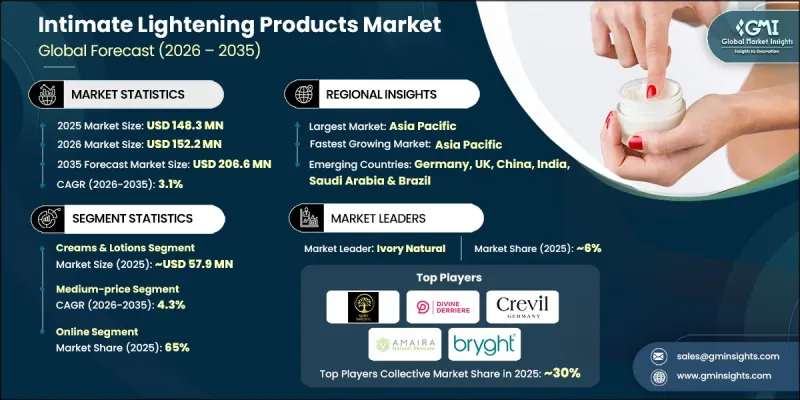
The industry is witnessing steady expansion as personal care routines increasingly incorporate intimate grooming as part of overall skincare and confidence-focused regimens. Consumer perception has shifted notably, with intimate lighting solutions transitioning from a niche category to a widely accepted segment within premium personal care. This change has been reinforced by greater visibility on digital platforms, increasing dermatological acceptance, and a stronger emphasis on intimate wellness and self-care awareness. As a result, these products are now positioned alongside mainstream skincare offerings, reflecting their integration into modern beauty standards.
| Market Scope | |
|---|---|
| Start Year | 2025 |
| Forecast Year | 2026-2035 |
| Start Value | $148.3 Million |
| Forecast Value | $206.6 Million |
| CAGR | 3.1% |
Market growth is further supported by continuous product innovation and the introduction of specialized formulations catering to sensitive skin requirements. Manufacturers are focusing on safer ingredients, improved efficacy, and dermatologically tested solutions to build trust and encourage repeat purchases. Rising urbanization, higher disposable incomes, and evolving beauty perceptions are also accelerating adoption, particularly in emerging economies where exposure to global skincare trends is increasing. The expansion of organized retail and e-commerce platforms has significantly improved accessibility, enabling consumers to explore a wider range of products with enhanced privacy and convenience. Additionally, growing emphasis on ingredient transparency and safety certifications is reshaping purchasing behavior, encouraging more informed decision-making. Together, these factors are creating a more structured and competitive market environment, where product quality, safety validation, and consumer education play a central role in shaping demand.
The creams and lotions segment generated USD 57.9 million in 2025 and is expected to grow at a CAGR of 3.4% from 2026 to 2035. This category continues to lead due to rising consumer preference for mild and effective formulations designed to address uneven skin tone and pigmentation concerns in sensitive areas. Demand is increasing for dermatologist-tested solutions enriched with naturally derived components that prioritize skin safety and comfort. Advances in formulation science, including improved delivery mechanisms and stabilization technologies, are enhancing product performance and absorption efficiency. In parallel, consumers are placing stronger emphasis on sustainability, prompting brands to adopt environmentally responsible packaging and more transparent ingredient sourcing practices, further strengthening the appeal of creams and lotions in this market.
The medium-price segment is projected to expand at a CAGR of 4.3% from 2026 to 2035. This segment is gaining momentum as consumers increasingly prefer products that offer a balance between affordability and higher-quality formulations. A growing middle-income population, particularly in developing regions, is fueling demand for mid-range solutions that deliver reliable performance without premium pricing. Frequent promotional activities across online retail channels are further stimulating adoption, while brands are actively enhancing formulation quality to align with evolving consumer expectations. This positioning between budget and luxury offerings has strengthened its appeal as a practical upgrade option, driving consistent growth across diverse consumer groups.
United States Intimate Lightening Products Market reached USD 24.9 million in 2025 and is expected to grow at a CAGR of 2.9% from 2026 to 2035. Market growth is supported by high consumer spending capacity and a strong preference for advanced personal care solutions that emphasize comfort, safety, and aesthetic enhancement. Intimate lightening products are increasingly viewed as part of broader wellness and self-care routines, contributing to their rising acceptance. Demand is also supported by the growing popularity of natural formulations, eco-conscious packaging, and clean-label product development. The expansion of online retail channels further strengthens accessibility, enabling discreet purchasing and wider product reach among health-conscious consumers.
Major players operating in the Global Intimate Lightening Products Market include Sesderma, Bushbalm, Musely, Crevil Cosmetics, Bryght, Pink Privates, DermalMD, Buddha Natural, WOO WOO, Amaira Natural Skincare, Gleamin, Ivory Natural, SlimSpaOnline, Divine Derriere, and Prana SpaCeuticals (Dermastart). Companies in the Intimate Lightening Products Market are focusing on strengthening their presence through advanced formulation innovation, clinical testing, and dermatological validation to build consumer trust. Strong emphasis is placed on ingredient transparency, safety certifications, and the use of gentle bioactive compounds suitable for sensitive skin. Brands are increasingly investing in research and development to create multifunctional products that combine lightening benefits with hydration and skin repair properties. Digital-first marketing strategies, influencer collaborations, and social media education campaigns are helping expand consumer awareness and normalize product usage. E-commerce optimization, discreet packaging, and subscription-based models are improving customer retention and repeat purchases. Additionally, companies are expanding their product portfolios to include diverse price points, enabling broader market penetration.
Table of Contents
Chapter 1 Research Methodology
- 1.1 Research approach
- 1.2 Quality Commitments
- 1.2.1 GMI AI policy & data integrity commitment
- 1.2.2 Source consistency protocol
- 1.3 Research Trail & Confidence Scoring
- 1.3.1 Research Trail Components
- 1.3.2 Scoring Components
- 1.4 Data Collection
- 1.4.1 Partial list of primary sources
- 1.5 Data mining sources
- 1.5.1 Paid sources
- 1.5.1.1 Sources, by region
- 1.5.1 Paid sources
- 1.6 Base estimates and calculations
- 1.6.1 Base year calculation for any one approach
- 1.7 Forecast model
- 1.7.1 Quantified market impact analysis
- 1.7.2 Mathematical impact of growth parameters on forecast
- 1.8 Research transparency addendum
- 1.8.1 Source attribution framework
- 1.8.2 Quality assurance metrics
- 1.8.3 Our commitment to trust
Chapter 2 Executive Summary
- 2.1 Industry 360° synopsis, 2022 - 2035
- 2.2 Key market trends
- 2.2.1 Regional
- 2.2.2 Product Type
- 2.2.3 Ingredients
- 2.2.4 Price
- 2.2.5 Age Group
- 2.2.6 Consumer Group
- 2.2.7 Distribution Channel
Chapter 3 Industry Insights
- 3.1 Industry ecosystem analysis
- 3.1.1 Factors affecting the value chain
- 3.1.2 Profit margin analysis
- 3.1.3 Disruptions
- 3.1.4 Future outlook
- 3.1.5 Manufacturers
- 3.1.6 Distributors
- 3.1.7 Retailers
- 3.2 Industry Impact forces
- 3.2.1 Growth drivers
- 3.2.1.1 Rising focus on aesthetic grooming & self-care
- 3.2.1.2 Growth of E-commerce & private purchasing
- 3.2.1.3 Shift toward "clean beauty" & natural ingredients
- 3.2.2 Industry pitfalls & challenges
- 3.2.2.1 Strict regulatory scrutiny & safety standards
- 3.2.2.2 High potential for skin sensitivity & irritation
- 3.2.3 Opportunities
- 3.2.3.1 Expanding intimate care hygiene
- 3.2.3.2 Dermatological & clinical endorsements
- 3.2.1 Growth drivers
- 3.3 Growth potential analysis
- 3.4 Regulatory landscape
- 3.5 Pricing analysis (Driven by Primary Research)
- 3.5.1 Historical Price Trend Analysis (Driven by Primary Research) (2022-2025)
- 3.5.2 Pricing Strategy by Player Type (Premium / Value / Cost-Plus) (Driven by Primary Research)
- 3.5.3 Price Elasticity Analysis by Consumer Segment
- 3.6 Major market trends and disruptions
- 3.7 Technological and innovation landscape
- 3.8 Patent Landscape (Driven by Primary Research)
- 3.8.1 Patent Filing Trends (2022-2025)
- 3.8.2 Key Patent Holders by IP Positioning
- 3.8.3 White Space Analysis for Innovation
- 3.9 Porter's analysis
- 3.10 PESTEL analysis
- 3.11 Trade Data Analysis (Driven by Paid Sources)
- 3.11.1 Import/Export Volume & Value Trend (Driven by Primary Research)
- 3.11.2 Key Trade Corridors & Tariff Impact (Driven by Primary Research)
- 3.11.3 Cross-Border E-Commerce Flows
- 3.12 Impact of AI & Generative AI on the Market
- 3.12.1 AI-Driven Disruption of Product Development & Personalization
- 3.12.2 GenAI Use Cases (Virtual Skin Tone Matching, Formulation Optimization, Customer Engagement)
- 3.12.3 Risks, Limitations & Regulatory Considerations
- 3.13 Distribution Infrastructure & Channel Penetration Landscape [SOLUTION CORE] (Driven by Primary Research)
- 3.13.1 Channel Coverage by Region & Format (Modern vs. Traditional Trade) [SOLUTION CORE] (Driven by Primary Research)
- 3.13.2 Last-Mile Infrastructure Gaps & Emerging Channel Shifts (D2C, Subscription Models) (Driven by Primary Research)
Chapter 4 Competitive Landscape, 2025
- 4.1 Introduction
- 4.2 Company market share analysis
- 4.2.1 By region
- 4.2.1.1 North America
- 4.2.1.2 Europe
- 4.2.1.3 Asia Pacific
- 4.2.1.4 Latin America
- 4.2.1.5 Middle East and Africa
- 4.2.1 By region
- 4.3 Company matrix analysis
- 4.4 Competitive analysis of major market players
- 4.5 Competitive positioning matrix
- 4.6 Key developments
- 4.6.1 Mergers & acquisitions
- 4.6.2 Partnerships & collaborations
- 4.6.3 New Product Launches
- 4.6.4 Expansion Plans
Chapter 5 Market Estimates & Forecast, By Product Type, 2022 - 2035, (USD Million) (Thousand Unit)
- 5.1 Key trends
- 5.2 Creams & lotions
- 5.3 Serums
- 5.4 Gels
- 5.5 Others (soaps, etc.)
Chapter 6 Market Estimates & Forecast, By Ingredients, 2022 - 2035, (USD Million) (Thousand Unit)
- 6.1 Key trends
- 6.2 Natural/organic
- 6.3 Chemical
Chapter 7 Market Estimates & Forecast, By Price, 2022 - 2035, (USD Million) (Thousand Unit)
- 7.1 Key trends
- 7.2 Low
- 7.3 Medium
- 7.4 High
Chapter 8 Market Estimates & Forecast, By Age Group, 2022 - 2035, (USD Million) (Thousand Unit)
- 8.1 Key trends
- 8.2 Below 20 Yrs
- 8.3 20-35 Yrs
- 8.4 35-50 Yrs
- 8.5 Above 50 Yrs
Chapter 9 Market Estimates & Forecast, By Consumer Group, 2022 - 2035, (USD Million) (Thousand Unit)
- 9.1 Key trends
- 9.2 Male
- 9.3 Female
Chapter 10 Market Estimates & Forecast, By Distribution Channel, 2022 - 2035, (USD Million) (Thousand Unit)
- 10.1 Key trends
- 10.2 Online
- 10.2.1 E-commerce
- 10.2.2 Company websites
- 10.3 Offline
- 10.3.1 Mega retail stores
- 10.3.2 Specialty stores
- 10.3.3 Pharmacies
- 10.3.4 Others (Individual stores, conventional stores, etc.)
Chapter 11 Market Estimates & Forecast, By Region, 2022 - 2035, (USD Million) (Million Units)
- 11.1 Key trends
- 11.2 North America
- 11.2.1 U.S.
- 11.2.2 Canada
- 11.3 Europe
- 11.3.1 Germany
- 11.3.2 UK
- 11.3.3 France
- 11.3.4 Italy
- 11.3.5 Spain
- 11.4 Asia Pacific
- 11.4.1 China
- 11.4.2 India
- 11.4.3 Japan
- 11.4.4 South Korea
- 11.4.5 Australia
- 11.5 Latin America
- 11.5.1 Brazil
- 11.5.2 Mexico
- 11.5.3 Argentina
- 11.6 MEA
- 11.6.1 Saudi Arabia
- 11.6.2 UAE
- 11.6.3 South Africa
Chapter 12 Company Profiles
- 12.1 Amaira Natural Skincare
- 12.2 Bryght
- 12.3 Buddha Natural
- 12.4 Bushbalm
- 12.5 Crevil Cosmetics
- 12.6 DermalMD
- 12.7 Divine Derriere
- 12.8 Gleamin
- 12.9 Ivory Natural
- 12.10 Musely
- 12.11 Pink Privates
- 12.12 Prana SpaCeuticals (Dermastart)
- 12.13 Sesderma
- 12.14 SlimSpaOnline
- 12.15 WOO WOO

