PUBLISHER: Global Market Insights Inc. | PRODUCT CODE: 2038425

PUBLISHER: Global Market Insights Inc. | PRODUCT CODE: 2038425
Cultured Buttermilk Market Opportunity, Growth Drivers, Industry Trend Analysis, and Forecast 2026 - 2035
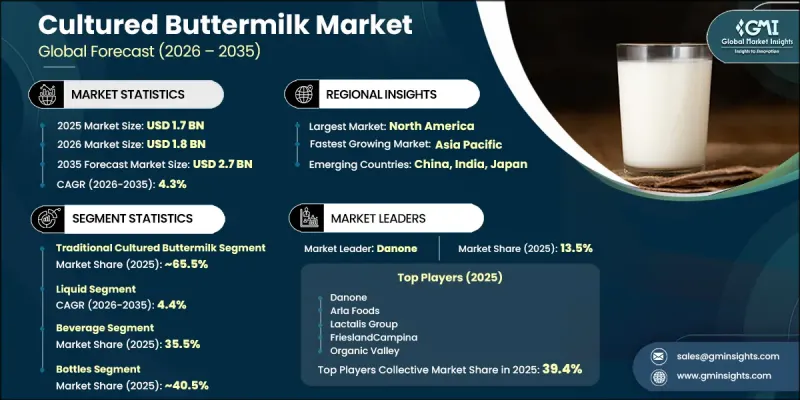
The Global Cultured Buttermilk Market was valued at USD 1.7 billion in 2025 and is estimated to grow at a CAGR of 4.3% to reach USD 2.7 billion by 2035.
The market is witnessing stable growth, driven by increasing consumer inclination toward natural, functional, and probiotic-rich dairy products. Rising awareness regarding digestive wellness and immune health has significantly contributed to the adoption of cultured buttermilk as part of daily dietary intake. Consumers are increasingly shifting toward products that offer both nutritional value and functional health benefits, supporting long-term market expansion. The demand for clean-label and minimally processed dairy products is further strengthening product acceptance across global markets. Additionally, the growing preference for versatile dairy ingredients used in both household cooking and commercial food applications is enhancing product utilization. The expansion of plant-based and lactose-free variants is also broadening the consumer base, catering to individuals with dietary restrictions. Overall, the market is evolving steadily, supported by health-driven consumption patterns, product innovation, and expanding application scope across food and beverage sectors.
| Market Scope | |
|---|---|
| Start Year | 2025 |
| Forecast Year | 2026-2035 |
| Start Value | $1.7 Billion |
| Forecast Value | $2.7 Billion |
| CAGR | 4.3% |
Cultured buttermilk is a fermented dairy product developed through controlled bacterial fermentation, resulting in a tangy flavor profile and a rich source of probiotics. It is widely recognized for its digestive health benefits, including support for gut microbiota balance and improved nutrient absorption. The product also provides essential nutrients such as calcium and vitamins, making it a functional addition to daily diets. Increasing consumer focus on preventive health and wellness has contributed to the growing popularity of probiotic-based dairy products. Its application extends beyond direct consumption, as it is commonly used in culinary preparations, including baking and cooking, which enhances its market relevance. The availability of dairy and non-dairy variants has further expanded its accessibility across diverse consumer groups.
The traditional cultured buttermilk segment accounted for a 65.5% share in 2025 and is expected to grow at a CAGR of 4.4% through 2035. This segment continues to dominate due to strong consumer preference for natural, unflavored dairy products with a long-standing presence in dietary habits. Its consistent demand is supported by familiarity, nutritional value, and widespread use in both household and foodservice applications. Traditional formulations remain a staple choice among consumers seeking authentic dairy experiences without added flavors or modifications.
The liquid segment held an 85.4% share in 2025 and is projected to grow at a CAGR of 4.4% during 2026 to 2035. Liquid cultured buttermilk remains the preferred format due to its ease of use, ready-to-consume nature, and versatility in food preparation. It is widely utilized in household kitchens, restaurants, and food processing applications. Its convenience aligns with modern lifestyles, where quick preparation and multipurpose use are key purchasing factors. The liquid form also supports seamless integration into various recipes, further strengthening its dominant market position.
North America Cultured Buttermilk Market accounted for 30.5% share in 2025. Growth in the region is supported by increasing consumer awareness regarding health, wellness, and probiotic-rich diets. Rising preference for functional dairy products has contributed to higher adoption rates across both traditional and flavored product categories. Busy urban lifestyles and demand for convenient nutritional options have further supported market expansion. The increasing focus on clean-label and organic dairy products has encouraged manufacturers to adopt minimal processing and natural production methods. Strong distribution networks and continuous product innovation are also contributing to sustained market growth across the region.
Key companies operating in the Global Cultured Buttermilk Market include Danone, Arla Foods, Lactalis Group, FrieslandCampina, Lifeway Foods, Stonyfield Organic, Organic Valley, Land O'Lakes, Muller Group, Maple Hill Creamery, Kalona SuperNatural, A2 Milk Company, Alexandre Family Farm, Butterworks Farm, and Straus Family Creamery. Companies in the Cultured Buttermilk Market are focusing on product innovation, clean-label positioning, and portfolio diversification to strengthen their market presence. Manufacturers are investing in research and development to enhance probiotic content and improve product functionality. Expansion into organic and plant-based variants is helping companies cater to evolving dietary preferences and widen their consumer base. Strengthening distribution networks across retail and foodservice channels is improving product accessibility. Strategic branding and marketing initiatives are being used to highlight health benefits and functional value. Companies are also focusing on sustainable sourcing and minimal processing techniques to align with clean-label demand.
Table of Contents
Chapter 1 Methodology & Scope
- 1.1 Market scope and definition
- 1.2 Research design
- 1.2.1 Research approach
- 1.2.2 Data collection methods
- 1.3 Data mining sources
- 1.3.1 Global
- 1.3.2 Regional/Country
- 1.4 Base estimates and calculations
- 1.4.1 Base year calculation
- 1.4.2 Key trends for market estimation
- 1.5 Primary research and validation
- 1.5.1 Primary sources
- 1.6 Forecast model
- 1.7 Research assumptions and limitations
Chapter 2 Executive Summary
- 2.1 Industry 360° synopsis
- 2.2 Key market trends
- 2.2.1 Regional
- 2.2.2 Type
- 2.2.3 Form
- 2.2.4 Application
- 2.2.5 Packaging type
- 2.2.6 Distribution channel
- 2.3 TAM Analysis, 2026-2035
- 2.4 CXO perspectives: Strategic imperatives
- 2.4.1 Executive decision points
Chapter 3 Industry Insights
- 3.1 Industry ecosystem analysis
- 3.1.1 Supplier landscape
- 3.1.2 Profit margin
- 3.1.3 Value addition at each stage
- 3.1.4 Factor affecting the value chain
- 3.1.5 Disruptions
- 3.2 Industry impact forces
- 3.2.1 Growth drivers
- 3.2.2 Industry pitfalls and challenges
- 3.2.3 Market opportunities
- 3.3 Growth potential analysis
- 3.4 Regulatory landscape
- 3.4.1 North America
- 3.4.2 Europe
- 3.4.3 Asia Pacific
- 3.4.4 Latin America
- 3.4.5 Middle East & Africa
- 3.5 Porter's analysis
- 3.6 PESTEL analysis
- 3.7 Price trends
- 3.7.1 By region
- 3.7.2 By type
- 3.8 Future market trends
- 3.9 Technology and Innovation landscape
- 3.9.1 Current technological trends
- 3.9.2 Emerging technologies
- 3.10 Patent Landscape
- 3.11 Trade statistics (HS code)
- 3.11.1 Major importing countries
- 3.11.2 Major exporting countries
- 3.12 Sustainability and environmental aspects
- 3.12.1 Sustainable practices
- 3.12.2 Waste reduction strategies
- 3.12.3 Energy efficiency in production
- 3.12.4 Eco-friendly initiatives
- 3.13 Carbon footprint consideration
Chapter 4 Competitive Landscape, 2025
- 4.1 Introduction
- 4.2 Company market share analysis
- 4.2.1 By region
- 4.2.1.1 North America
- 4.2.1.2 Europe
- 4.2.1.3 Asia Pacific
- 4.2.1.4 LATAM
- 4.2.1.5 MEA
- 4.2.1 By region
- 4.3 Company matrix analysis
- 4.4 Competitive analysis of major market players
- 4.5 Competitive positioning matrix
- 4.6 Key developments
- 4.6.1 Mergers & acquisitions
- 4.6.2 Partnerships & collaborations
- 4.6.3 New Product Launches
- 4.6.4 Expansion Plans
Chapter 5 Market Estimates and Forecast, By Type, 2022-2035 (USD Billion) (Kilo Tons)
- 5.1 Key trends
- 5.2 Traditional cultured buttermilk
- 5.3 Flavored cultured buttermilk
Chapter 6 Market Estimates and Forecast, By Form, 2022-2035 (USD Billion) (Kilo Tons)
- 6.1 Key trends
- 6.2 Liquid
- 6.3 Powder
Chapter 7 Market Estimates and Forecast, By Application, 2022-2035 (USD Billion) (Kilo Tons)
- 7.1 Key trends
- 7.2 Beverages
- 7.3 Bakery & confectionery
- 7.4 Dairy-based sauces and dressings
- 7.5 Snacks and savories
- 7.6 Others
Chapter 8 Market Estimates and Forecast, By Packaging Type, 2022-2035 (USD Billion) (Kilo Tons)
- 8.1 Key trends
- 8.2 Bottles
- 8.3 Cartons
- 8.4 Pouches
- 8.5 Others
Chapter 9 Market Estimates and Forecast, By Distribution Channel, 2022-2035 (USD Billion) (Kilo Tons)
- 9.1 Key trends
- 9.2 Offline retail
- 9.2.1 Supermarkets & hypermarkets
- 9.2.2 Convenience stores
- 9.2.3 Specialty stores
- 9.2.4 Others
- 9.3 Online retail
- 9.3.1 E-commerce platforms
- 9.3.2 Company websites
Chapter 10 Market Estimates and Forecast, By Region, 2022-2035 (USD Billion) (Kilo Tons)
- 10.1 Key trends
- 10.2 North America
- 10.2.1 U.S.
- 10.2.2 Canada
- 10.3 Europe
- 10.3.1 Germany
- 10.3.2 UK
- 10.3.3 France
- 10.3.4 Spain
- 10.3.5 Italy
- 10.3.6 Rest of Europe
- 10.4 Asia Pacific
- 10.4.1 China
- 10.4.2 India
- 10.4.3 Japan
- 10.4.4 Australia
- 10.4.5 South Korea
- 10.4.6 Rest of Asia Pacific
- 10.5 Latin America
- 10.5.1 Brazil
- 10.5.2 Mexico
- 10.5.3 Argentina
- 10.5.4 Rest of Latin America
- 10.6 Middle East and Africa
- 10.6.1 Saudi Arabia
- 10.6.2 South Africa
- 10.6.3 UAE
- 10.6.4 Rest of Middle East and Africa
Chapter 11 Company Profiles
- 11.1 A2 Milk Company
- 11.2 Alexandre Family Farm
- 11.3 Arla Foods
- 11.4 Butterworks Farm
- 11.5 Danone
- 11.6 FrieslandCampina
- 11.7 Kalona SuperNatural
- 11.8 Lactalis Group
- 11.9 Land O'Lakes
- 11.10 Lifeway Foods
- 11.11 Maple Hill Creamery
- 11.12 Muller Group
- 11.13 Organic Valley
- 11.14 Stonyfield Organic
- 11.15 Straus Family Creamery

