PUBLISHER: Global Market Insights Inc. | PRODUCT CODE: 2038429

PUBLISHER: Global Market Insights Inc. | PRODUCT CODE: 2038429
Slit Lamps Market Opportunity, Growth Drivers, Industry Trend Analysis, and Forecast 2026 - 2035
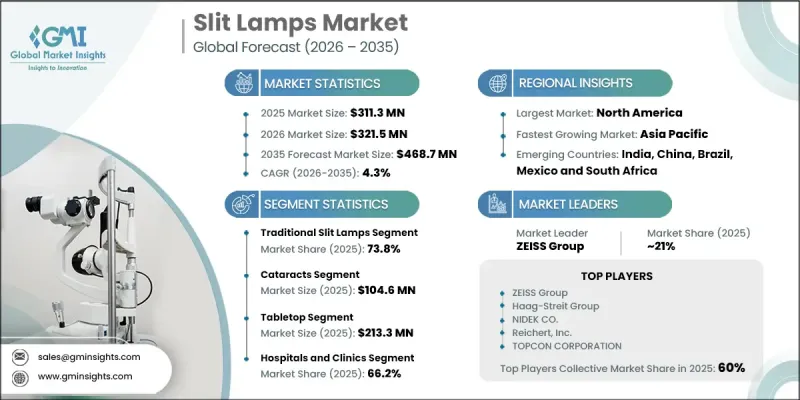
The Global Slit Lamps Market was valued at USD 311.3 million in 2025 and is estimated to grow at a CAGR of 4.3% to reach USD 468.7 million by 2035.
Market expansion is driven by the increasing prevalence of ocular disorders, a rising number of ophthalmic procedures, and continuous advancements in diagnostic ophthalmic equipment. Growing awareness of eye health and the importance of early diagnosis is further strengthening demand for slit lamps across healthcare settings. Expanding healthcare infrastructure, particularly in developing economies, along with the introduction of cost-efficient ophthalmic devices, is supporting broader market penetration. Preventive eye care is gaining significant attention as healthcare systems emphasize early detection of vision-related conditions. Slit lamps remain a core diagnostic tool in ophthalmology, enabling detailed examination of the eye's anterior segment and supporting timely clinical intervention. Technological advancements are also playing a key role in market development, with modern systems incorporating high-resolution imaging, LED-based illumination, digital capture capabilities, and software connectivity. These innovations enhance diagnostic precision, improve workflow efficiency, and allow seamless integration with electronic health record systems, ultimately supporting better patient management and long-term monitoring.
| Market Scope | |
|---|---|
| Start Year | 2025 |
| Forecast Year | 2026-2035 |
| Start Value | $311.3 Million |
| Forecast Value | $468.7 Million |
| CAGR | 4.3% |
The traditional slit lamps segment accounted for 73.8% share in 2025. Its growth is supported by increasing expansion of ophthalmology clinics and hospital-based eye care services. Traditional slit lamps remain widely adopted due to their high diagnostic accuracy, reliability, and established clinical utility in eye examinations. Their optical configuration, including binocular stereoscopic viewing and adjustable illumination systems, allows precise evaluation of ocular structures. These systems continue to be aligned with established clinical guidelines and examination protocols, maintaining their relevance in routine ophthalmic diagnostics.
The cataracts segment generated USD 104.6 million in 2025. Cataracts remain one of the most common causes of vision impairment and blindness globally, particularly affecting aging populations. The high prevalence of this condition is driving consistent demand for slit lamps, as they are essential for diagnosing and monitoring cataract progression through detailed examination of the eye lens and anterior segment. Increasing life expectancy is contributing to a larger elderly population, further elevating the incidence of cataract-related eye conditions. As a result, routine eye screening and early diagnosis are becoming increasingly important, supporting sustained utilization of slit lamp systems in ophthalmic care.
U.S. Slit Lamps Market was valued at USD 107.7 million in 2025. Market growth in the country is supported by the rising prevalence of diabetes-related ocular disorders and increasing investments in eye care-focused startups. The region benefits from strong healthcare innovation capabilities, which is driving the adoption of advanced slit lamp systems integrated with digital imaging technologies and enhanced diagnostic features. Healthcare providers are increasingly adopting modern ophthalmic equipment to improve diagnostic precision and patient outcomes. Growing emphasis on preventive eye care and routine screening programs is further contributing to market expansion across the United States.
Key companies operating in the Global Slit Lamps Market include ZEISS Group, Haag-Streit Group, TOPCON CORPORATION, NIDEK CO., Reichert, Inc., HEINE Optotechnik GmbH, Keeler, Kowa American Corporation, Visionix, Rexxam Co., Coburn Technologies, and 66 Vision Tech Co. Companies in the Slit Lamps Market are focusing on technological innovation, product upgrades, and strategic collaborations to strengthen their market position. Continuous investment in research and development is enabling the integration of advanced imaging systems, improved optical performance, and digital connectivity features. Manufacturers are increasingly incorporating automation and software-based diagnostic tools to enhance clinical efficiency and accuracy. Strategic partnerships with hospitals, ophthalmic clinics, and research institutions are supporting wider product adoption and market expansion. Firms are also prioritizing product affordability and compact design to increase accessibility across emerging markets. Additionally, expansion of distribution networks and after-sales service capabilities is helping companies strengthen customer retention and brand presence in the global ophthalmic equipment landscape.
Table of Contents
Chapter 1 Research Methodology
- 1.1 Research approach
- 1.2 Quality commitments
- 1.2.1 GMI AI policy & data integrity commitment
- 1.2.1.1 Source consistency protocol
- 1.2.1 GMI AI policy & data integrity commitment
- 1.3 Research trail & confidence scoring
- 1.3.1 Research trail components
- 1.3.2 Scoring components
- 1.4 Data collection
- 1.4.1 Partial list of primary sources
- 1.5 Data mining sources
- 1.5.1 Paid sources
- 1.5.1.1 Sources, by region
- 1.5.1 Paid sources
- 1.6 Base estimates and calculations
- 1.6.1 Base year calculation
- 1.7 Forecast model
- 1.7.1 Quantified market impact analysis
- 1.7.1.1 Mathematical impact of growth parameters on forecast
- 1.7.1 Quantified market impact analysis
- 1.8 Research transparency addendum
- 1.8.1 Source attribution framework
- 1.8.2 Quality assurance metrics
- 1.8.3 Our commitment to trust
Chapter 2 Executive Summary
- 2.1 Industry 360° synopsis
- 2.2 Key market trends
- 2.2.1 Regional trends
- 2.2.2 Product trends
- 2.2.3 Indication trends
- 2.2.4 Modality trends
- 2.2.5 End use trends
- 2.3 CXO perspectives: Strategic imperatives
Chapter 3 Industry Insights
- 3.1 Industry ecosystem analysis
- 3.2 Industry impact forces
- 3.2.1 Growth drivers
- 3.2.1.1 Increasing prevalence of eye disorders
- 3.2.1.2 Growing awareness and demand for ophthalmic care
- 3.2.1.3 Rise in number of ophthalmic surgeries
- 3.2.1.4 Technological advancements in slit lamps
- 3.2.2 Industry pitfalls and challenges
- 3.2.2.1 High cost of advanced systems
- 3.2.2.2 Limited access to eye care services in under-developed nations
- 3.2.3 Opportunities
- 3.2.3.1 Growth of portable and handheld slit lamps
- 3.2.3.2 Integration with artificial intelligence diagnostics
- 3.2.1 Growth drivers
- 3.3 Growth potential analysis
- 3.4 Regulatory landscape (Driven by Primary Research)
- 3.4.1 North America
- 3.4.2 Europe
- 3.4.3 Asia Pacific
- 3.4.4 Latin America
- 3.4.5 Middle East and Africa
- 3.5 Technology and innovation landscape
- 3.5.1 Current technological trends
- 3.5.2 Emerging technologies
- 3.6 Future market trends (Driven by Primary Research)
- 3.7 Impact of AI & generative AI on the market (Driven by Primary Research)
- 3.8 Pricing analysis, 2025 (Driven by Primary Research)
- 3.9 Gap analysis
- 3.10 Porter's analysis
- 3.11 PESTEL analysis
Chapter 4 Competitive Landscape, 2025
- 4.1 Introduction
- 4.2 Company matrix analysis
- 4.3 Company market share analysis (Driven by Primary Research)
- 4.3.1 Global
- 4.3.2 North America
- 4.3.3 Europe
- 4.3.4 Asia Pacific
- 4.4 Competitive analysis of major market players
- 4.5 Competitive positioning matrix
- 4.6 Key developments
- 4.6.1 Mergers & acquisitions
- 4.6.2 Partnerships & collaborations
- 4.6.3 New product launches
- 4.6.4 Expansion plans
Chapter 5 Market Estimates and Forecast, By Product, 2022 - 2035 ($ Mn)
- 5.1 Key trends
- 5.2 Traditional slit lamps
- 5.3 Digital slit lamps
Chapter 6 Market Estimates and Forecast, By Indication, 2022 - 2035 ($ Mn)
- 6.1 Key trends
- 6.2 Cataracts
- 6.3 Glaucoma
- 6.4 Conjunctivitis
- 6.5 Dry eye syndrome
- 6.6 Other indications
Chapter 7 Market Estimates and Forecast, By Modality, 2022 - 2035 ($ Mn)
- 7.1 Key trends
- 7.2 Tabletop
- 7.3 Portable/handheld
Chapter 8 Market Estimates and Forecast, By End Use, 2022 - 2035 ($ Mn)
- 8.1 Key trends
- 8.2 Hospitals and clinics
- 8.3 Ambulatory surgical centers
- 8.4 Other end-users
Chapter 9 Market Estimates and Forecast, By Region, 2022 - 2035 ($ Mn)
- 9.1 Key trends
- 9.2 North America
- 9.2.1 U.S.
- 9.2.2 Canada
- 9.3 Europe
- 9.3.1 Germany
- 9.3.2 UK
- 9.3.3 France
- 9.3.4 Spain
- 9.3.5 Italy
- 9.3.6 Netherlands
- 9.4 Asia Pacific
- 9.4.1 China
- 9.4.2 Japan
- 9.4.3 India
- 9.4.4 Australia
- 9.4.5 South Korea
- 9.5 Latin America
- 9.5.1 Brazil
- 9.5.2 Mexico
- 9.5.3 Argentina
- 9.6 Middle East and Africa
- 9.6.1 South Africa
- 9.6.2 Saudi Arabia
- 9.6.3 UAE
Chapter 10 Company Profiles
- 10.1 66 Vision Tech Co.
- 10.2 Coburn Technologies
- 10.3 Haag-Streit Group
- 10.4 HEINE Optotechnik GmbH
- 10.5 Keeler
- 10.6 Kowa American Corporation
- 10.7 NIDEK CO.
- 10.8 Reichert, Inc.
- 10.9 Rexxam Co.
- 10.10 TOPCON CORPORATION
- 10.11 Visionix
- 10.12 ZEISS Group

