PUBLISHER: Global Market Insights Inc. | PRODUCT CODE: 2038430

PUBLISHER: Global Market Insights Inc. | PRODUCT CODE: 2038430
Automatic Coffee Machine Market Opportunity, Growth Drivers, Industry Trend Analysis, and Forecast 2026 - 2035
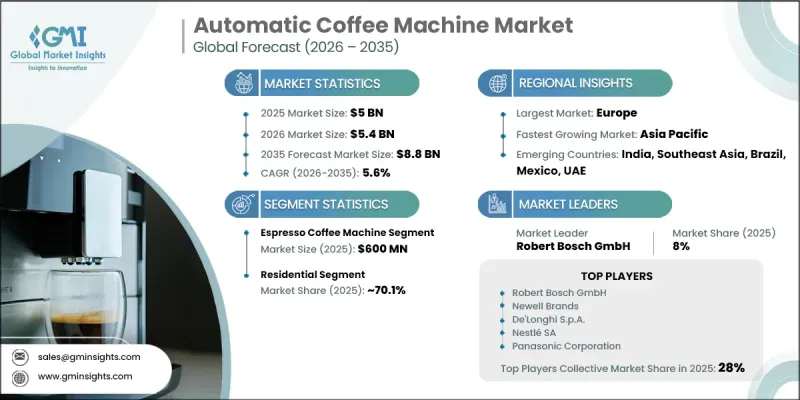
The Global Automatic Coffee Machine Market was valued at USD 5 billion in 2025 and is estimated to grow at a CAGR of 5.6% to reach USD 8.8 billion by 2035.
The market is experiencing steady growth as coffee consumption continues to rise globally, reinforcing its position as a daily essential across both developed and emerging economies. This sustained consumption trend is encouraging wider adoption of automatic coffee machines among households and commercial users who prioritize consistency, speed, and brewing precision. Coffee is increasingly being viewed as a personalized lifestyle product rather than a simple beverage, which is strengthening demand for automated brewing systems that deliver cafe-like quality at home or in workplaces.
| Market Scope | |
|---|---|
| Start Year | 2025 |
| Forecast Year | 2026-2035 |
| Start Value | $5 Billion |
| Forecast Value | $8.8 Billion |
| CAGR | 5.6% |
The growing preference for convenience-oriented appliances is further accelerating market expansion, as consumers seek solutions that simplify preparation while maintaining premium taste standards. Automatic coffee machines are gaining traction due to their ability to streamline brewing through advanced features such as programmable functions, integrated grinders, automated milk frothing systems, and self-cleaning technologies. These capabilities allow users to prepare a wide range of coffee styles with minimal effort, aligning with fast-paced urban lifestyles where time efficiency is essential. Rising interest in premium coffee experiences, along with increasing exposure to global coffee culture through digital platforms, is also contributing to stronger demand. In addition, evolving consumer expectations around consistency, hygiene, and customization are pushing manufacturers to innovate continuously, thereby expanding product penetration across both residential and commercial segments.
In 2025, the espresso coffee machines segment accounted for USD 600 million. This segment appeals strongly to consumers who prioritize rich flavor profiles, brewing precision, and a more refined coffee experience. Unlike basic brewing systems, automatic espresso machines are associated with a more premium and immersive approach to coffee preparation, attracting users who value craftsmanship and consistency. These consumers often view such machines as long-term lifestyle investments rather than simple kitchen appliances, as they enable cafe-quality beverages to be prepared conveniently at home without requiring professional expertise. The growing interest in specialty coffee culture and high-quality brewing methods continues to support demand for this segment.
The residential segment held a 70.1% share in 2025. Household consumption remains the primary driver of demand, spanning a wide range of users from casual drinkers to dedicated coffee enthusiasts. Growth in this segment is supported by evolving lifestyle patterns, increasing urban household formation, and rising replacement cycles for older appliances. Additionally, greater exposure to global coffee trends and the shift toward premium in-home beverage experiences are strengthening residential adoption. Within households, consumers increasingly prefer machines that combine ease of use with modern design, compact structure, and reliable performance, ensuring seamless integration into daily routines.
Europe Automatic Coffee Machine Market held 35% share in 2025 and is projected to grow at a CAGR of 5.5% during 2026-2035. The region represents one of the most established and mature markets for automatic coffee machines, shaped by long-standing coffee traditions and a strong preference for espresso-based beverages. Coffee consumption in Europe is deeply embedded in daily lifestyle habits, influencing high expectations for quality, durability, and performance in coffee equipment. Consumers in the region evaluate automatic coffee machines not only on convenience but also on their ability to consistently replicate authentic cafe-style beverages, including flavor intensity and texture precision. This strong cultural connection to coffee continues to support sustained demand across both residential and commercial applications.
The key companies operating in the Global Automatic Coffee Machine Market include Nestle Nespresso S.A., De'Longhi Group, Philips Domestic Appliances, Jura Elektroapparate AG, Panasonic Corporation, BSH Hausgerate GmbH, Breville Group Limited, Melitta Group, Miele & Cie. KG, Electrolux AB, Hamilton Beach Brands, Inc., Keurig Dr Pepper Inc., Morphy Richards, Newell Brands, and SMEG S.p.A. Market participants are actively focusing on product innovation by integrating smart technologies such as app-based controls, AI-driven brewing customization, and energy-efficient systems to enhance user experience. Companies are also expanding their premium product portfolios to cater to evolving consumer preferences for high-end coffee experiences at home and in offices. Strategic partnerships with retail chains and online platforms are being strengthened to improve distribution reach and brand visibility. In addition, manufacturers are investing in design innovation, sustainability-focused materials, and compact machine formats to attract urban consumers with space constraints. Continuous upgrades in automation features, self-cleaning mechanisms, and multi-beverage capabilities are further helping companies differentiate their offerings and strengthen long-term customer loyalty in a highly competitive market landscape.
Table of Contents
Chapter 1 Methodology and Scope
- 1.1 Market scope and definition
- 1.2 Research design
- 1.2.1 Research approach
- 1.2.2 Data collection methods
- 1.3 Data mining sources
- 1.3.1 Global
- 1.3.2 Regional/Country
- 1.4 Base estimates and calculations
- 1.4.1 Base year calculation
- 1.4.2 Key trends for market estimation
- 1.5 Primary research and validation
- 1.5.1 Primary sources
- 1.6 Forecast model
- 1.7 Research assumptions and limitations
Chapter 2 Executive Summary
- 2.1 Industry 360° synopsis
- 2.2 Key market trends
- 2.2.1 Regional
- 2.2.2 Product type
- 2.2.3 Capacity/cup size
- 2.2.4 Price range
- 2.2.5 End-use application
- 2.2.6 Distribution channel
Chapter 3 Industry Insights
- 3.1 Industry ecosystem analysis
- 3.1.1 Supplier landscape
- 3.1.2 Profit margin
- 3.1.3 Value addition at each stage
- 3.1.4 Factor affecting the value chain
- 3.2 Industry impact forces
- 3.2.1 Growth drivers
- 3.2.1.1 Rising global coffee consumption & coffee culture expansion
- 3.2.1.2 Growing demand for convenience & time-saving solutions
- 3.2.1.3 Increasing consumer disposable incomes in emerging markets
- 3.2.2 Industry pitfalls & challenges
- 3.2.2.1 High initial investment & acquisition costs
- 3.2.2.2 Maintenance, repair & servicing expenses
- 3.2.3 Opportunities
- 3.2.3.1 Untapped potential in Asia Pacific & Latin America
- 3.2.3.2 Subscription-based models (coffee beans + machine rental)
- 3.2.1 Growth drivers
- 3.3 Growth potential analysis
- 3.4 Future market trends
- 3.5 Technology and innovation landscape
- 3.5.1 Current technological trends
- 3.5.2 Emerging technologies
- 3.6 Pricing analysis (driven by primary research)
- 3.6.1 Pricing Strategy by player type (premium/mid-range/budget) (driven by primary research)
- 3.6.2 Regional price variation analysis
- 3.6.3 Feature-to-price correlation
- 3.7 Regulatory framework
- 3.8 Porter's analysis
- 3.9 PESTEL analysis
- 3.10 Impact of AI & generative AI on the market
- 3.10.1 AI-driven personalization & beverage customization
- 3.10.2 GenAI use cases (predictive maintenance, user preference learning)
- 3.10.3 Smart home integration & voice assistant compatibility
- 3.10.4 Risks, limitations & data privacy considerations
- 3.11 Consumer buying behavior analysis
- 3.11.1 Purchasing patterns
- 3.11.2 Preference analysis
- 3.11.3 Regional variations in consumer behavior
- 3.11.4 Impact of e-commerce on buying decisions
Chapter 4 Competitive Landscape, 2025
- 4.1 Introduction
- 4.2 Company market share analysis
- 4.2.1 By region
- 4.2.1.1 North America
- 4.2.1.2 Europe
- 4.2.1.3 Asia Pacific
- 4.2.1.4 Latin America
- 4.2.1.5 Middle East and Africa
- 4.2.1 By region
- 4.3 Competitive analysis of major market players
- 4.4 Competitive positioning matrix
- 4.5 Key developments
- 4.5.1 Mergers & acquisitions
- 4.5.2 Partnerships & collaborations
- 4.5.3 New product launches
- 4.5.4 Expansion plans
Chapter 5 Market Estimates and Forecast, By Product Type, 2022 - 2035 (USD Billion) (Thousand Units)
- 5.1 Key trends
- 5.2 Drip filter coffee machine
- 5.2.1 Single-serve drip machines
- 5.2.2 Multi-cup drip machines
- 5.2.3 Programmable drip machines
- 5.3 Espresso coffee machine
- 5.4 Bean-to-cup machine
- 5.5 Capsule/pod-compatible automatic machine
Chapter 6 Market Estimates and Forecast, By Capacity/Cup Size, 2022 - 2035 (USD Billion) (Thousand Units)
- 6.1 Key trends
- 6.2 ≤50 cups
- 6.3 51-100 cups
- 6.4 101-200 cups
- 6.5 201-350 cups
- 6.6 >350 cups
Chapter 7 Market Estimates and Forecast, By Price, 2022 - 2035 (USD Billion) (Thousand Units)
- 7.1 Key trends
- 7.2 Budget/Economy (<$200)
- 7.3 Mid-range ($200-$800)
- 7.4 Premium (>$800)
Chapter 8 Market Estimates and Forecast, By End-Use Application, 2022 - 2035 (USD Billion) (Thousand Units)
- 8.1 Key trends
- 8.2 Residential
- 8.3 Commercial
- 8.3.1 Cafes & coffee shops
- 8.3.2 Restaurants & hotels
- 8.3.3 Offices & corporate workplaces
- 8.3.4 Retail outlets
- 8.3.5 Healthcare facilities
- 8.3.6 Others (educational institutions, co-working spaces)
Chapter 9 Market Estimates and Forecast, By Distribution Channel, 2022 - 2035 (USD Billion) (Thousand Units)
- 9.1 Key trends
- 9.2 Online
- 9.2.1 E-commerce
- 9.2.2 Company websites
- 9.3 Offline
- 9.3.1 Supermarkets & hypermarkets
- 9.3.2 Specialty appliance stores
- 9.3.3 Others
Chapter 10 Market Estimates and Forecast, By Region, 2022 - 2035 (USD Billion) (Thousand Units)
- 10.1 Key trends
- 10.2 North America
- 10.2.1 U.S.
- 10.2.2 Canada
- 10.3 Europe
- 10.3.1 Germany
- 10.3.2 UK
- 10.3.3 France
- 10.3.4 Italy
- 10.3.5 Spain
- 10.4 Asia Pacific
- 10.4.1 China
- 10.4.2 Japan
- 10.4.3 India
- 10.4.4 Australia
- 10.4.5 South Korea
- 10.5 Latin America
- 10.5.1 Brazil
- 10.5.2 Mexico
- 10.5.3 Argentina
- 10.6 Middle East and Africa
- 10.6.1 South Africa
- 10.6.2 Saudi Arabia
- 10.6.3 UAE
Chapter 11 Company Profiles
- 11.1 Breville Group Limited
- 11.2 BSH Hausgerate GmbH
- 11.3 De'Longhi Group
- 11.4 Electrolux AB
- 11.5 Hamilton Beach Brands, Inc.
- 11.6 Jura Elektroapparate AG
- 11.7 Keurig Dr Pepper Inc.
- 11.8 Melitta Group
- 11.9 Miele & Cie. KG
- 11.10 Morphy Richards
- 11.11 Nestle Nespresso S.A.
- 11.12 Newell Brands
- 11.13 Panasonic Corporation
- 11.14 Philips Domestic Appliances
- 11.15 SMEG S.p.A.

