PUBLISHER: Global Market Insights Inc. | PRODUCT CODE: 2038441

PUBLISHER: Global Market Insights Inc. | PRODUCT CODE: 2038441
Aluminum Market Opportunity, Growth Drivers, Industry Trend Analysis, and Forecast 2026 - 2035
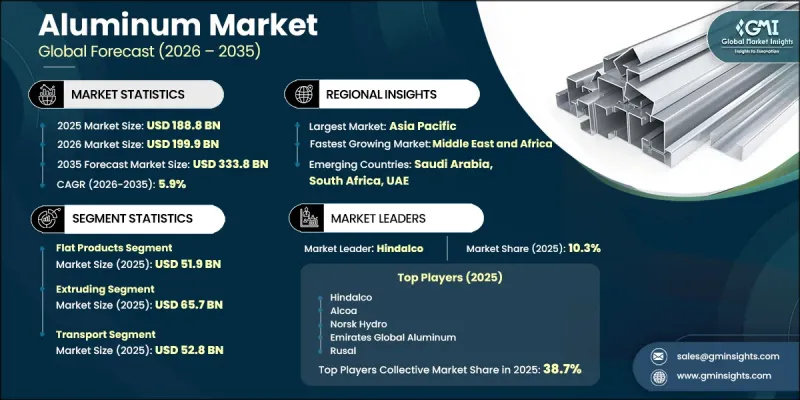
The Global Aluminum Market was valued at USD 188.8 billion in 2025 and is estimated to grow at a CAGR of 5.9% to reach USD 333.8 billion by 2035.
The industry covers the full value chain, including extraction, refining, processing, and distribution of aluminum products used across diverse end-use sectors. Aluminum continues to gain strong relevance due to its lightweight nature, corrosion resistance, high electrical conductivity, and excellent formability, making it suitable for a wide range of industrial applications. It is widely used in construction, transportation, packaging, electrical systems, and heavy industrial operations, supporting both structural and functional requirements. The market is segmented into primary aluminum derived from bauxite and secondary aluminum produced through recycling streams, both contributing significantly to supply stability. Its long lifecycle and recyclability strengthen its role in modern manufacturing ecosystems where efficiency and sustainability are key priorities. Growing focus on reducing material weight while maintaining strength has further accelerated its adoption across industries. Ongoing technological advancements in aluminum production are primarily aimed at improving energy efficiency, optimizing manufacturing processes, and enhancing overall material performance across applications.
| Market Scope | |
|---|---|
| Start Year | 2025 |
| Forecast Year | 2026-2035 |
| Start Value | $188.8 Billion |
| Forecast Value | $333.8 Billion |
| CAGR | 5.9% |
The flat products segment accounted for USD 51.9 billion in 2025, supported by their extensive use across packaging, construction, and transportation applications where surface finish quality and formability are critical. Demand for these products remains strong due to their adaptability in multiple industrial processes.
The extruded aluminum segment reached USD 65.7 billion in 2025, driven by its ability to produce customized structural profiles used across automotive, construction, and electrical applications. Rolling processes are widely utilized to manufacture sheets and plates, while extrusion supports complex shapes used in engineering and industrial designs. Casting processes are essential for producing durable aluminum components used in machinery and automotive systems, whereas drawing processes support the production of precision tubing and related components. Forged aluminum products are also widely used in applications requiring high strength and reliability across transportation and heavy-duty industrial environments.
North America Aluminum Market is projected to grow from USD 32.6 billion in 2025 to USD 60.1 billion by 2035, supported by steady demand across transportation, construction, packaging, recycling, and power infrastructure development. The region continues to prioritize sustainable materials and efficient manufacturing practices, contributing to stable aluminum consumption patterns. In the United States, demand is strongly influenced by vehicle lightweighting initiatives, beverage packaging requirements, infrastructure modernization, renewable energy integration, and expanding recycling systems, all of which reinforce aluminum's importance across industrial, commercial, and consumer sectors.
Major players operating in the Global Aluminum Industry are Alcoa, Norsk Hydro, Hindalco Industries Ltd., Emirates Global Aluminum, Rusal, Arconic, JW Aluminium, Logan Aluminium, INALCO Private Limited, Hongqiao Group, Hangzhou Century Aluminium, Zhongxiang Steel Group CO.,LTD. Companies in the Aluminum Market are increasingly focusing on strengthening their production efficiency through advanced smelting technologies and energy-optimized manufacturing systems. Strategic investments in recycling infrastructure are being prioritized to enhance secondary aluminum output and support circular economy goals. Many players are expanding downstream capabilities by developing value-added products tailored for automotive, construction, and packaging industries. Partnerships and long-term supply agreements are being used to stabilize raw material sourcing and ensure consistent demand fulfillment. Digitalization of operations, including smart monitoring and process automation, is improving yield efficiency and reducing operational costs. Firms are also expanding geographically through capacity additions and joint ventures in high-demand regions. Sustainability initiatives, including carbon reduction programs and renewable energy integration in production facilities, are becoming central to competitive positioning.
Table of Contents
Chapter 1 Methodology & Scope
- 1.1 Market scope and definition
- 1.2 Research design
- 1.2.1 Research approach
- 1.2.2 Data collection methods
- 1.3 Data mining sources
- 1.3.1 Global
- 1.3.2 Regional/Country
- 1.4 Base estimates and calculations
- 1.4.1 Base year calculation
- 1.4.2 Key trends for market estimation
- 1.5 Primary research and validation
- 1.5.1 Primary sources
- 1.6 Forecast model
- 1.7 Research assumptions and limitations
Chapter 2 Executive Summary
- 2.1 Industry 360° synopsis
- 2.2 Key market trends
- 2.2.1 Product
- 2.2.2 Processing Method
- 2.2.3 Application
- 2.2.4 Regional
- 2.3 TAM Analysis, 2026-2035
- 2.4 CXO perspectives: Strategic imperatives
- 2.5 Future outlook and strategic recommendations
Chapter 3 Industry Insights
- 3.1 Industry ecosystem analysis
- 3.1.1 Supplier landscape
- 3.1.2 Profit margin
- 3.1.3 Value addition at each stage
- 3.1.4 Factor affecting the value chain
- 3.1.5 Disruptions
- 3.2 Industry impact forces
- 3.2.1 Growth drivers
- 3.2.1.1 Lightweight material demand across transportation sectors
- 3.2.1.2 Infrastructure expansion and urban construction activity
- 3.2.1.3 Increased focus on recyclable packaging materials
- 3.2.2 Pitfalls/challenge
- 3.2.2.1 High energy consumption in primary production
- 3.2.2.2 Volatile raw material and electricity prices
- 3.2.3 Opportunities
- 3.2.3.1 Growing secondary aluminum production and recycling
- 3.2.3.2 Electric vehicle manufacturing supporting aluminum usage
- 3.2.1 Growth drivers
- 3.3 Growth potential analysis
- 3.4 Regulatory landscape
- 3.4.1 North America
- 3.4.2 Europe
- 3.4.3 Asia Pacific
- 3.4.4 Latin America
- 3.4.5 Middle East & Africa
- 3.5 Porter's analysis
- 3.6 PESTEL analysis
- 3.7 Technology and innovation landscape
- 3.7.1 Current technological trends
- 3.7.2 Emerging technologies
- 3.8 Price trends
- 3.8.1 By region
- 3.8.2 By product
- 3.9 Future market trends
- 3.10 Technology and innovation landscape
- 3.10.1 Current technological trends
- 3.10.2 Emerging technologies
- 3.11 Patent landscape
- 3.12 Trade statistics (HS code)
- 3.12.1 Major importing countries
- 3.12.2 Major exporting countries
- 3.13 Sustainability and environmental aspects
- 3.13.1 Sustainable practices
- 3.13.2 Waste reduction strategies
- 3.13.3 Energy efficiency in production
- 3.13.4 Eco-friendly initiatives
- 3.14 Carbon footprint consideration
Chapter 4 Competitive Landscape, 2025
- 4.1 Introduction
- 4.2 Company market share analysis
- 4.2.1 By region
- 4.2.1.1 North America
- 4.2.1.2 Europe
- 4.2.1.3 Asia Pacific
- 4.2.1.4 LATAM
- 4.2.1.5 MEA
- 4.2.1 By region
- 4.3 Company matrix analysis
- 4.4 Competitive analysis of major market players
- 4.5 Competitive positioning matrix
- 4.6 Key developments
- 4.6.1 Mergers & acquisitions
- 4.6.2 Partnerships & collaborations
- 4.6.3 New product launches
- 4.6.4 Expansion plans
Chapter 5 Market Estimates and Forecast, By Product, 2022-2035 (USD Billion) (Kilo Tons)
- 5.1 Key trends
- 5.2 Flat products
- 5.3 Extruded products
- 5.4 Forged products
- 5.5 Long products
- 5.6 Cast products
- 5.7 Others
Chapter 6 Market Estimates and Forecast, By Processing Method, 2022-2035 (USD Billion) (Kilo Tons)
- 6.1 Key trends
- 6.2 Rolling
- 6.3 Extruding
- 6.4 Drawn
- 6.5 Casting
- 6.6 Forging
Chapter 7 Market Estimates and Forecast, By Application, 2022-2035 (USD Billion) (Kilo Tons)
- 7.1 Key trends
- 7.2 Transport
- 7.3 Construction
- 7.4 Electrical & electronics
- 7.5 Packaging
- 7.6 Equipment & machinery
- 7.7 Consumer durables
- 7.8 Foil stock
- 7.9 Others
Chapter 8 Market Estimates and Forecast, By Region, 2022-2035 (USD Billion) (Kilo Tons)
- 8.1 Key trends
- 8.2 North America
- 8.2.1 U.S.
- 8.2.2 Canada
- 8.3 Europe
- 8.3.1 Germany
- 8.3.2 UK
- 8.3.3 France
- 8.3.4 Spain
- 8.3.5 Italy
- 8.3.6 Rest of Europe
- 8.4 Asia Pacific
- 8.4.1 China
- 8.4.2 India
- 8.4.3 Japan
- 8.4.4 Australia
- 8.4.5 South Korea
- 8.4.6 Rest of Asia Pacific
- 8.5 Latin America
- 8.5.1 Brazil
- 8.5.2 Mexico
- 8.5.3 Argentina
- 8.5.4 Rest of Latin America
- 8.6 Middle East and Africa
- 8.6.1 Saudi Arabia
- 8.6.2 South Africa
- 8.6.3 UAE
- 8.6.4 Rest of Middle East and Africa
Chapter 9 Company Profiles
- 9.1 Alcoa
- 9.2 Zhongxiang Steel Group CO., LTD
- 9.3 Arconic
- 9.4 Emirates Global Aluminum
- 9.5 Hangzhou Century Aluminium
- 9.6 Hindalco Industries Ltd.
- 9.7 Hongqiao Group
- 9.8 JW Aluminium
- 9.9 Logan Aluminium
- 9.10 Norsk Hydro
- 9.11 Rusal
- 9.12 INALCO Private Limited

