PUBLISHER: Global Market Insights Inc. | PRODUCT CODE: 2038446

PUBLISHER: Global Market Insights Inc. | PRODUCT CODE: 2038446
Tobacco Products Market Opportunity, Growth Drivers, Industry Trend Analysis, and Forecast 2026 - 2035
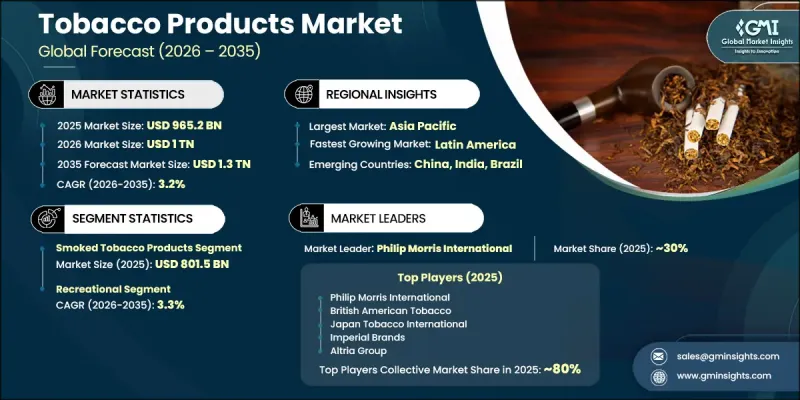
The Global Tobacco Products Market was valued at USD 965.2 billion in 2025 and is estimated to grow at a CAGR of 3.2% to reach USD 1.3 trillion by 2035.
The industry is experiencing a period of transition as companies adjust their portfolios to include both conventional tobacco offerings and emerging alternatives. Despite increasing regulatory scrutiny and a growing shift toward health-conscious consumption patterns, the market continues to demonstrate stability through diversification strategies and innovation. Manufacturers are actively investing in research and development to introduce next-generation nicotine delivery solutions, while also strengthening their premium product lines. Competitive dynamics are shaped by global players focusing on innovation, brand positioning, and geographic expansion. In mature markets, where smoking rates are declining and regulations are stringent, companies are prioritizing value-driven growth over volume expansion. Meanwhile, the Asia Pacific region maintains a leading position due to strong consumer demand, population scale, and relatively flexible regulatory conditions. The increasing focus on reduced-risk products is enabling companies to reposition themselves and capture new growth opportunities across both developed and emerging markets.
| Market Scope | |
|---|---|
| Start Year | 2025 |
| Forecast Year | 2026-2035 |
| Start Value | $965.2 Billion |
| Forecast Value | $1.3 Trillion |
| CAGR | 3.2% |
The smoked tobacco products segment generated USD 801.5 billion in 2025 and is expected to grow at a CAGR of 3.2% between 2026 and 2035. This segment continues to hold a dominant position within the market due to its established consumer base and widespread availability. Industry players are responding to evolving consumer expectations by incorporating reduced-risk alternatives into their portfolios, ensuring long-term competitiveness. Growth in this segment is supported by factors such as strategic market expansion, premium product offerings, and demographic trends that sustain demand in specific regions.
The recreational segment accounted for 95.2% share in 2025 and is projected to grow at a CAGR of 3.3% from 2026 to 2035. This segment leads the market due to the widespread consumption of tobacco products for their stimulating effects. Demand is reinforced by nicotine's ability to influence behavioral patterns through its impact on cognitive function and stress response. The reinforcing nature of nicotine contributes to consistent usage patterns, supporting steady demand across global markets.
U.S. Tobacco Products Market reached USD 140.5 billion in 2025 and is anticipated to grow at a CAGR of 2.1% from 2026 to 2035, leading the North American region. The regulatory environment in the United States plays a critical role in shaping market dynamics, with strict oversight governing product development, approval, and commercialization. Companies must adhere to comprehensive compliance requirements, including product evaluations, ingredient disclosures, and marketing restrictions, while also implementing measures to address age-related access and public health considerations.
Key companies operating in the Global Tobacco Products Market include Philip Morris International, British American Tobacco, Altria Group, Imperial Brands, Japan Tobacco International, ITC, KT&G Corp, China National Tobacco Corporation (CNTC), Godfrey Phillips, Benson and Hedges, Eastern Company S.A.E., PT Gudang Garam Tbk, PT Hanjaya Mandala Sampoerna Tbk, Pyxus International, Scandinavian Tobacco Group, Shanghai Tobacco Group, Smoore International Holdings Limited, Turning Point Brands, U.S. Smokeless Tobacco, Universal Corp, and Vector Group. Companies in the tobacco products market are focusing on innovation, portfolio diversification, and regulatory alignment to strengthen their market position. Significant investments are being directed toward the development of reduced-risk products and alternative nicotine solutions to meet shifting consumer preferences. Strategic partnerships and acquisitions are helping companies expand their geographic footprint and enhance distribution capabilities. Firms are also emphasizing premiumization to improve margins and brand value in competitive markets. Digital transformation and data-driven insights are being utilized to better understand consumer behavior and optimize product offerings.
Table of Contents
Chapter 1 Research methodology
- 1.1 Research approach
- 1.2 Quality Commitments
- 1.2.1 GMI AI policy & data integrity commitment
- 1.2.1.1 Source consistency protocol
- 1.2.1 GMI AI policy & data integrity commitment
- 1.3 Research trail & confidence scoring
- 1.3.1 Research trail components
- 1.3.2 Scoring components
- 1.4 Data Collection
- 1.4.1 Partial list of primary sources
- 1.5 Data mining sources
- 1.5.1 Paid sources
- 1.5.1.1 Sources, by region
- 1.5.1 Paid sources
- 1.6 Base estimates and calculations
- 1.6.1 Base year calculation
- 1.7 Forecast model
- 1.7.1 Quantified market impact analysis
- 1.7.1.1 Mathematical impact of growth parameters on forecast
- 1.7.1 Quantified market impact analysis
- 1.8 Research transparency addendum
- 1.8.1 Source attribution framework
- 1.8.2 Quality assurance metrics
- 1.8.3 Our commitment to trust
Chapter 2 Executive Summary
- 2.1 Industry 360° synopsis
- 2.2 Key market trends
- 2.2.1 Regional
- 2.2.2 Product type
- 2.2.3 Usage
- 2.2.4 Consumer group
- 2.2.5 Age group
- 2.2.6 Price
- 2.2.7 Distribution channel
Chapter 3 Industry Insights
- 3.1 Industry ecosystem analysis
- 3.1.1 Supplier landscape
- 3.1.2 Profit margin analysis
- 3.1.3 Value addition at each stage
- 3.1.4 Factor affecting the value chain
- 3.2 Industry impact forces
- 3.2.1 Growth drivers
- 3.2.1.1 Rising demand for next generation products
- 3.2.1.2 Premiumization trends in emerging markets
- 3.2.1.3 Product innovation & diversification
- 3.2.1.4 Expansion in Asia-Pacific Markets
- 3.2.2 Industry pitfalls & challenges
- 3.2.2.1 Stringent regulatory environment & compliance costs
- 3.2.2.2 Increasing health awareness & anti-smoking campaigns
- 3.2.2.3 Declining smoking prevalence in developed markets
- 3.2.1 Growth drivers
- 3.3 Growth potential analysis
- 3.4 Future market trends
- 3.5 Technology and innovation landscape
- 3.5.1 Current technological trends
- 3.5.2 Emerging technologies
- 3.6 Price trends
- 3.6.1 By region
- 3.6.2 By product type
- 3.7 Regulatory landscape
- 3.7.1 Standards and compliance requirements
- 3.7.2 Regional regulatory frameworks
- 3.7.3 Certification standards
- 3.8 Consumer behavior analysis
- 3.8.1 Purchasing patterns
- 3.8.2 Preference analysis
- 3.8.3 Regional variations in consumer behavior
- 3.9 Porter's analysis
- 3.10 PESTEL analysis
- 3.11 Impact of AI & generative AI on the market
- 3.11.1 AI-driven disruption of existing business models
- 3.11.2 GenAI use cases & adoption roadmap by segment
- 3.11.3 Risks, limitations & regulatory considerations
Chapter 4 Competitive Landscape, 2025
- 4.1 Introduction
- 4.2 Company market share analysis
- 4.2.1 By Region
- 4.2.1.1 North America
- 4.2.1.2 Europe
- 4.2.1.3 Asia Pacific
- 4.2.1.4 Latin America
- 4.2.1.5 Middle East & Africa
- 4.2.1 By Region
- 4.3 Company matrix analysis
- 4.4 Competitive analysis of major market players
- 4.5 Competitive positioning matrix
- 4.6 Key developments
- 4.6.1 Mergers & acquisitions
- 4.6.2 Partnerships & collaborations
- 4.6.3 New product launches
- 4.6.4 Expansion plans
Chapter 5 Market Estimates & Forecast, By Product Type, 2022 - 2035, (USD Billion) (Units)
- 5.1 Key trends
- 5.2 Smoked tobacco products
- 5.2.1 Cigarettes
- 5.2.2 Cigars and pipes
- 5.2.3 Hookah
- 5.2.4 E-cigarettes
- 5.2.5 Others
- 5.3 Smokeless tobacco products
- 5.3.1 Chewing tobacco
- 5.3.2 Snuff
- 5.3.3 Dry snuff
- 5.3.4 Moist snuff
- 5.3.5 Dissolvable tobacco
- 5.3.6 Others
- 5.4 Nicotine products
- 5.4.1 Electronic cigarette
- 5.4.1.1 Disposable
- 5.4.1.2 Rechargeable
- 5.4.2 Nicotine pouches
- 5.4.1 Electronic cigarette
Chapter 6 Market Estimates & Forecast, By Usage, 2022 - 2035, (USD Billion) (Units)
- 6.1 Key trends
- 6.2 Medical
- 6.3 Recreational
Chapter 7 Market Estimates & Forecast, By Consumer Group, 2022 - 2035, (USD Billion) (Units)
- 7.1 Key trends
- 7.2 Men
- 7.3 Women
Chapter 8 Market Estimates & Forecast, By Age Group, 2022 - 2035, (USD Billion) (Units)
- 8.1 Key trends
- 8.2 Youth (13-17 years)
- 8.3 Young Adults (18-24 years)
- 8.4 Adults (25-44 years)
- 8.5 Older Adults (45+ years)
Chapter 9 Market Estimates & Forecast, By Price, 2022 - 2035, (USD Billion) (Units)
- 9.1 Key trends
- 9.2 Low
- 9.3 Medium
- 9.4 High
Chapter 10 Market Estimates & Forecast, By Distribution Channel, 2022 - 2035, (USD Billion) (Units)
- 10.1 Key trends
- 10.2 Online
- 10.2.1 E-commerce
- 10.2.2 Company websites
- 10.3 Offline
- 10.3.1 Supermarkets/hypermarket
- 10.3.2 Specialty vape/tobacco shops
- 10.3.3 Convenience stores and gas stations
- 10.3.4 Others
Chapter 11 Market Estimates & Forecast, By Region, 2022 - 2035, (USD Billion) (Units)
- 11.1 Key trends
- 11.2 North America
- 11.2.1 U.S.
- 11.2.2 Canada
- 11.3 Europe
- 11.3.1 Germany
- 11.3.2 UK
- 11.3.3 France
- 11.3.4 Italy
- 11.3.5 Spain
- 11.3.6 Sweden
- 11.4 Asia Pacific
- 11.4.1 China
- 11.4.2 India
- 11.4.3 Japan
- 11.4.4 South Korea
- 11.4.5 Australia
- 11.4.6 Indonesia
- 11.5 Latin America
- 11.5.1 Brazil
- 11.5.2 Mexico
- 11.5.3 Argentina
- 11.6 MEA
- 11.6.1 Saudi Arabia
- 11.6.2 UAE
- 11.6.3 South Africa
Chapter 12 Company Profiles
- 12.1 Top Global Players
- 12.1.1 Philip Morris International
- 12.1.2 Altria Group
- 12.1.3 British American Tobacco
- 12.1.4 Japan Tobacco International
- 12.1.5 Imperial Brands
- 12.1.6 ITC
- 12.1.7 China National Tobacco Corporation (CNTC)
- 12.2 Regional Players
- 12.2.1 KT&G Corp
- 12.2.2 PT Gudang Garam Tbk
- 12.2.3 Shanghai Tobacco Group
- 12.2.4 Eastern Company S.A.E.
- 12.2.5 PT Hanjaya Mandala Sampoerna Tbk
- 12.2.6 Turning Point Brands
- 12.2.7 Godfrey Phillips
- 12.3 Emerging Players & Innovators
- 12.3.1 Smoore International Holdings Limited
- 12.3.2 Pyxus International
- 12.3.3 Scandinavian Tobacco Group
- 12.3.4 U.S. Smokeless Tobacco
- 12.3.5 Universal Corp
- 12.3.6 Vector Group
- 12.3.7 Benson and Hedges

