PUBLISHER: Global Market Insights Inc. | PRODUCT CODE: 2038450

PUBLISHER: Global Market Insights Inc. | PRODUCT CODE: 2038450
Data Center IT Asset Disposition Market Opportunity, Growth Drivers, Industry Trend Analysis, and Forecast 2026 - 2035
The Global Data Center IT Asset Disposition Market was valued at USD 13.1 billion in 2025and is estimated to grow at a CAGR of 10.2% to reach USD 33.6 billion in 2035.
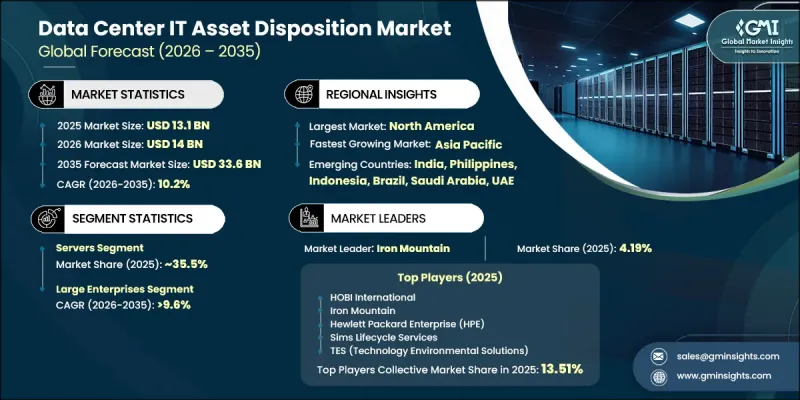
The market is undergoing strong transformation as rapid digitalization, hyperscale data center expansion, and rising cloud adoption continue to accelerate the volume of retired IT hardware worldwide. IT asset disposition has shifted from a basic end-of-life service to a critical strategic function focused on secure data handling, regulatory compliance, and sustainable lifecycle management of IT infrastructure. Enterprises, cloud providers, and colocation operators are increasingly relying on ITAD services to ensure safe data destruction, maximize residual asset value, and reduce electronic waste through refurbishment and recycling. Growing regulatory pressure around data privacy and environmental compliance is pushing organizations to adopt certified disposal processes and end-to-end traceability across asset lifecycles. At the same time, rising focus on circular economy practices is encouraging reuse, resale, and redeployment of decommissioned equipment. The combination of frequent infrastructure upgrades, increasing data volumes, and strict compliance requirements is creating sustained demand for advanced ITAD solutions across global digital ecosystems.
| Market Scope | |
|---|---|
| Start Year | 2025 |
| Forecast Year | 2026-2035 |
| Start Value | $13.1 Billion |
| Forecast Value | $33.6 Billion |
| CAGR | 10.2% |
The servers segment accounted for 35.5% share and is expected to grow at a CAGR of 11% through 2035. Their dominance is driven by their essential role in computing, storage, and cloud infrastructure operations. Continuous technological upgrades and performance enhancements result in frequent replacement cycles, generating a steady stream of retired servers that require secure disposition, refurbishment, or recycling through professional ITAD services.
The large enterprises segment held a 75.9% share and is projected to grow at a CAGR of 9.6% from 2026 to 2035. These organizations manage extensive IT infrastructures and operate multiple data centers, resulting in large-scale equipment turnover. Their strong regulatory obligations around data protection and compliance drive demand for certified ITAD providers that offer secure data destruction, audit reporting, logistics management, and value recovery services.
United States Data Center IT Asset Disposition Market held an 81.6% share in 2025, generating USD 3.9 billion. Market expansion is driven by the rapid growth of hyperscale data centers, cloud infrastructure development, and continuous hardware refresh cycles across enterprises and service providers. The high volume of decommissioned assets is increasing demand for secure, efficient, and environmentally responsible ITAD solutions that support asset recovery, resale, and recycling initiatives.
Major players operating in the Global Data Center IT Asset Disposition Industry are Arrow Electronics, Blancco Technology Group, Hewlett Packard Enterprise (HPE), HOBI International, Ingram Micro Lifecycle Services, Iron Mountain, Sims Lifecycle Services, TES (Technology Environmental Solutions), Veolia, and Wisetek. Key strategies adopted by companies in the Data Center IT Asset Disposition Market include expanding certified data destruction capabilities and strengthening compliance with global data protection regulations to build client trust. Firms are increasingly investing in automation, advanced tracking systems, and AI-enabled asset management platforms to improve transparency and operational efficiency. Strategic partnerships with cloud providers, hyperscale data center operators, and enterprise IT departments are helping expand service contracts and recurring revenue streams. Companies are also focusing on geographic expansion to capture rising demand from emerging digital economies. Additionally, investments in refurbishment, resale channels, and recycling infrastructure are enhancing value recovery from retired assets. Sustainability initiatives, including carbon reduction and circular economy integration, are becoming key differentiators, while mergers and acquisitions are helping firms broaden service portfolios and strengthen global competitiveness in a rapidly evolving digital infrastructure landscape.
Table of Contents
Chapter 1 Methodology
- 1.1 Research approach
- 1.2 Quality Commitments
- 1.2.1 GMI AI policy & data integrity commitment
- 1.2.1.1 Source consistency protocol
- 1.2.1 GMI AI policy & data integrity commitment
- 1.3 Research Trail & Confidence Scoring
- 1.3.1 Research Trail Components
- 1.3.2 Scoring Components
- 1.4 Data Collection
- 1.4.1 Partial list of primary sources
- 1.5 Data mining sources
- 1.5.1 Paid sources
- 1.5.1.1 Sources, by region
- 1.5.1 Paid sources
- 1.6 Base estimates and calculations
- 1.6.1 Base year calculation
- 1.7 Forecast Model
- 1.7.1 Quantified market impact analysis
- 1.7.1.1 Mathematical impact of growth parameters on forecast
- 1.7.1 Quantified market impact analysis
- 1.8 Research transparency addendum
- 1.8.1 Source attribution framework
- 1.8.2 Quality assurance metrics
- 1.8.3 Our commitment to trust
Chapter 2 Executive Summary
- 2.1 Industry 360° synopsis, 2022 - 2035
- 2.2 Key market trends
- 2.2.1 Regional
- 2.2.2 Assets
- 2.2.3 Organization Size
- 2.2.4 Application
- 2.2.5 End Use
- 2.3 TAM Analysis, 2026-2035
- 2.4 CXO perspectives: Strategic imperatives
Chapter 3 Industry Insights
- 3.1 Industry ecosystem analysis
- 3.1.1 Supplier landscape
- 3.1.2 Profit margin analysis
- 3.1.3 Cost structure
- 3.1.4 Value addition at each stage
- 3.1.5 Factor affecting the value chain
- 3.1.6 Disruptions
- 3.2 Industry impact forces
- 3.2.1 Growth drivers
- 3.2.1.1 Increasing demand for data center consolidation and cloud adoption
- 3.2.1.2 Increase in cloud migration and hyperscale data center adoption
- 3.2.1.3 Surge in regulatory compliance requirements (HIPAA, GDPR, ISO standards)
- 3.2.1.4 Rise in data center consolidation and virtualization
- 3.2.1.5 Increase in sustainability and e-waste management initiatives
- 3.2.1.6 Rise in cybersecurity threats and data breaches
- 3.2.2 Industry pitfalls and challenges
- 3.2.2.1 Fluctuations in commodity prices
- 3.2.2.2 Inadequate infrastructure for recycling
- 3.2.3 Market opportunities
- 3.2.3.1 Increase in secondary market opportunities for resale and remarketing
- 3.2.3.2 Surge in adoption of AI and automation technologies in ITAD workflows
- 3.2.3.3 Rise in IT infrastructure expansion in emerging markets (APAC, Latin America, MEA)
- 3.2.3.4 Increase in green IT and circular economy initiatives
- 3.2.1 Growth drivers
- 3.3 Growth potential analysis
- 3.4 Regulatory guideline
- 3.4.1 North America
- 3.4.1.1 U.S.: Resource Conservation and Recovery Act (RCRA), EPA Electronics Recycling Guidelines, and NIST Data Sanitization Standards (SP 800-88)
- 3.4.1.2 Canada: Canadian Environmental Protection Act (CEPA) & Provincial E-Waste Stewardship Programs
- 3.4.2 Europe
- 3.4.2.1 Germany: Waste Electrical and Electronic Equipment (WEEE) Directive & Circular Economy Act
- 3.4.2.2 UK: UK WEEE Regulations & Environment Act Compliance
- 3.4.2.3 France: Anti-Waste Law for Circular Economy (AGEC) & Extended Producer Responsibility (EPR)
- 3.4.2.4 Italy: National Waste Management Framework aligned with EU Circular Economy Action Plan
- 3.4.3 Asia Pacific
- 3.4.3.1 China: Circular Economy Promotion Law & E-Waste Recycling Regulations
- 3.4.3.2 India: E-Waste (Management) Rules & Extended Producer Responsibility (EPR) Compliance
- 3.4.3.3 Japan: Home Appliance Recycling Law & Act on Promotion of Effective Utilization of Resources
- 3.4.3.4 Australia: National Television and Computer Recycling Scheme (NTCRS)
- 3.4.4 Latin America
- 3.4.4.1 Brazil: National Solid Waste Policy (PNRS) & Reverse Logistics Regulations
- 3.4.4.2 Mexico: General Law for the Prevention and Integral Management of Waste (LGPGIR)
- 3.4.4.3 Argentina: Hazardous Waste Law & Emerging E-Waste Management Policies
- 3.4.5 MEA
- 3.4.5.1 UAE: Federal Waste Management Law & Circular Economy Policy Framework
- 3.4.5.2 Saudi Arabia: National Waste Management Center Regulations & Vision 2030 Sustainability Goals
- 3.4.5.3 South Africa: National Environmental Management: Waste Act (NEMWA) & E-Waste Regulations
- 3.4.1 North America
- 3.5 Porter's analysis
- 3.6 PESTEL analysis
- 3.7 Technology and Innovation landscape
- 3.7.1 Current technological trends
- 3.7.2 Emerging technologies
- 3.8 Patent analysis (Driven by Primary Research)
- 3.9 Pricing Analysis (Driven by Primary Research)
- 3.9.1 Historical Price Trend Analysis
- 3.9.2 Pricing Strategy by Player Type
- 3.10 Data Center Capacity & Infrastructure Landscape
- 3.10.1 Installed capacity (MW) by country
- 3.10.2 Expansion pipeline 2025-2027
- 3.10.3 Utilization rates & supply-demand
- 3.11 Impact of AI & generative AI on the market
- 3.11.1 AI-Driven Disruption of Existing Business Models
- 3.11.2 GenAI Use Cases & Adoption Roadmap by Segment
- 3.11.3 Risks, limitations & regulatory considerations
- 3.12 3.13. Service Delivery Capacity & Provider Infrastructure (Driven by Primary Research)
- 3.12.1 Provider Network Density & Coverage by Region (Driven by Primary Research)
- 3.12.2 Capacity Gaps & Addressable Demand Mismatch (Driven by Primary Research)
- 3.13 Sustainability and environmental aspects
- 3.13.1 Sustainable practices
- 3.13.2 Waste reduction strategies
- 3.13.3 Energy efficiency in production
- 3.13.4 Eco-friendly initiatives
- 3.13.5 Carbon footprint considerations
- 3.14 Forecast assumptions & scenario analysis (Driven by Primary Research)
- 3.14.1 Base Case - Key Macro & Industry Variables Driving CAGR
- 3.14.2 Optimistic Scenarios - Favourable macro and industry tailwinds
- 3.14.3 Pessimistic Scenario - Macroeconomic slowdown or industry headwinds
Chapter 4 Competitive Landscape, 2025
- 4.1 Introduction
- 4.2 Company market share analysis
- 4.2.1 North America
- 4.2.2 Europe
- 4.2.3 Asia Pacific
- 4.2.4 Latin America
- 4.2.5 MEA
- 4.3 Competitive analysis of major market players
- 4.4 Competitive positioning matrix
- 4.5 Key developments
- 4.5.1 Mergers & acquisitions
- 4.5.2 Partnerships & collaborations
- 4.5.3 New Product Launches
- 4.5.4 Expansion Plans and funding
- 4.6 Company Tier Benchmarking
- 4.6.1 Tier Classification Criteria & Qualifying Thresholds
- 4.6.2 Tier Positioning Matrix by Revenue, Geography & Innovation
Chapter 5 Market Estimates & Forecast, By Assets, 2022 - 2035 ($Bn)
- 5.1 Key trends
- 5.2 Servers
- 5.3 Memory modules
- 5.4 HDD
- 5.5 CPU
- 5.6 GBIC
- 5.7 Line cards
- 5.8 Desktops
- 5.9 Laptops
- 5.10 SSD
Chapter 6 Market Estimates & Forecast, By Organization Size, 2022 - 2035 ($Bn)
- 6.1 Key trends
- 6.2 SME
- 6.3 Large Enterprises
Chapter 7 Market Estimates & Forecast, By Application, 2022 - 2035 ($Bn)
- 7.1 Key trends
- 7.2 Data Sanitation/ Destruction
- 7.3 Remarketing/Resale
- 7.4 Recycling
Chapter 8 Market Estimates & Forecast, By End Use, 2022 - 2035 ($Bn)
- 8.1 Key trends
- 8.2 Enterprises
- 8.3 Cloud Service Providers
- 8.4 Colocation Providers
Chapter 9 Market Estimates & Forecast, By Region, 2022 - 2035 ($Bn)
- 9.1 Key trends
- 9.2 North America
- 9.2.1 US
- 9.2.2 Canada
- 9.3 Europe
- 9.3.1 Germany
- 9.3.2 UK
- 9.3.3 France
- 9.3.4 Italy
- 9.3.5 Spain
- 9.3.6 Russia
- 9.3.7 Netherlands
- 9.3.8 Belgium
- 9.4 Asia Pacific
- 9.4.1 China
- 9.4.2 India
- 9.4.3 Japan
- 9.4.4 Australia
- 9.4.5 South Korea
- 9.4.6 Philippines
- 9.4.7 Indonesia
- 9.5 Latin America
- 9.5.1 Brazil
- 9.5.2 Mexico
- 9.5.3 Argentina
- 9.6 MEA
- 9.6.1 South Africa
- 9.6.2 Saudi Arabia
- 9.6.3 UAE
Chapter 10 Company Profiles
- 10.1 Global Players
- 10.1.1 Arrow Electronics
- 10.1.2 Blancco Technology Group
- 10.1.3 ERI (Electronic Recyclers International)
- 10.1.4 Hewlett Packard Enterprise
- 10.1.5 HOBI International
- 10.1.6 Ingram Micro Commerce & Lifecycle
- 10.1.7 Iron Mountain
- 10.1.8 Sims Lifecycle Services
- 10.1.9 TES (Technology Environmental Solutions)
- 10.1.10 Veolia
- 10.1.11 Wisetek
- 10.2 Regional Players
- 10.2.1 All Green Electronics Recycling
- 10.2.2 Cascade Asset Management
- 10.2.3 Dataserv
- 10.2.4 Dataspan
- 10.2.5 Enviroserve
- 10.2.6 LifeSpan Technology (Data Center Division)
- 10.2.7 Quantum Lifecycle Partners
- 10.2.8 RackBank
- 10.2.9 RLG (Reverse Logistics Group)
- 10.2.10 TechReset
- 10.3 Emerging Players
- 10.3.1 Circular Computing
- 10.3.2 CloudBlue
- 10.3.3 Dynamic Lifecycle Innovations
- 10.3.4 Excess Logic
- 10.3.5 Greentek Reman
- 10.3.6 Shift Ecological

