PUBLISHER: Global Market Insights Inc. | PRODUCT CODE: 2038451

PUBLISHER: Global Market Insights Inc. | PRODUCT CODE: 2038451
Alkyl Polyglucosides Market Opportunity, Growth Drivers, Industry Trend Analysis, and Forecast 2026 - 2035
The Global Alkyl Polyglucosides Market was valued at USD 840.6 million in 2025 and is estimated to grow at a CAGR of 5.2% to reach USD 1.4 billion by 2035.
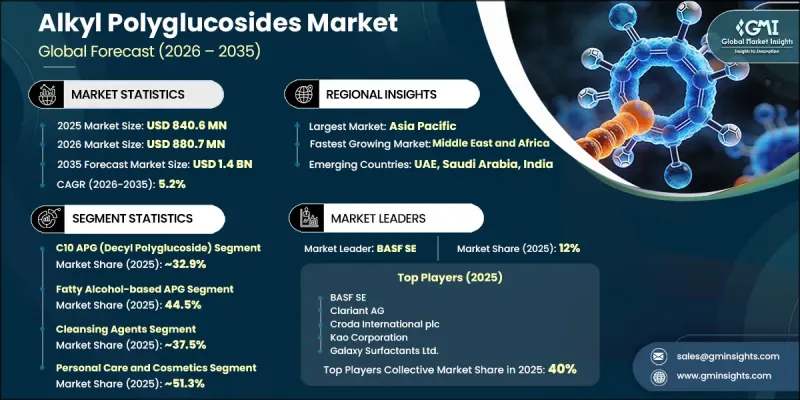
Market growth is shaped by the rising demand for bio-based and environmentally responsible surfactants across multiple industries. Alkyl polyglucosides are non-ionic surfactants derived from renewable feedstocks, offering strong biodegradability, low toxicity, and favorable environmental performance compared to conventional alternatives. Increasing awareness regarding sustainability, coupled with stricter regulatory frameworks governing product safety and environmental impact, is encouraging manufacturers to adopt greener ingredients. Advancements in production technologies are enhancing product efficiency, consistency, and application scope, enabling broader usage across diverse end markets. The shift toward natural and eco-friendly formulations is further strengthening product adoption, particularly as industries prioritize sustainable sourcing and performance optimization. However, higher production costs and limited differentiation compared to traditional surfactants continue to present challenges for wider penetration. Despite these constraints, the market maintains a positive trajectory, supported by ongoing innovation and growing emphasis on environmentally aligned chemical solutions.
| Market Scope | |
|---|---|
| Start Year | 2025 |
| Forecast Year | 2026-2035 |
| Start Value | $840.6 Million |
| Forecast Value | $1.4 Billion |
| CAGR | 5.2% |
The C10 alkyl polyglucosides segment held a 32.9% share in 2025 and is anticipated to grow at a CAGR of 6.2% through 2035. Their balanced performance characteristics and formulation adaptability support widespread use across applications. Continued focus on refining product blends, improving purity levels, and advancing bio-based processing techniques is enhancing performance consistency and sustainability credentials across both premium and industrial segments.
The personal care and cosmetics segment accounted for 51.3% share in 2025 and is projected to grow at a CAGR of 4.8% through 2035. Demand is driven by the increasing preference for mild, skin-compatible, and environmentally friendly ingredients. In addition, their effectiveness in cleaning formulations supports strong adoption across household and industrial applications, aligning with evolving consumer expectations for sustainable solutions.
North America Alkyl Polyglucosides Market held a 29% share in 2025, supported by well-established sustainability standards, advanced formulation expertise, and widespread adoption of green surfactants across multiple application areas. The region continues to play a key role due to strong regulatory frameworks and consistent demand for environmentally responsible chemical ingredients.
Key companies operating in the Global Alkyl Polyglucosides Industry include Clariant AG, BASF SE, Croda International plc, Seppic (Air Liquide Healthcare), Kao Corporation, Galaxy Surfactants Ltd., Shanghai Fine Chemical Co., Ltd., Jiangsu WanQi Biotechnology Co., Ltd., Yangzhou Chenhua New Material Co., Ltd., FENCHEM, and Shanghai Auway Daily Chemicals Co., Ltd. Companies in the Alkyl Polyglucosides Market are strengthening their market position through continuous innovation, sustainable sourcing, and strategic expansion initiatives. Manufacturers are investing in advanced production technologies to improve product purity, efficiency, and environmental performance while reducing manufacturing costs. Expanding product portfolios with tailored formulations for personal care, home care, and industrial applications is a key focus area. Firms are also forming partnerships and distribution alliances to enhance global reach and penetrate emerging markets. Emphasis on compliance with evolving environmental regulations and certifications is helping build brand credibility.
Table of Contents
Chapter 1 Methodology & Scope
- 1.1 Market scope and definition
- 1.2 Research design
- 1.2.1 Research approach
- 1.2.2 Data collection methods
- 1.3 Data mining sources
- 1.3.1 Global
- 1.3.2 Regional/Country
- 1.4 Base estimates and calculations
- 1.4.1 Base year calculation
- 1.4.2 Key trends for market estimation
- 1.5 Primary research and validation
- 1.5.1 Primary sources
- 1.6 Forecast model
- 1.7 Research assumptions and limitations
Chapter 2 Executive Summary
- 2.1 Industry 360° synopsis
- 2.2 Key market trends
- 2.2.1 Regional
- 2.2.2 Product type
- 2.2.3 Feedstock
- 2.2.4 Primary function
- 2.2.5 Application
- 2.3 TAM Analysis, 2026-2035
- 2.4 CXO perspectives: Strategic imperatives
- 2.4.1 Executive decision points
- 2.4.2 Critical success factors
- 2.5 Future Outlook and Strategic Recommendations
Chapter 3 Industry Insights
- 3.1 Industry ecosystem analysis
- 3.1.1 Supplier landscape
- 3.1.2 Profit margin
- 3.1.3 Value addition at each stage
- 3.1.4 Factor affecting the value chain
- 3.1.5 Disruptions
- 3.2 Industry impact forces
- 3.2.1 Growth drivers
- 3.2.1.1 Biodegradability and low toxicity
- 3.2.1.2 Regulatory support
- 3.2.1.3 Increasing consumer awareness and regulatory pressure regarding environmental sustainability
- 3.2.2 Industry pitfalls and challenges
- 3.2.2.1 Higher production costs
- 3.2.2.2 Limited product differentiation
- 3.2.3 Market opportunities
- 3.2.3.1 Growth in natural & organic personal care markets
- 3.2.3.2 Agricultural adjuvant applications expansion
- 3.2.1 Growth drivers
- 3.3 Growth potential analysis
- 3.4 Regulatory landscape
- 3.4.1 North America
- 3.4.2 Europe
- 3.4.3 Asia Pacific
- 3.4.4 Latin America
- 3.4.5 Middle East & Africa
- 3.5 Porter's analysis
- 3.6 PESTEL analysis
- 3.7 Price trends
- 3.7.1 By region
- 3.7.2 By product type
- 3.8 Future market trends
- 3.9 Technology and Innovation landscape
- 3.9.1 Current technological trends
- 3.9.2 Emerging technologies
- 3.10 Patent Landscape
- 3.11 Trade statistics (HS code)
- 3.11.1 Major importing countries
- 3.11.2 Major exporting countries
- 3.12 Sustainability and environmental aspects
- 3.12.1 Sustainable practices
- 3.12.2 Waste reduction strategies
- 3.12.3 Energy efficiency in production
- 3.12.4 Eco-friendly initiatives
- 3.13 Carbon footprint consideration
Chapter 4 Competitive Landscape, 2025
- 4.1 Introduction
- 4.2 Company market share analysis
- 4.2.1 By region
- 4.2.1.1 North America
- 4.2.1.2 Europe
- 4.2.1.3 Asia Pacific
- 4.2.1.4 LATAM
- 4.2.1.5 MEA
- 4.2.1 By region
- 4.3 Company matrix analysis
- 4.4 Competitive analysis of major market players
- 4.5 Competitive positioning matrix
- 4.6 Key developments
- 4.6.1 Mergers & acquisitions
- 4.6.2 Partnerships & collaborations
- 4.6.3 New Product Launches
- 4.6.4 Expansion Plans
Chapter 5 Market Estimates and Forecast, By Product Type, 2022-2035 (USD Million) (Kilo Tons)
- 5.1 Key trends
- 5.2 C8 APG (Capryl/Octyl Polyglucoside)
- 5.3 C10 APG (Decyl Polyglucoside)
- 5.4 C12 APG (Lauryl Polyglucoside)
- 5.5 Mixed Short-Chain APG
- 5.6 Others
Chapter 6 Market Estimates and Forecast, By Feedstock, 2022-2035 (USD Million) (Kilo Tons)
- 6.1 Key trends
- 6.2 Fatty Alcohol-based APG
- 6.3 Sugar-based APG
- 6.4 Cornstarch-based APG
- 6.5 Vegetable Oil-based APG
- 6.6 Others
Chapter 7 Market Estimates and Forecast, By Primary Function, 2022-2035 (USD Million) (Kilo Tons)
- 7.1 Key trends
- 7.2 Cleansing Agents
- 7.3 Emulsifying Agents
- 7.4 Wetting Agents
- 7.5 Degreasing Agents
- 7.6 Solubilizing Agents
- 7.7 Hydrotrope
- 7.8 Foaming Agents
- 7.9 Others
Chapter 8 Market Estimates and Forecast, By Application, 2022-2035 (USD Million) (Kilo Tons)
- 8.1 Key trends
- 8.2 Personal care and cosmetics
- 8.3 Home care products
- 8.4 Industrial cleaners
- 8.5 Agricultural chemicals
- 8.6 Others
Chapter 9 Market Estimates and Forecast, By Region, 2022-2035 (USD Million) (Kilo Tons)
- 9.1 Key trends
- 9.2 North America
- 9.2.1 U.S.
- 9.2.2 Canada
- 9.3 Europe
- 9.3.1 Germany
- 9.3.2 UK
- 9.3.3 France
- 9.3.4 Spain
- 9.3.5 Italy
- 9.3.6 Rest of Europe
- 9.4 Asia Pacific
- 9.4.1 China
- 9.4.2 India
- 9.4.3 Japan
- 9.4.4 Australia
- 9.4.5 South Korea
- 9.4.6 Rest of Asia Pacific
- 9.5 Latin America
- 9.5.1 Brazil
- 9.5.2 Mexico
- 9.5.3 Argentina
- 9.5.4 Rest of Latin America
- 9.6 Middle East and Africa
- 9.6.1 Saudi Arabia
- 9.6.2 South Africa
- 9.6.3 UAE
- 9.6.4 Rest of Middle East and Africa
Chapter 10 Company Profiles
- 10.1 BASF SE
- 10.2 Clariant AG
- 10.3 Seppic (Air Liquide Healthcare)
- 10.4 Croda International plc
- 10.5 Kao Corporation
- 10.6 Galaxy Surfactants Ltd.
- 10.7 Shanghai Fine Chemical Co., Ltd.
- 10.8 Jiangsu WanQi Biotechnology Co., Ltd.
- 10.9 Yangzhou Chenhua New Material Co., Ltd.
- 10.10 FENCHEM
- 10.11 Shanghai Auway Daily Chemicals Co., Ltd.

