PUBLISHER: Global Market Insights Inc. | PRODUCT CODE: 2038456

PUBLISHER: Global Market Insights Inc. | PRODUCT CODE: 2038456
Pyrethroids Market Opportunity, Growth Drivers, Industry Trend Analysis, and Forecast 2026 - 2035
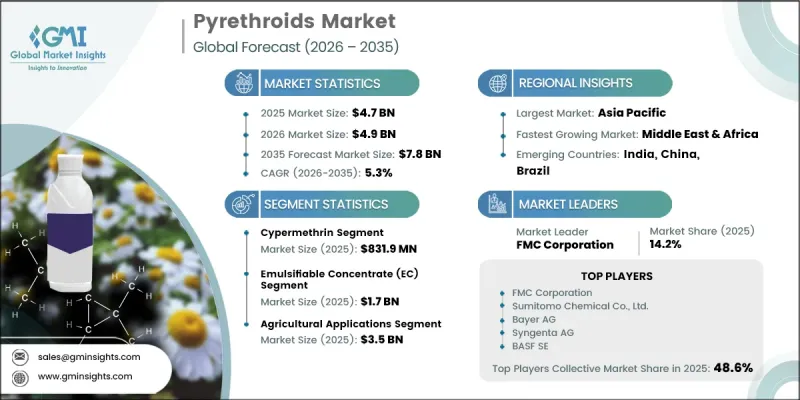
The Global Pyrethroids Market was valued at USD 4.7 billion in 2025 and is estimated to grow at a CAGR of 5.3% to reach USD 7.8 billion in 2035.
Pyrethroids are synthetic insecticidal compounds developed through chemical modification of naturally occurring pyrethrins derived from chrysanthemum flowers. These compounds are engineered to provide enhanced photostability and strong insecticidal performance by targeting and disrupting the nervous systems of insects. Their key properties include rapid knockdown action, broad-spectrum pest control capability, resistance to environmental degradation, and suitability for both indoor and outdoor applications. Pyrethroids are widely utilized across agriculture, public health programs, and residential pest management due to their effectiveness and relatively low toxicity toward mammals. They are also increasingly incorporated into integrated pest management strategies because of their versatility and consistent performance across varied environments. Continuous advancements in production technologies, including improved synthesis routes, stereochemical control, and enhanced formulation techniques, have strengthened product efficiency and safety profiles. These innovations enable manufacturers to achieve precise control over efficacy, stability, and environmental behavior, supporting expanding global demand across multiple end-use industries. This outlook reflects sustained adoption across both developed and emerging markets globally.
| Market Scope | |
|---|---|
| Start Year | 2025 |
| Forecast Year | 2026-2035 |
| Start Value | $4.7 Billion |
| Forecast Value | $7.8 Billion |
| CAGR | 5.3% |
The cypermethrin segment reached USD 831.9 million in 2025. Its dominance is supported by strong demand in agricultural protection and structural pest control applications, where its affordability and wide-spectrum efficacy make it highly effective. The compound continues to play a central role in controlling a broad range of insect pests, reinforcing its commercial importance across multiple usage areas. At the same time, the development of newer pyrethroid variants is expanding opportunities in specialized segments that require improved photostability and longer residual performance, further widening the application scope of this class of insecticides.
The emulsifiable concentrate (EC) formulations segment generated USD 1.7 billion in 2025. This segment continues to gain traction due to its ease of handling, improved spray coverage, and efficient delivery of active ingredients. Farmers increasingly prefer water-dispersible solutions that integrate seamlessly with existing spraying equipment, supporting consistent demand growth. The convenience, compatibility, and operational efficiency of EC formulations are key factors driving their widespread adoption across pest control applications.
North America Pyrethroids Market is projected to grow from USD 1.3 billion in 2025 to USD 2.2 billion in 2035. Growth in this region is primarily driven by strong agricultural demand for effective crop protection solutions and the widespread implementation of integrated pest management practices. Market expansion is further supported by increasing adoption of advanced formulation technologies and structured resistance management programs that enhance long-term pest control effectiveness while maintaining product reliability across diverse application settings.
FMC Corporation, Syngenta AG, Bayer AG, BASF SE, Sumitomo Chemical Co., Ltd., UPL Limited, ADAMA Agricultural Solutions Ltd., Jiangsu Yangnong Chemical Co., Ltd., Heranba Industries Limited, Meghmani Organics Ltd., Gharda Chemicals Limited, Tagros Chemicals India Pvt. Ltd., Nanjing Red Sun Co., Ltd., SinoHarvest Corp., and Zhejiang Xinan Chemical Industrial Group are among the leading companies operating in the pyrethroids market. Companies operating in the pyrethroids industry are focusing on strengthening their market position through continuous innovation in formulation technologies and active ingredient efficiency. They are investing heavily in research and development to enhance product stability, improve pest resistance management, and expand application versatility. Strategic collaborations, partnerships, and geographic expansion into high-growth agricultural regions are also being prioritized to increase market penetration. Manufacturers are further adopting advanced synthesis techniques and optimized production processes to improve cost efficiency and product consistency.
Table of Contents
Chapter 1 Methodology & Scope
- 1.1 Market scope and definition
- 1.2 Research design
- 1.2.1 Research approach
- 1.2.2 Data collection methods
- 1.3 Data mining sources
- 1.3.1 Global
- 1.3.2 Regional/Country
- 1.4 Base estimates and calculations
- 1.4.1 Base year calculation
- 1.4.2 Key trends for market estimation
- 1.5 Primary research and validation
- 1.5.1 Primary sources
- 1.6 Forecast model
- 1.7 Research assumptions and limitations
Chapter 2 Executive Summary
- 2.1 Industry 360° synopsis
- 2.2 Key market trends
- 2.2.1 Product Type
- 2.2.2 Formulation Type
- 2.2.3 Application
- 2.2.4 Regional
- 2.3 TAM Analysis, 2026-2035
- 2.4 CXO perspectives: Strategic imperatives
Chapter 3 Industry Insights
- 3.1 Industry ecosystem analysis
- 3.1.1 Supplier landscape
- 3.1.2 Profit margin
- 3.1.3 Value addition at each stage
- 3.1.4 Factor affecting the value chain
- 3.1.5 Disruptions
- 3.2 Industry impact forces
- 3.2.1 Growth drivers
- 3.2.2 Industry pitfalls and challenges
- 3.2.3 Market opportunities
- 3.3 Growth potential analysis
- 3.4 Regulatory landscape
- 3.4.1 North America
- 3.4.2 Europe
- 3.4.3 Asia Pacific
- 3.4.4 Latin America
- 3.4.5 Middle East & Africa
- 3.5 Porter's analysis
- 3.6 PESTEL analysis
- 3.7 Price trends
- 3.7.1 By region
- 3.7.2 By product type
- 3.8 Future market trends
- 3.9 Technology and Innovation landscape
- 3.9.1 Current technological trends
- 3.9.2 Emerging technologies
- 3.10 Patent Landscape
- 3.11 Trade statistics (HS code)
- 3.11.1 Major importing countries
- 3.11.2 Major exporting countries
- 3.12 Sustainability and environmental aspects
- 3.12.1 Sustainable practices
- 3.12.2 Waste reduction strategies
- 3.12.3 Energy efficiency in production
- 3.12.4 Eco-friendly initiatives
- 3.13 Carbon footprint consideration
Chapter 4 Competitive Landscape, 2025
- 4.1 Introduction
- 4.2 Company market share analysis
- 4.2.1 By region
- 4.2.1.1 North America
- 4.2.1.2 Europe
- 4.2.1.3 Asia Pacific
- 4.2.1.4 LATAM
- 4.2.1.5 MEA
- 4.2.1 By region
- 4.3 Competitive analysis of major market players
- 4.4 Competitive positioning matrix
- 4.5 Key developments
- 4.5.1 Mergers & acquisitions
- 4.5.2 Partnerships & collaborations
- 4.5.3 New Product Launches
- 4.5.4 Expansion Plans
Chapter 5 Market Estimates and Forecast, By Product Type, 2022-2035 (USD Billion) (Million Litters)
- 5.1 Key trends
- 5.2 Bifenthrin
- 5.3 Deltamethrin
- 5.4 Permethrin
- 5.5 Cypermethrin
- 5.6 Cyfluthrin
- 5.7 Lambda-Cyhalothrin
- 5.8 Others
Chapter 6 Market Estimates and Forecast, By Formulation Type, 2022-2035 (USD Billion) (Million Litters)
- 6.1 Key trends
- 6.2 Emulsifiable Concentrate (EC)
- 6.3 Wettable Powder (WP)
- 6.4 Water-Dispersible Granules (WG)
- 6.5 Granular (GR)
- 6.6 Ultra-Low Volume (ULV)
- 6.7 Others
Chapter 7 Market Estimates and Forecast, By Application, 2022-2035 (USD Billion) (Million Litters)
- 7.1 Key trends
- 7.2 Agricultural Applications
- 7.2.1 Cereals & Grains
- 7.2.2 Oilseeds & Pulses
- 7.2.3 Fruits & Vegetables
- 7.2.4 Others
- 7.3 Non-Agricultural Applications
- 7.3.1 Public Health
- 7.3.2 Residential
- 7.3.3 Others
Chapter 8 Market Estimates and Forecast, By Region, 2022-2035 (USD Billion) (Kilo Tons)
- 8.1 Key trends
- 8.2 North America
- 8.2.1 U.S.
- 8.2.2 Canada
- 8.3 Europe
- 8.3.1 Germany
- 8.3.2 UK
- 8.3.3 France
- 8.3.4 Spain
- 8.3.5 Italy
- 8.3.6 Rest of Europe
- 8.4 Asia Pacific
- 8.4.1 China
- 8.4.2 India
- 8.4.3 Japan
- 8.4.4 Australia
- 8.4.5 South Korea
- 8.4.6 Rest of Asia Pacific
- 8.5 Latin America
- 8.5.1 Brazil
- 8.5.2 Mexico
- 8.5.3 Argentina
- 8.5.4 Rest of Latin America
- 8.6 Middle East and Africa
- 8.6.1 Saudi Arabia
- 8.6.2 South Africa
- 8.6.3 UAE
- 8.6.4 Rest of Middle East and Africa
Chapter 9 Company Profiles
- 9.1 FMC Corporation
- 9.2 Sumitomo Chemical Co., Ltd.
- 9.3 Bayer AG
- 9.4 Syngenta AG
- 9.5 BASF SE
- 9.6 ADAMA Agricultural Solutions Ltd.
- 9.7 UPL Limited
- 9.8 Jiangsu Yangnong Chemical Co., Ltd.
- 9.9 Nanjing Red Sun Co., Ltd.
- 9.10 Tagros Chemicals India Pvt. Ltd.
- 9.11 Heranba Industries Limited
- 9.12 Gharda Chemicals Limited
- 9.13 Meghmani Organics Ltd.
- 9.14 SinoHarvest Corp.
- 9.15 Zhejiang Xinan Chemical Industrial Group

