
PUBLISHER: Global Market Insights Inc. | PRODUCT CODE: 2038459

PUBLISHER: Global Market Insights Inc. | PRODUCT CODE: 2038459
Air Separation Unit Market Opportunity, Growth Drivers, Industry Trend Analysis, and Forecast 2026 - 2035
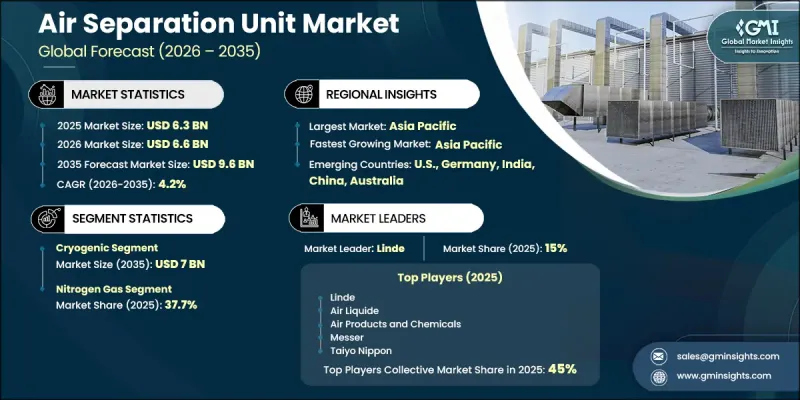
The Global Air Separation Unit Market was valued at USD 6.3 billion in 2025 and is estimated to grow at a CAGR of 4.2% to reach USD 9.6 billion by 2035.
The market is experiencing expansion due to rising demand for industrial-grade gases across multiple end-use sectors and increasing emphasis on efficient and sustainable gas production technologies. Air separation units play a critical role in producing oxygen, nitrogen, and argon, which are essential inputs for a wide range of industrial processes. Growing industrialization, coupled with expanding energy transition initiatives, is strengthening demand for high-purity gases. The market is also benefiting from increasing integration of automation and digital monitoring systems, which enhance operational efficiency and reduce downtime. Additionally, manufacturers are focusing on cost-efficient and modular ASU systems to meet evolving infrastructure requirements and environmental standards. The shift toward greener production methods and low-emission industrial operations is further reinforcing market growth. Expanding hydrogen production activities, particularly through established industrial processes and emerging clean energy pathways, are also supporting long-term demand for ASUs. Overall, the market is evolving toward more compact, flexible, and digitally enabled systems that support diversified industrial gas requirements while improving efficiency and sustainability outcomes.
| Market Scope | |
|---|---|
| Start Year | 2025 |
| Forecast Year | 2026-2035 |
| Start Value | $6.3 Billion |
| Forecast Value | $9.6 Billion |
| CAGR | 4.2% |
The cryogenic air separation unit segment is expected to reach USD 7 billion by 2035, supported by rising industrial gas demand and increasing hydrogen production activities. Cryogenic technology continues to dominate large-scale gas separation applications due to its ability to produce high-purity gases required in energy-intensive industries. Growing demand from sectors such as metallurgy, healthcare, and advanced manufacturing is reinforcing adoption of cryogenic ASU systems. These systems are preferred for their reliability, scalability, and ability to deliver consistent gas purity levels, making them suitable for high-volume industrial operations where quality control is critical.
The nitrogen gas segment accounted for 37.7% share in 2025, driven by its extensive use across chemical processing, food and beverage production, electronics manufacturing, and other industrial applications. Increasing demand for nitrogen across diverse industries has encouraged the adoption of air separation units capable of producing tailored purity levels. This flexibility allows industries to utilize nitrogen for various specialized applications, including inerting, preservation, and manufacturing processes, thereby supporting sustained market growth.
U.S. Air Separation Unit Market was valued at USD 900 million in 2025. The country is witnessing increased adoption of air separation units due to rising environmental regulations and growing focus on reducing industrial carbon emissions. The expansion of hydrogen-related applications is also contributing to market growth, as ASUs play a key role in supporting hydrogen production infrastructure. In addition, rising demand for medical-grade gases, particularly oxygen for healthcare facilities, is further driving installation of ASU systems across the country. The emphasis on reliable and continuous gas supply in critical sectors continues to strengthen market expansion in the U.S.
Major players operating in the Global Air Separation Unit Industry include Linde, Air Liquide, Air Products and Chemicals, Messer, Taiyo Nippon Sanso, Praxair Technology, Chart Industries, Cryogenmash JSC, Cryostar, Cryotec Anlagenbau, Gruppo SIAD, Hangzhou Nuzhuo Technology Group Co., Ltd, Henan Dinak Mechanical Equipment, Henan Kylin Air Separation Group, Kaifeng Air Separation Group, Ranch Cryogenics, Sichuan Air Separation Plant Group, Suzhou Oxygen Plant Co., Ltd., Universal Industrial Gases, and Yingde Gases. Key companies in the Global Air Separation Unit Market are focusing on enhancing operational efficiency through advanced automation, digital monitoring, and predictive maintenance systems that improve plant reliability and reduce downtime. They are investing in modular and compact ASU designs to meet the rising demand for flexible and space-efficient installations across diverse industries. Strategic expansion of production facilities and global distribution networks is helping companies strengthen supply chain resilience and meet growing regional demand. Firms are also prioritizing integration of energy-efficient technologies and low-emission processes to align with stricter environmental regulations.
Table of Contents
Chapter 1 Methodology & Scope
- 1.1 Research approach
- 1.2 Quality commitments
- 1.2.1 GMI AI policy & data integrity commitment
- 1.2.1.1 Source consistency protocol
- 1.2.1 GMI AI policy & data integrity commitment
- 1.3 Research trail & confidence scoring
- 1.3.1 Research trail components
- 1.3.2 Scoring components
- 1.4 Data collection
- 1.4.1 Partial list of primary sources
- 1.5 Data mining sources
- 1.5.1 Paid sources
- 1.5.1.1 Sources, by region
- 1.5.1 Paid sources
- 1.6 Base estimates and calculations
- 1.6.1 Base year calculation for any one approach
- 1.7 Market estimates & forecasts parameters
- 1.8 Forecast model
- 1.8.1 Quantified market impact analysis
- 1.8.1.1 Mathematical impact of growth parameters on forecast
- 1.8.1 Quantified market impact analysis
- 1.9 Research transparency addendum
- 1.9.1 Source attribution framework
- 1.9.2 Quality assurance metrics
- 1.9.3 Our commitment to trust
- 1.10 Market definitions
Chapter 2 Executive Summary
- 2.1 Industry synopsis, 2022 - 2035
- 2.1.1 Business trends
- 2.1.2 Process trends
- 2.1.3 Gas trends
- 2.1.4 End use trends
- 2.1.5 Regional trends
Chapter 3 Industry Insights
- 3.1 Industry ecosystem analysis
- 3.1.1 Raw material availability & sourcing analysis
- 3.1.2 supply chain resilience & risk factors
- 3.1.3 Distribution network analysis
- 3.2 Regulatory landscape
- 3.3 Industry impact forces
- 3.3.1 Growth drivers
- 3.3.2 Industry pitfalls & challenges
- 3.4 Growth potential analysis
- 3.5 Porter's Analysis
- 3.5.1 Bargaining power of suppliers
- 3.5.2 Bargaining power of buyers
- 3.5.3 Threat of new entrants
- 3.5.4 Threat of substitutes
- 3.6 PESTEL Analysis
- 3.6.1 Political factors
- 3.6.2 Economic factors
- 3.6.3 Social factors
- 3.6.4 Technological factors
- 3.6.5 Environmental factors
- 3.6.6 Legal factors
- 3.7 Cost structure analysis of air separation units
- 3.8 Emerging opportunities & trends
- 3.9 Digitalization & IoT integration
- 3.10 Investment analysis & future prospects
- 3.11 Impact of AI & Generative AI on the market (Solution Core)
- 3.11.1 AI-driven production optimization
- 3.11.2 Predictive maintenance & fault detection
Chapter 4 Competitive Landscape, 2026
- 4.1 Introduction
- 4.2 Company market share analysis, by region, 2025
- 4.2.1 North America
- 4.2.2 Europe
- 4.2.3 Asia Pacific
- 4.2.4 Middle East & Africa
- 4.2.5 Latin America
- 4.3 Competitive positioning matrix
- 4.4 key developments
- 4.4.1 Merger & acquisition
- 4.4.2 Partnership & collaboration
- 4.4.3 New product launched
- 4.4.4 Expansion plans & funding
Chapter 5 Market Size and Forecast, By Process, 2022 - 2035 (USD Billion)
- 5.1 Key trends
- 5.2 Cryogenic
- 5.3 Non-Cryogenic
Chapter 6 Market Size and Forecast, By Gas, 2022 - 2035 (USD Billion)
- 6.1 Key trends
- 6.2 Nitrogen
- 6.3 Oxygen
- 6.4 Argon
- 6.5 Others
Chapter 7 Market Size and Forecast, By End Use, 2022 - 2035 (USD Billion)
- 7.1 Key trends
- 7.2 Iron & Steel
- 7.3 Oil & Gas
- 7.4 Healthcare
- 7.5 Chemicals
- 7.6 Others
Chapter 8 Market Size and Forecast, By Region, 2022 - 2035 (USD Billion)
- 8.1 Key trends
- 8.2 North America
- 8.2.1 U.S.
- 8.2.2 Canada
- 8.3 Europe
- 8.3.1 Germany
- 8.3.2 France
- 8.3.3 UK
- 8.3.4 Spain
- 8.3.5 Italy
- 8.4 Asia Pacific
- 8.4.1 China
- 8.4.2 India
- 8.4.3 Japan
- 8.4.4 Australia
- 8.4.5 South Korea
- 8.5 Middle East & Africa
- 8.5.1 Saudi Arabia
- 8.5.2 UAE
- 8.5.3 South Africa
- 8.6 Latin America
- 8.6.1 Brazil
- 8.6.2 Argentina
Chapter 9 Company Profiles
- 9.1 Air Liquide
- 9.2 Air Products and Chemicals
- 9.3 Chart Industries
- 9.4 Cryogenmash JSC
- 9.5 Cryostar
- 9.6 Cryotec Anlagenbau
- 9.7 Gruppo SIAD
- 9.8 Hangzhou Nuzhuo Technology Group Co., Ltd
- 9.9 Henan Dinak Mechanical Equipment
- 9.10 Henan Kylin Air Separation Group
- 9.11 Kaifeng Air Separation Group
- 9.12 Linde
- 9.13 Messer
- 9.14 Praxair Technology
- 9.15 Ranch Cryogenics
- 9.16 Sichuan Air Separation Plant Group
- 9.17 Suzhou Oxygen Plant Co., Ltd.
- 9.18 Taiyo Nippon Sanso
- 9.19 Universal Industrial Gases
- 9.20 Yingde Gases

