PUBLISHER: Global Market Insights Inc. | PRODUCT CODE: 2038657

PUBLISHER: Global Market Insights Inc. | PRODUCT CODE: 2038657
U.S. Over the Counter (OTC) Drugs Market Opportunity, Growth Drivers, Industry Trend Analysis, and Forecast 2026 - 2035
U.S. Over the Counter Drugs Market was valued at USD 54.6 billion in 2025 and is estimated to grow at a CAGR of 5.6% to reach USD 92.7 billion by 2035.
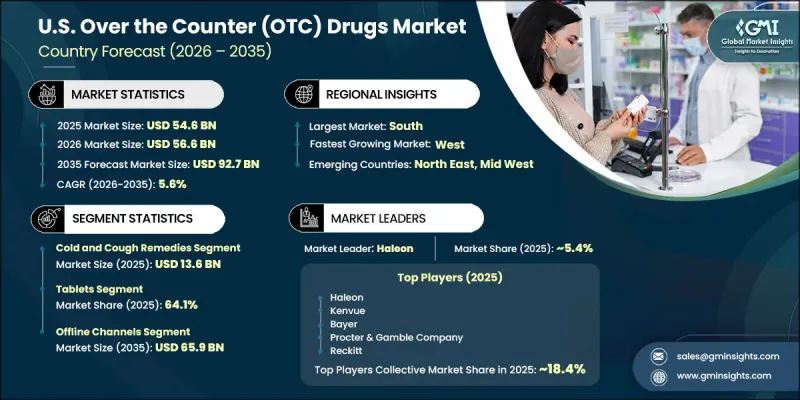
The market is experiencing steady expansion, supported by rising consumer preference for accessible and cost-effective healthcare solutions. Increasing awareness regarding self-care and preventive health practices has significantly influenced purchasing behavior, encouraging individuals to rely on non-prescription medications for common health concerns. The growing aging population is another critical factor contributing to demand, as older adults increasingly depend on easily available treatments for routine health management. This demographic shift is creating a substantial consumer base with consistent demand for products addressing pain management, digestive health, and general wellness. Additionally, the convenience associated with purchasing these medications without medical consultation is further strengthening market growth. The overall outlook remains positive, driven by expanding healthcare awareness, affordability advantages, and continuous product availability across multiple distribution channels.
| Market Scope | |
|---|---|
| Start Year | 2025 |
| Forecast Year | 2026-2035 |
| Start Value | $54.6 Billion |
| Forecast Value | $92.7 Billion |
| CAGR | 5.6% |
Over the counter drugs refer to medications that can be obtained without a physician's prescription through various distribution points, including pharmacies and digital platforms. These products are widely used for addressing a broad spectrum of health concerns, ranging from minor ailments to general wellness management. The market structure includes a combination of established global pharmaceutical companies and regional manufacturers, contributing to a competitive and diversified landscape. The ease of accessibility and wide therapeutic coverage continue to support the growing reliance on these products among consumers.
The cold and cough remedies segment generated USD 13.6 billion in 2025, driven by the high occurrence of respiratory-related conditions. Demand for these products remains strong as consumers seek quick and effective relief from symptoms associated with common illnesses. The recurring nature of such conditions encourages individuals to opt for readily available solutions, reinforcing the segment's leading position within the market.
The tablets segment accounted for a 64.1% share in 2025 and is anticipated to grow at a CAGR of 5.9% over 2035. This segment continues to dominate due to its convenience, accurate dosage, and extended shelf stability. Tablets are widely preferred for their ease of use and storage, making them suitable for self-administered treatment. Their broad applicability across multiple therapeutic areas further strengthens their position, supported by the availability of both branded and generic options that cater to diverse consumer needs.
South zone Over the Counter Drugs Market held a dominant share in 2025, supported by a large and diverse population base. The region benefits from a well-established retail infrastructure, which facilitates widespread product availability and accessibility. Increasing urban development and rising awareness of personal health management have contributed to higher adoption of self-care solutions. The strong distribution network and consistent consumer demand enable the region to maintain a significant share within the overall market.
Key players operating in the U.S. Over The Counter Drugs Market include Bayer, Sanofi, Procter & Gamble Company, Abbott Laboratories, Teva Pharmaceuticals, Reckitt, Haleon, Perrigo Company, Kenvue, Sun Pharma, Cipla, Dr. Reddy's Laboratories, Glenmark Pharmaceuticals, Stada Arzneimittel, Taisho Pharmaceutical, Piramal Pharma, Himalaya Wellness Company, and Alkem Laboratories. Companies in the U.S. Over The Counter Drugs Market are focusing on innovation, portfolio expansion, and strategic collaborations to strengthen their competitive position. Market participants are investing in research and development to introduce advanced formulations that enhance efficacy and user convenience. Expanding product lines across multiple therapeutic categories enables companies to address a broader consumer base. Firms are also strengthening distribution networks and leveraging digital platforms to improve accessibility and market reach. Strategic partnerships and brand-building initiatives are being implemented to increase consumer engagement and trust. Additionally, companies are emphasizing cost optimization and product differentiation to remain competitive while meeting evolving consumer expectations in a dynamic healthcare environment.
Table of Contents
Chapter 1 Methodology and Scope
- 1.1 Market scope and definition
- 1.2 Research approach
- 1.3 Quality commitments
- 1.3.1 GMI AI policy and data integrity commitment
- 1.3.1.1 Source consistency protocol
- 1.3.1 GMI AI policy and data integrity commitment
- 1.4 Research trail and confidence scoring
- 1.4.1 Research trail components
- 1.4.2 Scoring components
- 1.5 Data collection
- 1.5.1 Partial list of primary sources
- 1.6 Data mining sources
- 1.6.1 Paid sources
- 1.6.1.1 Sources
- 1.6.1 Paid sources
- 1.7 Base estimates and calculations
- 1.7.1 Revenue share analysis
- 1.7.2 Base year calculation
- 1.8 Forecast model
- 1.9 Research transparency addendum
- 1.9.1 Source attribution framework
- 1.9.2 Quality assurance metrics
- 1.9.3 Our commitment to trust
Chapter 2 Executive Summary
- 2.1 Industry 360° synopsis
- 2.2 Key market trends
- 2.2.1 Business trends
- 2.2.2 Zone trends
- 2.2.3 Drug category trends
- 2.2.4 Formulation type trends
- 2.2.5 Distribution channel trends
- 2.3 CXO perspectives: Strategic imperatives
Chapter 3 Industry Insights
- 3.1 Industry ecosystem analysis
- 3.1.1 Supplier landscape
- 3.1.2 Value addition at each stage
- 3.1.3 Factors affecting the value chain
- 3.2 Industry impact forces
- 3.2.1 Growth drivers
- 3.2.1.1 Growing consumer awareness of self-medication and disease management
- 3.2.1.2 High cost of prescription drugs leading to a shift towards OTC drugs
- 3.2.1.3 Favorable regulatory support for OTC drug approvals
- 3.2.1.4 Expansion of digital commerce and e-pharmacy platforms
- 3.2.1.5 Rising prevalence of chronic diseases
- 3.2.2 Industry pitfalls and challenges
- 3.2.2.1 Concern towards misuse or risk of self-diagnosis
- 3.2.2.2 Potential side effects and interactions due to medication
- 3.2.3 Market opportunities
- 3.2.3.1 Increasing shift towards natural and herbal OTC products
- 3.2.3.2 Expanding women's health and specialty segments
- 3.2.1 Growth drivers
- 3.3 Growth potential analysis
- 3.4 Regulatory landscape
- 3.5 Technology/innovation landscape
- 3.5.1 Novel drug delivery systems for OTC products
- 3.5.2 Smart packaging & patient adherence technologies
- 3.6 Prescription to nonprescription switch list
- 3.7 Patent landscape (Driven by Primary Research)
- 3.8 Self-care & consumer health behavior trends
- 3.9 Future market trends (Driven by Primary Research)
- 3.10 Impact of AI and generative AI on the market
- 3.11 Pipeline analysis
- 3.12 Porter's analysis
- 3.13 PESTEL analysis
Chapter 4 Competitive Landscape, 2025
- 4.1 Introduction
- 4.2 Company matrix analysis
- 4.3 Company market share analysis
- 4.4 Competitive analysis of major market players
- 4.5 Competitive positioning matrix
- 4.6 Strategy dashboard
- 4.6.1 Merger and acquisition
- 4.6.2 Partnership and collaboration
- 4.6.3 New product launches
- 4.6.4 Expansion plans
Chapter 5 Market Estimates and Forecast, By Drug Category, 2022 - 2035 ($ Mn)
- 5.1 Key trends
- 5.2 Cold and cough remedies
- 5.3 Vitamins and supplements
- 5.4 Digestive and intestinal remedies
- 5.5 Skin treatment
- 5.6 Analgesics
- 5.7 Sleeping aids
- 5.8 Other drug categories
Chapter 6 Market Estimates and Forecast, By Formulation Type, 2022 - 2035 ($ Mn)
- 6.1 Key trends
- 6.2 Tablets
- 6.3 Liquids
- 6.4 Ointments
- 6.5 Sprays
Chapter 7 Market Estimates and Forecast, By Distribution Channel, 2022 - 2035 ($ Mn)
- 7.1 Key trends
- 7.2 Online channels
- 7.3 Offline channels
- 7.3.1 Hospital pharmacies
- 7.3.2 Retail pharmacies
- 7.3.3 Other offline channels
Chapter 8 Market Estimates and Forecast, By Zone, 2022 - 2035 ($ Mn)
- 8.1 Key trends
- 8.2 North East
- 8.2.1 Connecticut
- 8.2.2 Maine
- 8.2.3 Massachusetts
- 8.2.4 New Hampshire
- 8.2.5 Rhode Island
- 8.2.6 Vermont
- 8.2.7 New Jersey
- 8.2.8 New York
- 8.2.9 Pennsylvania
- 8.3 Mid West
- 8.3.1 Wisconsin
- 8.3.2 Michigan
- 8.3.3 Illinois
- 8.3.4 Indiana
- 8.3.5 Ohio
- 8.3.6 North Dakota
- 8.3.7 South Dakota
- 8.3.8 Nebraska
- 8.3.9 Kansas
- 8.3.10 Minnesota
- 8.3.11 Iowa
- 8.3.12 Missouri
- 8.4 South
- 8.4.1 Delaware
- 8.4.2 Maryland
- 8.4.3 District of Columbia
- 8.4.4 Virginia
- 8.4.5 West Virginia
- 8.4.6 North Carolina
- 8.4.7 South Carolina
- 8.4.8 Georgia
- 8.4.9 Florida
- 8.4.10 Kentucky
- 8.4.11 Tennessee
- 8.4.12 Mississippi
- 8.4.13 Alabama
- 8.4.14 Oklahoma
- 8.4.15 Texas
- 8.4.16 Arkansas
- 8.4.17 Louisiana
- 8.5 West
- 8.5.1 Idaho
- 8.5.2 Montana
- 8.5.3 Wyoming
- 8.5.4 Nevada
- 8.5.5 Utah
- 8.5.6 Colorado
- 8.5.7 Arizona
- 8.5.8 New Mexico
- 8.5.9 California
- 8.5.10 Alaska
- 8.5.11 Hawaii
- 8.5.12 Oregon
- 8.5.13 Washington
Chapter 9 Company Profiles
- 9.1 Abbott Laboratories
- 9.2 Alkem Laboratories
- 9.3 Bayer
- 9.4 Cipla
- 9.5 Dr. Reddy’s Laboratories
- 9.6 Glenmark Pharmaceuticals
- 9.7 Haleon
- 9.8 Himalaya Wellness Company
- 9.9 Kenvue
- 9.10 Perrigo Company
- 9.11 Piramal Pharma
- 9.12 Procter & Gamble Company
- 9.13 Reckitt
- 9.14 Sanofi
- 9.15 Stada Arzneimittel
- 9.16 Sun Pharma
- 9.17 Taisho Pharmaceutical
- 9.18 Teva Pharmaceuticals

