PUBLISHER: Global Market Insights Inc. | PRODUCT CODE: 2038661

PUBLISHER: Global Market Insights Inc. | PRODUCT CODE: 2038661
Asia Pacific Waterproofing Membrane Market Opportunity, Growth Drivers, Industry Trend Analysis, and Forecast 2026 - 2035
Asia Pacific Waterproofing Membrane Market was valued at USD 3.4 billion in 2025 and is estimated to grow at a CAGR of 9.6% to reach USD 8.5 billion by 2035.
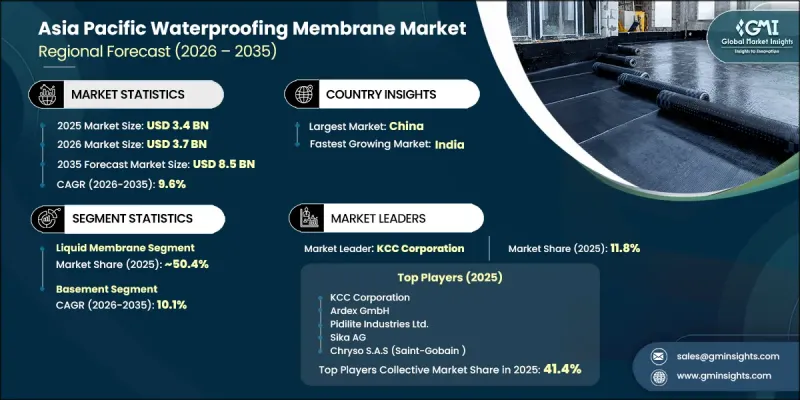
The regional market is witnessing strong momentum driven by large-scale infrastructure expansion, rapid urban development, and increasing investments in both residential and commercial construction activities. Governments across the region are prioritizing sustainable construction practices, which is significantly increasing the adoption of advanced waterproofing solutions designed for long-term durability and environmental compatibility. Demand is rising across high-rise buildings, transport infrastructure, and industrial facilities where protection against moisture, leakage, and extreme weather conditions is essential for structural integrity. Growing environmental awareness is also pushing the use of eco-friendly and recyclable waterproofing materials. In addition, rising disposable incomes in urban centers are supporting demand for premium residential projects featuring terraces, landscaped rooftops, and modern architectural designs requiring advanced waterproofing systems. Expanding e-commerce and logistics sectors are further increasing warehouse construction, strengthening the need for reliable waterproofing membranes to ensure asset protection and operational efficiency.
| Market Scope | |
|---|---|
| Start Year | 2025 |
| Forecast Year | 2026-2035 |
| Start Value | $3.4 Billion |
| Forecast Value | $8.5 Billion |
| CAGR | 9.6% |
The liquid waterproofing membranes segment held a 50.4% share in 2025, supported by their widespread application across complex construction surfaces and faster installation benefits. These systems include bitumen-based, polymer-modified cement, and polyacrylic formulations that provide seamless coverage and reduced curing time, improving construction efficiency. Polyurethane-based systems, available in both single and two-component variants, are widely adopted for their elasticity, durability, and strong bonding characteristics. Polymer-modified cement and polyacrylic solutions are increasingly used in wet environments and landscaped structures due to their flexibility and resistance to chemical exposure. Ongoing advancements in liquid membrane technology are focused on improving sustainability, enhancing curing speed, and expanding application versatility across diverse construction environments.
The basement applications segment accounted for 18.3% share in 2025 and is expected to grow at a CAGR of 10.1% through 2035. Basements require high-performance waterproofing systems to prevent water infiltration, structural deterioration, and long-term damage caused by moisture exposure. Bituminous and synthetic membrane solutions are widely used in these applications due to their durability and resistance properties. Increasing complexity in construction projects and growing infrastructure development are driving demand for application-specific waterproofing systems that ensure compliance, safety, and structural longevity across diverse building environments.
China Waterproofing Membrane Market held a 44.5% share in 2025, supported by extensive infrastructure expansion, rapid urbanization, and large-scale construction activities. The country continues to lead regional demand due to ongoing investments in skyscraper development, transportation infrastructure, and urban modernization initiatives. Government policies promoting sustainable construction practices and environmental protection are further encouraging the use of advanced waterproofing technologies. The adoption of high-performance materials such as EPDM and TPO is gaining traction due to their durability and environmental benefits, reinforcing China's position as a key growth hub in the regional market.
Major players operating in the Asia Pacific Waterproofing Membrane Industry include Ardex GmbH, BASF SE, Sika AG, Mapei, Oriental Yuhong, Fosroc Ltd., Covestro (Bayer AG), DOW Chemical Company, Tremco Inc., KCC Corporation, Pidilite Industries Ltd., Chryso S.A.S (Saint-Gobain), Samhwa Paints Industrial Co., Ltd., Inter Aneka Lestari Kimia, PT, Polymer Technologies Pte. Ltd., Pentens Ind. Corp., EP Borneo Sdn. Bhd., Fair Mate, Uniseal. Companies in the Asia Pacific Waterproofing Membrane Market are focusing on strengthening their position through product innovation and the development of high-performance, sustainable membrane solutions tailored for diverse climatic and structural conditions. Strategic collaborations with construction firms and infrastructure developers are being used to expand project-based adoption. Manufacturers are investing in advanced material technologies that enhance durability, flexibility, and environmental compliance. Expansion of production capacities across high-growth economies is helping companies improve supply chain efficiency and regional accessibility. Digital integration in construction planning and application techniques is also improving installation accuracy and reducing project timelines. Firms are increasingly prioritizing eco-friendly formulations to align with government regulations and sustainability goals.
Table of Contents
Chapter 1 Methodology & Scope
- 1.1 Market scope and definition
- 1.2 Research design
- 1.2.1 Research approach
- 1.2.2 Data collection methods
- 1.3 Data mining sources
- 1.3.1 Global
- 1.3.2 Regional/Country
- 1.4 Base estimates and calculations
- 1.4.1 Base year calculation
- 1.4.2 Key trends for market estimation
- 1.5 Primary research and validation
- 1.5.1 Primary sources
- 1.6 Forecast model
- 1.7 Research assumptions and limitations
Chapter 2 Executive Summary
- 2.1 Industry 360° synopsis
- 2.2 Key market trends
- 2.2.1 Regional
- 2.2.2 Product
- 2.2.3 Application
- 2.3 TAM Analysis, 2026-2035
- 2.4 CXO perspectives: Strategic imperatives
Chapter 3 Industry Insights
- 3.1 Industry ecosystem analysis
- 3.1.1 Supplier landscape
- 3.1.2 Profit margin
- 3.1.3 Value addition at each stage
- 3.1.4 Factor affecting the value chain
- 3.1.5 Disruptions
- 3.2 Industry impact forces
- 3.2.1 Growth drivers
- 3.2.2 Industry pitfalls and challenges
- 3.2.3 Market opportunities
- 3.3 Growth potential analysis
- 3.4 Regulatory landscape
- 3.5 Porter's analysis
- 3.6 PESTEL analysis
- 3.7 Price trends
- 3.7.1 By region
- 3.7.2 By type
- 3.8 Future market trends
- 3.9 Technology and Innovation landscape
- 3.9.1 Current technological trends
- 3.9.2 Emerging technologies
- 3.10 Patent Landscape
- 3.11 Trade statistics (HS code)
- 3.11.1 Major importing countries
- 3.11.2 Major exporting countries
- 3.12 Sustainability and environmental aspects
- 3.12.1 Sustainable practices
- 3.12.2 Waste reduction strategies
- 3.12.3 Energy efficiency in production
- 3.12.4 Eco-friendly initiatives
- 3.13 Carbon footprint consideration
Chapter 4 Competitive Landscape, 2025
- 4.1 Introduction
- 4.2 Company market share analysis
- 4.3 Company matrix analysis
- 4.4 Competitive analysis of major market players
- 4.5 Competitive positioning matrix
- 4.6 Key developments
- 4.6.1 Mergers & acquisitions
- 4.6.2 Partnerships & collaborations
- 4.6.3 New Product Launches
- 4.6.4 Expansion Plans
Chapter 5 Market Estimates and Forecast, By Product, 2022-2035 (USD Million) (Million Square Meters)
- 5.1 Key trends
- 5.2 Sheet membrane
- 5.2.1 Bitumen
- 5.2.2 EPDM
- 5.2.3 TPO
- 5.2.4 PVC
- 5.3 Liquid membrane
- 5.3.1 Bitumen solvent
- 5.3.2 Bitumen waterbase
- 5.3.3 Polymer modified cement
- 5.3.4 Polyacrylic
- 5.3.5 Rapid cure system
- 5.3.6 1k PU solvent
- 5.3.7 2K PU solvent
Chapter 6 Market Estimates and Forecast, By Application, 2022-2035 (USD Million) (Million Square Meters)
- 6.1 Key trends
- 6.2 Roof
- 6.3 Deck & terrace
- 6.4 Car park deck
- 6.5 Garden roof
- 6.6 Wall
- 6.7 Landfill & tunnel
- 6.8 Wet area
- 6.9 Pool
- 6.10 Basement
Chapter 7 Market Estimates and Forecast, By Country, 2022-2035 (USD Million) (Million Square Meters)
- 7.1 Key trends
- 7.2 Asia Pacific
- 7.2.1 China
- 7.2.2 India
- 7.2.3 Japan
- 7.2.4 Taiwan
- 7.2.5 South Korea
- 7.2.6 Thailand
- 7.2.7 Malaysia
- 7.2.8 Singapore
- 7.2.9 Philippine
- 7.2.10 Vietnam
- 7.2.11 Indonesia
- 7.2.12 Australia
- 7.2.13 Rest of Asia Pacific
Chapter 8 Company Profiles
- 8.1 Ardex GmbH
- 8.2 BASF SE
- 8.3 Chryso S.A.S (Saint-Gobain )
- 8.4 Covestro (Bayer AG)
- 8.5 DOW Chemical Company
- 8.6 EP Borneo sdn. Bhd.
- 8.7 Fair Mate
- 8.8 Fosroc Ltd.
- 8.9 Inter Aneka Lestari Kimia, PT
- 8.10 KCC Corporation
- 8.11 Mapei
- 8.12 Oriental Yuhong
- 8.13 Pentens Ind. Corp.
- 8.14 Pidilite Industries Ltd.
- 8.15 Polymer Technologies Pte. Ltd.
- 8.16 Samhwa Paints Industrial Co., Ltd.
- 8.17 Sika AG
- 8.18 Tremco Inc.
- 8.19 Uniseal

