PUBLISHER: Global Market Insights Inc. | PRODUCT CODE: 2038669

PUBLISHER: Global Market Insights Inc. | PRODUCT CODE: 2038669
U.S. Female External Catheter Market Opportunity, Growth Drivers, Industry Trend Analysis, and Forecast 2026 - 2035
U.S. Female External Catheter Market was valued at USD 306.8 million in 2025 and is estimated to grow at a CAGR of 5.7% to reach USD 526.8 million by 2035.
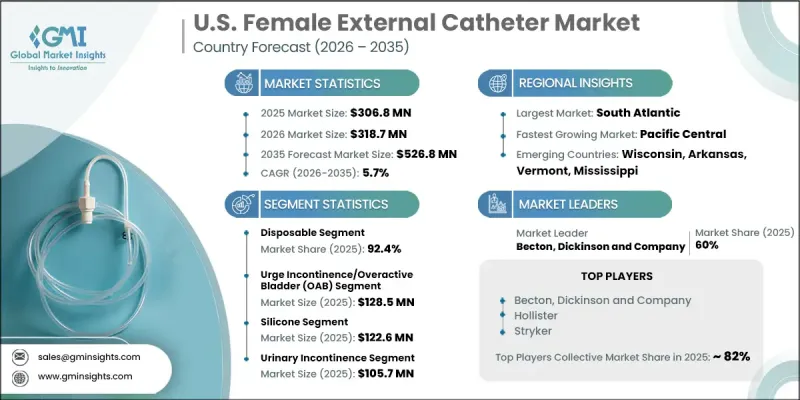
The U.S. female external catheter industry is gaining traction due to rising awareness around effective management of urinary incontinence and the growing burden of chronic health conditions among women. Increasing demand for non-invasive solutions, along with continuous advancements in product design, is supporting market expansion. Manufacturers are focusing on improving product performance through enhanced comfort, better fit, and skin-friendly materials, which is increasing patient acceptance. The shift toward preventive care and infection control is also contributing to higher adoption, as these devices help reduce complications associated with traditional catheter use. In addition, the expansion of home-based healthcare services is playing a significant role in driving demand, as more patients seek convenient and easy-to-use solutions outside clinical settings. Improved accessibility to advanced medical devices and growing healthcare awareness are further strengthening the market outlook, positioning female external catheters as an essential component in modern incontinence management.
| Market Scope | |
|---|---|
| Start Year | 2025 |
| Forecast Year | 2026-2035 |
| Start Value | $306.8 Million |
| Forecast Value | $526.8 Million |
| CAGR | 5.7% |
The market for female external catheters is driven by increased adoption of solutions designed to minimize catheter-associated complications, along with continuous improvements in product innovation. Advancements in materials and structural design are enhancing usability, comfort, and clinical effectiveness. The development of soft, breathable materials, refined anatomical configurations, and improved adhesion technologies is enabling better fit and reducing the risk of leakage and skin irritation. The growing availability of disposable products and simplified application methods is also reducing caregiver workload while supporting infection control, which is further encouraging adoption across healthcare settings. The rising preference for home healthcare solutions continues to reinforce demand for products that are convenient, efficient, and suitable for independent use.
The disposable segment held a share of 92.4% in 2025 and is expected to reach USD 492 million by 2035, growing at a CAGR of 5.9% during 2026-2035. This segment is expanding due to its ease of use, as single-use products eliminate the need for cleaning and maintenance associated with reusable alternatives. The convenience and hygienic benefits of disposable designs are driving strong demand, particularly among users seeking simple and effective solutions for managing urinary incontinence. Increasing preference for comfortable and non-invasive products is further supporting segment growth.
The urge incontinence and overactive bladder segment generated USD 128.5 million in 2025 within the U.S. female external catheter industry. The use of these devices for managing such conditions is increasing, as they offer a non-invasive method for urine collection while allowing greater mobility. These solutions help maintain skin dryness, which reduces the likelihood of irritation and other related complications, thereby improving overall patient comfort and quality of care.
South Atlantic Female External Catheter Market accounted for 21% share in 2025. The region's expansion is supported by a growing aging population, which is more susceptible to urinary incontinence, leading to increased demand for effective management solutions. Additionally, healthcare providers are placing greater emphasis on women's health initiatives, promoting awareness and improving access to treatment options. These efforts are contributing to higher adoption rates of female external catheters across the region.
Key players operating in the U.S. Female External Catheter Market include Medline, Stryker, Becton, Dickinson and Company, Hollister, Wellspect HealthCare, BOEHRINGER, Consure MEDICAL, Tilla care, and Ur24Technology. Companies in the U.S. Female External Catheter Market are focusing on strengthening their competitive position through innovation and strategic collaboration. Significant efforts are being directed toward developing advanced products with improved comfort, enhanced fit, and better skin compatibility to meet patient needs. Organizations are also investing in research and development to introduce more efficient and user-friendly designs. Partnerships with healthcare providers and distributors are helping expand market reach and improve product accessibility. Companies are increasingly targeting the home healthcare segment by offering convenient solutions tailored for independent use.
Table of Contents
Chapter 1 Research Methodology
- 1.1 Research approach
- 1.2 Quality commitments
- 1.2.1 GMI AI policy & data integrity commitment
- 1.2.1.1 Source consistency protocol
- 1.2.1 GMI AI policy & data integrity commitment
- 1.3 Research trail & confidence scoring
- 1.3.1 Research trail components
- 1.3.2 Scoring components
- 1.4 Data collection
- 1.4.1 Partial list of primary sources
- 1.5 Data mining sources
- 1.5.1 Paid sources
- 1.5.1.1 Sources, by zone
- 1.5.1 Paid sources
- 1.6 Base estimates and calculations
- 1.6.1 Base year calculation
- 1.7 Forecast model
- 1.7.1 Quantified market impact analysis
- 1.7.1.1 Mathematical impact of growth parameters on forecast
- 1.7.1 Quantified market impact analysis
- 1.8 Research transparency addendum
- 1.8.1 Source attribution framework
- 1.8.2 Quality assurance metrics
- 1.8.3 Our commitment to trust
Chapter 2 Executive Summary
- 2.1 Industry 360° synopsis
- 2.2 Key market trends
- 2.2.1 Zonal trends
- 2.2.2 Product type trends
- 2.2.3 Incontinence type trends
- 2.2.4 Material trends
- 2.2.5 Application trends
- 2.2.6 End use trends
- 2.3 CXO perspectives: Strategic imperatives
Chapter 3 Industry Insights
- 3.1 Industry ecosystem analysis
- 3.2 Industry impact forces
- 3.2.1 Growth drivers
- 3.2.1.1 Increasing prevalence of urinary incontinence
- 3.2.1.2 Growing awareness about female incontinence management
- 3.2.1.3 Technological advancements in product
- 3.2.1.4 Rise in chronic conditions
- 3.2.2 Industry pitfalls and challenges
- 3.2.2.1 Risk of infections and skin irritation
- 3.2.2.2 High cost associated with advanced catheter
- 3.2.3 Opportunities
- 3.2.3.1 Expansion of home healthcare services
- 3.2.1 Growth drivers
- 3.3 Growth potential analysis
- 3.4 Regulatory landscape (Driven by Primary Research)
- 3.5 Technology and innovation landscape
- 3.5.1 Current technological trends
- 3.5.2 Emerging technologies
- 3.6 Future market trends (Driven by Primary Research)
- 3.7 Pricing analysis, 2025
- 3.8 Reimbursement scenario (Driven by Primary Research)
- 3.9 Gap analysis
- 3.10 Porter's analysis
- 3.11 PESTEL analysis
Chapter 4 Competitive Landscape, 2025
- 4.1 Introduction
- 4.2 Company matrix analysis
- 4.3 Company market share analysis (Driven by Primary Research)
- 4.4 Competitive analysis of major market players
- 4.5 Competitive positioning matrix
- 4.6 Key developments
- 4.6.1 Mergers & acquisitions
- 4.6.2 Partnerships & collaborations
- 4.6.3 New product launches
- 4.6.4 Expansion plans
Chapter 5 Market Estimates and Forecast, By Product Type, 2022 - 2035 ($ Mn)
- 5.1 Key trends
- 5.2 Disposable
- 5.3 Reusable
Chapter 6 Market Estimates and Forecast, By Incontinence Type, 2022 - 2035 ($ Mn)
- 6.1 Key trends
- 6.2 Urge Incontinence/Overactive Bladder (OAB)
- 6.3 Stress Urinary Incontinence (SUI)
- 6.4 Other incontinence types
Chapter 7 Market Estimates and Forecast, By Material, 2022 - 2035 ($ Mn)
- 7.1 Key trends
- 7.2 Silicone
- 7.3 Latex
- 7.4 PVC (polyvinyl chloride)
- 7.5 Other materials
Chapter 8 Market Estimates and Forecast, By Application, 2022 - 2035 ($ Mn)
- 8.1 Key trends
- 8.2 Urinary incontinence
- 8.3 Urinary retention
- 8.4 Post-surgical recovery
- 8.5 Neurological disorders
- 8.6 Other applications
Chapter 9 Market Estimates and Forecast, By End Use, 2022 - 2035 ($ Mn)
- 9.1 Key trends
- 9.2 Hospitals
- 9.3 Ambulatory surgical centers
- 9.4 Specialty clinics
- 9.5 Other end users
Chapter 10 Market Estimates and Forecast, By Zone, 2022 - 2035 ($ Mn)
- 10.1 Key trends
- 10.2 East North Central
- 10.3 West South Central
- 10.4 South Atlantic
- 10.5 Northeast
- 10.6 East South Central
- 10.7 West North Central
- 10.8 Pacific Central
- 10.9 Mountain States
Chapter 11 Company Profiles
- 11.1 Becton, Dickinson and Company
- 11.2 BOEHRINGER
- 11.3 consure MEDICAL
- 11.4 Hollister
- 11.5 Medline
- 11.6 Stryker
- 11.7 tilla care
- 11.8 Ur24Technology
- 11.9 Wellspect HealthCare

