PUBLISHER: Global Market Insights Inc. | PRODUCT CODE: 2038678

PUBLISHER: Global Market Insights Inc. | PRODUCT CODE: 2038678
Fresh Vegetable Market Opportunity, Growth Drivers, Industry Trend Analysis, and Forecast 2026 - 2035
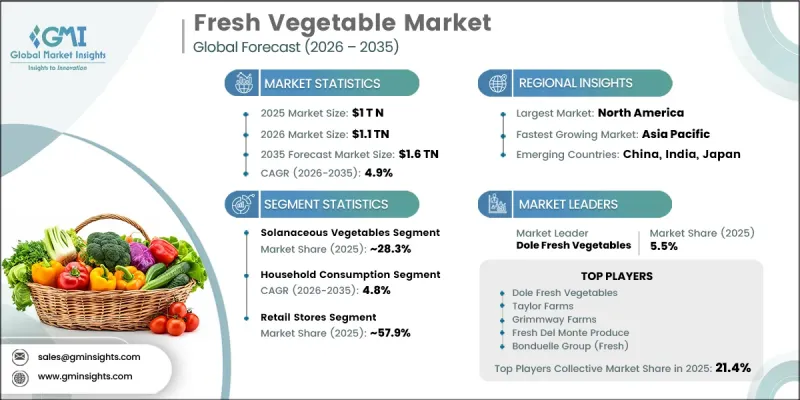
The Global Fresh Vegetable Market was valued at USD 1 trillion in 2025 and is estimated to grow at a CAGR of 4.9% to reach USD 1.6 trillion by 2035.
Rising consumer preference for healthier food options, increasing sustainability awareness, and advancements in agricultural technology are fueling market expansion. There is an increasing demand as many people focus on nutrient-rich diets and seek out fresher, chemical-free options. Sustainable farming practices and eco-conscious purchasing habits are driving shifts in production and distribution. Enhanced supply chain efficiency, supported by technological improvements in farming techniques and storage solutions, ensures year-round availability.
| Market Scope | |
|---|---|
| Start Year | 2025 |
| Forecast Year | 2026-2035 |
| Start Value | $1 Trillion |
| Forecast Value | $1.6 Trillion |
| CAGR | 4.9% |
Segmented by application, the market includes household consumption, food processing, food service, and others. Household consumption remains dominant, contributing 60.4% of total demand as consumers prioritize fresh, whole foods in their daily meals. Increased awareness of nutritional benefits, combined with marketing campaigns promoting fresh produce, is influencing purchasing patterns. The ongoing shift toward plant-based eating habits reinforces this growth, as more consumers opt for minimally processed foods with high nutrient content.
The retail stores segment held a 57.9% share and is projected to grow at a CAGR of 4.9% through 2035. Distribution channels are evolving quickly as consumers increasingly prioritize easy access, transparent product information, and consistent quality standards. Conventional retail formats such as supermarkets and hypermarkets continue to play a central role by offering a wide assortment of products, competitive pricing, and a comprehensive shopping experience under one roof. At the same time, online retailing has expanded significantly, supported by the shift toward digital purchasing behavior, especially following the pandemic, along with growing preference for doorstep delivery and targeted digital promotions. E-commerce platforms also enable access to organic and specialty vegetables while providing detailed product insights, allowing companies to reach broader consumer segments. In parallel, farmers markets are gaining popularity among health-conscious consumers who value fresh, locally sourced produce and transparent farming practices, while also supporting regional agricultural economies.
North America Fresh Vegetable Market accounted for 13.8% share in 2025. Demand in the region is strongly influenced by the growing preference for organically produced vegetables sourced through sustainable and local farming practices. Consumers in both the United States and Canada are increasingly shifting toward healthier diets, including plant-based food choices. Distribution networks such as supermarkets, retail outlets, and online platforms are ensuring wider product availability while improving transparency through labeling and certification standards. Additionally, the foodservice sector is increasingly incorporating fresh vegetables to enhance nutritional value and overall food quality. Rising awareness regarding food safety, environmental sustainability, and responsible agricultural practices is further supporting long-term market growth.
Major companies operating in the Global Fresh Vegetable Market include Fresh Del Monte Produce, Taylor Farms, Dole Fresh Vegetables, Bonduelle Group, Grimmway Farms, BrightFarms, Earthbound Farm, Tanimura & Antle, Mann Packing Company, Mastronardi Produce (SUNSET Grown), Church Brothers Farms, Baloian Farms, Ocean Mist Farms, Lipman Family Farms, and SunFed. Key strategies to strengthen growth in the fresh vegetable market include expanding contract farming and direct sourcing partnerships to ensure consistent supply and quality control. Companies are investing in cold chain logistics and advanced storage systems to reduce post-harvest losses and maintain freshness across long distribution routes. Strengthening organic certification and transparent labeling practices is helping build consumer trust and brand loyalty. Market players are also focusing on digital transformation through e-commerce platforms and mobile applications to improve accessibility and customer engagement. Product diversification, including ready-to-eat and pre-cut vegetable offerings, is supporting convenience-driven demand. Additionally, investments in sustainable farming techniques and water-efficient cultivation methods are enhancing long-term productivity while aligning with environmental expectations.
Table of Contents
Chapter 1 Methodology & Scope
- 1.1 Market scope and definition
- 1.2 Research design
- 1.2.1 Research approach
- 1.2.2 Data collection methods
- 1.3 Data mining sources
- 1.3.1 Global
- 1.3.2 Regional/Country
- 1.4 Base estimates and calculations
- 1.4.1 Base year calculation
- 1.4.2 Key trends for market estimation
- 1.5 Primary research and validation
- 1.5.1 Primary sources
- 1.6 Forecast model
- 1.7 Research assumptions and limitations
Chapter 2 Executive Summary
- 2.1 Industry 360° synopsis
- 2.2 Key market trends
- 2.2.1 Regional
- 2.2.2 Vegetable type
- 2.2.3 End use
- 2.2.4 Distribution channel
- 2.3 TAM Analysis, 2026-2035
- 2.4 CXO perspectives: Strategic imperatives
- 2.4.1 Executive decision points
Chapter 3 Industry Insights
- 3.1 Industry ecosystem analysis
- 3.1.1 Supplier landscape
- 3.1.2 Profit margin
- 3.1.3 Value addition at each stage
- 3.1.4 Factor affecting the value chain
- 3.1.5 Disruptions
- 3.2 Industry impact forces
- 3.2.1 Growth drivers
- 3.2.2 Industry pitfalls and challenges
- 3.2.3 Market opportunities
- 3.3 Growth potential analysis
- 3.4 Regulatory landscape
- 3.4.1 North America
- 3.4.2 Europe
- 3.4.3 Asia Pacific
- 3.4.4 Latin America
- 3.4.5 Middle East & Africa
- 3.5 Porter's analysis
- 3.6 PESTEL analysis
- 3.7 Price trends
- 3.7.1 By region
- 3.7.2 By type
- 3.8 Future market trends
- 3.9 Technology and Innovation landscape
- 3.9.1 Current technological trends
- 3.9.2 Emerging technologies
- 3.10 Patent Landscape
- 3.11 Trade statistics (HS code)
- 3.11.1 Major importing countries
- 3.11.2 Major exporting countries
- 3.12 Sustainability and environmental aspects
- 3.12.1 Sustainable practices
- 3.12.2 Waste reduction strategies
- 3.12.3 Energy efficiency in production
- 3.12.4 Eco-friendly initiatives
- 3.13 Carbon footprint consideration
Chapter 4 Competitive Landscape, 2025
- 4.1 Introduction
- 4.2 Company market share analysis
- 4.2.1 By region
- 4.2.1.1 North America
- 4.2.1.2 Europe
- 4.2.1.3 Asia Pacific
- 4.2.1.4 LATAM
- 4.2.1.5 MEA
- 4.2.1 By region
- 4.3 Company matrix analysis
- 4.4 Competitive analysis of major market players
- 4.5 Competitive positioning matrix
- 4.6 Key developments
- 4.6.1 Mergers & acquisitions
- 4.6.2 Partnerships & collaborations
- 4.6.3 New Product Launches
- 4.6.4 Expansion Plans
Chapter 5 Market Estimates and Forecast, By Vegetable Type, 2022-2035 (USD Billion) (Kilo Tons)
- 5.1 Key trends
- 5.2 Leafy Greens
- 5.2.1 Lettuce
- 5.2.2 Spinach
- 5.2.3 Kale
- 5.2.4 Swiss Chard
- 5.2.5 Others
- 5.3 Cruciferous Vegetables
- 5.3.1 Broccoli
- 5.3.2 Cauliflower
- 5.3.3 Cabbage
- 5.3.4 Brussels Sprouts
- 5.3.5 Others
- 5.4 Root Vegetables
- 5.4.1 Carrots
- 5.4.2 Potatoes
- 5.4.3 Beets
- 5.4.4 Radishes
- 5.4.5 Others
- 5.5 Allium Vegetables
- 5.5.1 Onions
- 5.5.2 Garlic
- 5.5.3 Leeks
- 5.5.4 Shallots
- 5.5.5 Others
- 5.6 Solanaceous Vegetables
- 5.6.1 Tomatoes
- 5.6.2 Peppers
- 5.6.3 Eggplants
- 5.6.4 Others
- 5.7 Legumes
- 5.7.1 Peas
- 5.7.2 Beans
- 5.7.3 Lentils
- 5.7.4 Others
- 5.8 Cucurbitaceous Vegetables
- 5.8.1 Cucumbers
- 5.8.2 Zucchinis
- 5.8.3 Pumpkins
- 5.8.4 Melons
- 5.8.5 Others
- 5.9 Other
- 5.9.1 Corn
- 5.9.2 Asparagus
- 5.9.3 Artichokes
- 5.9.4 Others
Chapter 6 Market Estimates and Forecast, By End Use, 2022-2035 (USD Billion) (Kilo Tons)
- 6.1 Key trends
- 6.2 Household consumption
- 6.3 Food processing
- 6.4 Foodservice
- 6.5 Other end-uses
Chapter 7 Market Estimates and Forecast, By Distribution Channel, 2022-2035 (USD Billion) (Kilo Tons)
- 7.1 Key trends
- 7.2 Retail stores
- 7.3 Online retailing
- 7.4 Farmers' markets
- 7.5 Specialty stores
- 7.6 Foodservice providers
- 7.7 Wholesale markets
Chapter 8 Market Estimates and Forecast, By Region, 2022-2035 (USD Billion) (Kilo Tons)
- 8.1 Key trends
- 8.2 North America
- 8.2.1 U.S.
- 8.2.2 Canada
- 8.3 Europe
- 8.3.1 Germany
- 8.3.2 UK
- 8.3.3 France
- 8.3.4 Spain
- 8.3.5 Italy
- 8.3.6 Rest of Europe
- 8.4 Asia Pacific
- 8.4.1 China
- 8.4.2 India
- 8.4.3 Japan
- 8.4.4 Australia
- 8.4.5 South Korea
- 8.4.6 Rest of Asia Pacific
- 8.5 Latin America
- 8.5.1 Brazil
- 8.5.2 Mexico
- 8.5.3 Argentina
- 8.5.4 Rest of Latin America
- 8.6 Middle East and Africa
- 8.6.1 Saudi Arabia
- 8.6.2 South Africa
- 8.6.3 UAE
- 8.6.4 Rest of Middle East and Africa
Chapter 9 Company Profiles
- 9.1 Baloian Farms
- 9.2 Bonduelle Group
- 9.3 BrightFarms
- 9.4 Church Brothers Farms
- 9.5 Dole Fresh Vegetables
- 9.6 Earthbound Farm
- 9.7 Fresh Del Monte Produce
- 9.8 Grimmway Farms
- 9.9 Lipman Family Farms
- 9.10 Mann Packing Company
- 9.11 Mastronardi Produce (SUNSET Grown)
- 9.12 Ocean Mist Farms
- 9.13 SunFed
- 9.14 Tanimura & Antle
- 9.15 Taylor Farms

