PUBLISHER: Global Market Insights Inc. | PRODUCT CODE: 2038692

PUBLISHER: Global Market Insights Inc. | PRODUCT CODE: 2038692
Masonry Cement Market Opportunity, Growth Drivers, Industry Trend Analysis, and Forecast 2026 - 2035
The Global Masonry Cement Market was valued at USD 6.2 billion in 2025 and is estimated to grow at a CAGR of 5.2% to reach USD 10.3 billion by 2035.
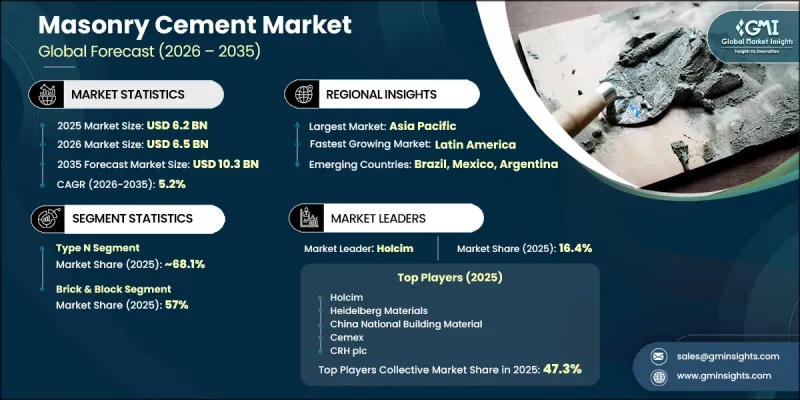
Masonry cement helps in construction applications, particularly in structural bonding processes where strength, durability, and workability are essential. Increasing urban development across major economies is driving consistent demand for reliable construction materials, as expanding populations continue to reshape housing and infrastructure requirements. The shift toward modern construction methods, along with the growing emphasis on efficient and cost-effective building solutions, is further supporting market expansion. Rapid urban transformation in key regions is reinforcing the need for materials that can deliver long-term performance and adaptability across various construction environments. Additionally, the global focus on sustainable development and improved construction standards is encouraging the adoption of materials that align with evolving environmental and efficiency goals. These factors collectively position masonry cement as a fundamental component in the advancement of global construction activities.
| Market Scope | |
|---|---|
| Start Year | 2025 |
| Forecast Year | 2026-2035 |
| Start Value | $6.2 Billion |
| Forecast Value | $10.3 Billion |
| CAGR | 5.2% |
Type N segment accounted for 68.1% share in 2025 and is expected to grow at a CAGR of 4.8% through 2035. Its widespread adoption is attributed to its versatility and suitability for general construction requirements, making it a preferred choice across a broad range of building applications.
The brick and block segment held a 57% share in 2025. This segment continues to lead due to its extensive use across multiple construction environments, where durability, cost efficiency, and structural reliability remain key considerations. The consistent demand for long-lasting and economical building solutions supports the segment's strong market position.
North America Masonry Cement Market was valued at USD 620 million in 2025 and is projected to grow at a CAGR of 4% from 2026 to 2035. The region continues to experience stable demand, supported by ongoing development in residential and commercial construction. Advancements in building techniques and a growing focus on energy-efficient and environmentally responsible materials are further contributing to market expansion.
Prominent companies operating in the Global Masonry Cement Market include Holcim, Heidelberg Materials, CRH plc, Cemex, UltraTech Cement, Shree Cement, JSW Cement, Dangote Cement, Taiwan Cement Corporation (TCC), Siam Cement Group (SCG), Cementos Argos, Cementir Holding, Vicat Group, Buzzi Unicem, Titan Cement Group, Votorantim Cimentos, China National Building Material, InterCement, GCC Group, and Anhui Conch Cement. Companies in the Masonry Cement Market are enhancing their competitive position through continuous product innovation and strategic expansion initiatives. They are investing in advanced production technologies to improve product quality, performance, and environmental sustainability. Many players are focusing on expanding their geographic footprint to tap into high-growth regions and strengthen distribution networks. Strategic partnerships and collaborations are being adopted to enhance supply chain efficiency and broaden market reach. In addition, companies are prioritizing the development of eco-friendly cement solutions to align with evolving regulatory standards and sustainability goals.
Table of Contents
Chapter 1 Methodology & Scope
- 1.1 Market scope and definition
- 1.2 Research design
- 1.2.1 Research approach
- 1.2.2 Data collection methods
- 1.3 Data mining sources
- 1.3.1 Global
- 1.3.2 Regional/Country
- 1.4 Base estimates and calculations
- 1.4.1 Base year calculation
- 1.4.2 Key trends for market estimation
- 1.5 Primary research and validation
- 1.5.1 Primary sources
- 1.6 Forecast model
- 1.7 Research assumptions and limitations
Chapter 2 Executive Summary
- 2.1 Industry 360° synopsis
- 2.2 Key market trends
- 2.2.1 Regional
- 2.2.2 Type
- 2.2.3 Application
- 2.2.4 End-use
- 2.2.5 Distribution Channel
- 2.3 TAM Analysis, 2026-2035
- 2.4 CXO perspectives: Strategic imperatives
Chapter 3 Industry Insights
- 3.1 Industry ecosystem analysis
- 3.1.1 Supplier landscape
- 3.1.2 Profit margin
- 3.1.3 Value addition at each stage
- 3.1.4 Factor affecting the value chain
- 3.1.5 Disruptions
- 3.2 Industry impact forces
- 3.2.1 Growth drivers
- 3.2.1.1 Increasing urbanization driving higher construction activity.
- 3.2.1.2 Rising infrastructure development boosts masonry cement demand.
- 3.2.1.3 Growth in residential and commercial building projects worldwide
- 3.2.2 Industry pitfalls and challenges
- 3.2.2.1 Volatility in raw material prices impacts profit margins.
- 3.2.2.2 Stringent environmental regulations increase production costs
- 3.2.3 Market opportunities
- 3.2.3.1 Adoption of eco-friendly and sustainable cement products.
- 3.2.3.2 Expansion into emerging markets with growing construction needs
- 3.2.1 Growth drivers
- 3.3 Growth potential analysis
- 3.4 Regulatory landscape
- 3.4.1 North America
- 3.4.2 Europe
- 3.4.3 Asia Pacific
- 3.4.4 Latin America
- 3.4.5 Middle East & Africa
- 3.5 Porter's analysis
- 3.6 PESTEL analysis
- 3.7 Price trends
- 3.7.1 By region
- 3.7.2 By type
- 3.8 Future market trends
- 3.9 Technology and innovation landscape
- 3.9.1 Current technological trends
- 3.9.2 Emerging technologies
- 3.10 Patent Landscape
- 3.11 Trade statistics (HS code)
- 3.11.1 Major importing countries
- 3.11.2 Major exporting countries
- 3.12 Sustainability and environmental aspects
- 3.12.1 Sustainable practices
- 3.12.2 Waste reduction strategies
- 3.12.3 Energy efficiency in production
- 3.12.4 Eco-friendly initiatives
- 3.13 Carbon footprint consideration
Chapter 4 Competitive Landscape, 2025
- 4.1 Introduction
- 4.2 Company market share analysis
- 4.2.1 By region
- 4.2.1.1 North America
- 4.2.1.2 Europe
- 4.2.1.3 Asia Pacific
- 4.2.1.4 LATAM
- 4.2.1.5 MEA
- 4.2.1 By region
- 4.3 Competitive analysis of major market players
- 4.4 Competitive positioning matrix
- 4.5 Key developments
- 4.5.1 Mergers & acquisitions
- 4.5.2 Partnerships & collaborations
- 4.5.3 New Product Launches
- 4.5.4 Expansion Plans
Chapter 5 Market Estimates and Forecast, By Type, 2022-2035 (USD Billion) (Kilo Tons)
- 5.1 Key trends
- 5.2 Type N
- 5.3 Type S
- 5.4 Type M
- 5.5 Type 0
Chapter 6 Market Estimates and Forecast, By Application, 2022-2035 (USD Billion) (Kilo Tons)
- 6.1 Brick and block construction
- 6.2 Stone masonry
- 6.3 Plastering
- 6.4 Others
Chapter 7 Market Estimates and Forecast, By End Use, 2022-2035 (USD Billion) (Kilo Tons)
- 7.1 Key trends
- 7.2 Residential
- 7.2.1 Single-family housing
- 7.2.2 Multi-family housing
- 7.2.3 Residential renovation & repair
- 7.3 Commercial
- 7.3.1 Office buildings
- 7.3.2 Retail & hospitality
- 7.3.3 Institutional
- 7.4 Industrial/Infrastructure
- 7.4.1 Transportation infrastructure
- 7.4.2 Water & wastewater facilities
- 7.4.3 Energy & industrial plants
Chapter 8 Market Estimates and Forecast, By Distribution Channel, 2022-2035 (USD Billion) (Kilo Tons)
- 8.1 Key trends
- 8.2 Direct
- 8.3 Indirect
Chapter 9 Market Estimates and Forecast, By Region, 2022-2035 (USD Billion) (Kilo Tons)
- 9.1 Key trends
- 9.2 North America
- 9.2.1 U.S.
- 9.2.2 Canada
- 9.3 Europe
- 9.3.1 Germany
- 9.3.2 UK
- 9.3.3 France
- 9.3.4 Spain
- 9.3.5 Italy
- 9.3.6 Rest of Europe
- 9.4 Asia Pacific
- 9.4.1 China
- 9.4.2 India
- 9.4.3 Japan
- 9.4.4 Australia
- 9.4.5 South Korea
- 9.4.6 Rest of Asia Pacific
- 9.5 Latin America
- 9.5.1 Brazil
- 9.5.2 Mexico
- 9.5.3 Argentina
- 9.5.4 Rest of Latin America
- 9.6 Middle East and Africa
- 9.6.1 Saudi Arabia
- 9.6.2 South Africa
- 9.6.3 UAE
- 9.6.4 Rest of Middle East and Africa
Chapter 10 Company Profiles
- 10.1 Anhui Conch Cement
- 10.2 Buzzi Unicem
- 10.3 Cementir Holding
- 10.4 Cementos Argos
- 10.5 Cemex
- 10.6 China National Building Material
- 10.7 CRH plc
- 10.8 Dangote Cement
- 10.9 GCC Group
- 10.10 Heidelberg Materials
- 10.11 Holcim
- 10.12 InterCement
- 10.13 JSW Cement
- 10.14 Shree Cement
- 10.15 Siam Cement Group (SCG)
- 10.16 Taiwan Cement Corporation (TCC)
- 10.17 Titan Cement Group
- 10.18 UltraTech Cement
- 10.19 Vicat Group
- 10.20 Votorantim Cimentos

