
PUBLISHER: Global Market Insights Inc. | PRODUCT CODE: 2038693

PUBLISHER: Global Market Insights Inc. | PRODUCT CODE: 2038693
Space-Based Solar Power Market Opportunity, Growth Drivers, Industry Trend Analysis, and Forecast 2026 - 2035
The Global Space-Based Solar Power Market was valued at USD 710 million in 2025 and is estimated to grow at a CAGR of 17.1% to reach USD 3.3 billion by 2035.
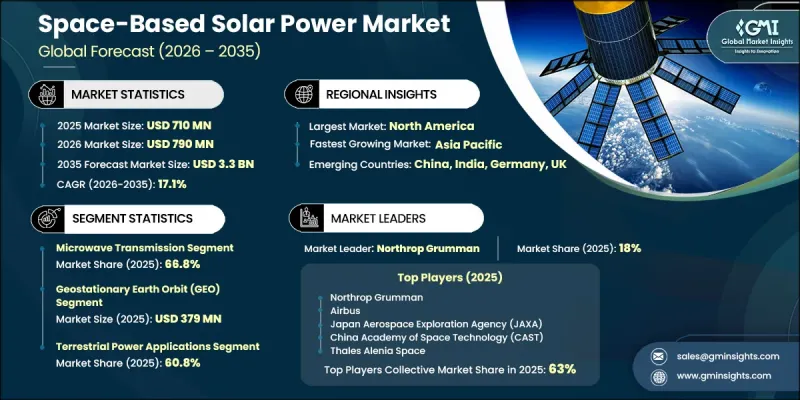
The market is gaining momentum as demand rises for uninterrupted and sustainable energy generation beyond the limitations of ground-based renewable sources. Increasing reliance on conventional solar and wind systems has highlighted intermittency challenges, driving interest in orbital energy platforms capable of delivering continuous power. Advancements in reusable launch systems and heavy-lift capabilities are improving the feasibility of deploying large-scale energy infrastructure into space. Growing government support through demonstration missions and funding initiatives is accelerating technology validation and commercialization efforts. In parallel, defense-related interest in secure and reliable energy supply systems is further supporting market expansion. Continuous progress in wireless power transmission technologies and in-orbit assembly methods is enhancing system efficiency and scalability. As global focus intensifies on energy security, decarbonization, and next-generation infrastructure, space-based solar power is emerging as a promising solution capable of transforming long-term energy supply models.
| Market Scope | |
|---|---|
| Start Year | 2025 |
| Forecast Year | 2026-2035 |
| Start Value | $710 Million |
| Forecast Value | $3.3 Billion |
| CAGR | 17.1% |
The space-based solar power market is further driven by increasing demand for reliable baseload renewable energy that operates independently of terrestrial environmental conditions. The shift toward continuous energy availability is encouraging investment in orbital platforms capable of generating and transmitting power without disruption. Improvements in launch economics, enabled by reusable vehicle technologies, are reducing deployment costs and supporting higher launch frequency. This is making large-scale orbital infrastructure more commercially viable. Growing investment in research, pilot programs, and feasibility assessments is also accelerating technological progress. Enhanced satellite manufacturing capabilities and improvements in power transmission systems are contributing to increased efficiency and reliability, strengthening the market outlook.
The microwave transmission segment accounted for 66.8% share in 2025, reflecting its technological maturity and strong performance in long-distance energy transfer. This method offers lower atmospheric loss and greater efficiency compared to alternative transmission approaches, making it a preferred option for early-stage deployment. Its compatibility with large-scale ground receiving systems further supports its adoption, while ongoing advancements in transmission technologies continue to improve reliability and scalability.
The geostationary Earth orbit segment reached USD 379 million in 2025, owing to its ability to provide consistent solar exposure and stable energy transmission. Systems operating in this orbit benefit from continuous alignment with receiving stations, enabling uninterrupted power delivery. This stability makes it particularly suitable for long-duration missions and large-scale energy generation projects. The ability to maintain constant positioning reduces operational complexity and enhances overall system efficiency, supporting strong demand.
North America Space-Based Solar Power Market accounted for 37.1% share in 2025, driven by increasing focus on energy independence, sustainability goals, and technological innovation. The region benefits from strong participation by space agencies and advanced aerospace organizations that are actively developing and testing orbital energy systems. Investments in next-generation launch infrastructure and research programs are accelerating progress in key technologies such as wireless power transmission and in-orbit assembly. A well-established aerospace ecosystem and growing interest in continuous renewable energy solutions are further strengthening regional market growth.
Key companies operating in the Global Space-Based Solar Power Market include Airbus, SpaceX, Boeing, Lockheed Martin, Northrop Grumman, Mitsubishi Electric Corporation, Thales Alenia Space, Blue Origin, OHB SE, Solaren Corporation, Space Solar Ltd, Emrod, China Academy of Space Technology (CAST), and Japan Aerospace Exploration Agency (JAXA).Companies in the Space-Based Solar Power Market are focusing on strategic developments to enhance their competitive position and accelerate commercialization. A major priority is investment in research and development to improve energy conversion efficiency, wireless transmission capabilities, and large-scale orbital system design. Firms are forming partnerships with government agencies, defense organizations, and research institutions to secure funding and support pilot projects. Emphasis is also being placed on developing modular and scalable system architectures that can be deployed efficiently in space. Companies are leveraging advancements in reusable launch technologies to reduce deployment costs and improve project feasibility. Additionally, efforts are being made to strengthen supply chains and manufacturing capabilities for satellite components.
Table of Contents
Chapter 1 Methodology and Scope
- 1.1 Market scope and definition
- 1.2 Research design
- 1.2.1 Research approach
- 1.2.2 Data collection methods
- 1.3 Data mining sources
- 1.3.1 Global
- 1.3.2 Regional/Country
- 1.4 Base estimates and calculations
- 1.4.1 Base year calculation
- 1.4.2 Key trends for market estimation
- 1.5 Primary research and validation
- 1.5.1 Primary sources
- 1.6 Forecast model
- 1.7 Research assumptions and limitations
Chapter 2 Executive Summary
- 2.1 Industry 360° synopsis, 2022 - 2035
- 2.2 Key market trends
- 2.2.1 Energy transmission type trends
- 2.2.2 Orbit type trends
- 2.2.3 Power capacity trends
- 2.2.4 Application trends
- 2.2.5 End-user trends
- 2.2.6 Regional trends
- 2.3 TAM Analysis, 2026-2035
- 2.4 CXO perspectives: Strategic imperatives
Chapter 3 Industry Insights
- 3.1 Industry ecosystem analysis
- 3.1.1 Supplier Landscape
- 3.1.2 Profit Margin
- 3.1.3 Cost structure
- 3.1.4 Value addition at each stage
- 3.1.5 Factor affecting the value chain
- 3.1.6 Disruptions
- 3.2 Industry impact forces
- 3.2.1 Growth drivers
- 3.2.1.1 Rising baseload renewable demand beyond terrestrial intermittency
- 3.2.1.2 Advancements in reusable launch vehicles lowering deployment costs
- 3.2.1.3 Increasing defense interest in uninterrupted orbital power supply
- 3.2.1.4 Government-funded SBSP pilot missions in US, China, Japan
- 3.2.1.5 Net-zero targets driving investment in scalable clean energy
- 3.2.2 Industry pitfalls and challenges
- 3.2.2.1 Extremely high upfront capital and orbital deployment costs
- 3.2.2.2 Atmospheric losses and safety concerns in power beaming
- 3.2.3 Market opportunities
- 3.2.3.1 Integration with lunar missions and deep-space infrastructure
- 3.2.3.2 Public-private partnerships accelerating SBSP commercialization
- 3.2.1 Growth drivers
- 3.3 Growth potential analysis
- 3.4 Regulatory landscape
- 3.4.1 North America
- 3.4.2 Europe
- 3.4.3 Asia Pacific
- 3.4.4 Latin America
- 3.4.5 Middle East & Africa
- 3.5 Porter's analysis
- 3.6 PESTEL analysis
- 3.7 Technology and Innovation landscape
- 3.7.1 Current technological trends
- 3.7.2 Emerging technologies
- 3.8 Price trends
- 3.8.1 By region
- 3.8.2 By product
- 3.9 Pricing Strategies
- 3.10 Emerging Business Models
- 3.11 Compliance Requirements
- 3.12 Patent and IP analysis
Chapter 4 Competitive Landscape, 2025
- 4.1 Introduction
- 4.2 Company market share analysis
- 4.2.1 By region
- 4.2.1.1 North America
- 4.2.1.2 Europe
- 4.2.1.3 Asia Pacific
- 4.2.1.4 Latin America
- 4.2.1.5 Middle East & Africa
- 4.2.2 Market concentration analysis
- 4.2.1 By region
- 4.3 Competitive benchmarking of key players
- 4.3.1 Financial performance comparison
- 4.3.1.1 Revenue
- 4.3.1.2 Profit margin
- 4.3.1.3 R&D
- 4.3.2 Product portfolio comparison
- 4.3.2.1 Product range breadth
- 4.3.2.2 Technology
- 4.3.2.3 Innovation
- 4.3.3 Geographic presence comparison
- 4.3.3.1 Global footprint analysis
- 4.3.3.2 Service network coverage
- 4.3.3.3 Market penetration by region
- 4.3.4 Competitive positioning matrix
- 4.3.4.1 Leaders
- 4.3.4.2 Challengers
- 4.3.4.3 Followers
- 4.3.4.4 Niche players
- 4.3.5 Strategic outlook matrix
- 4.3.1 Financial performance comparison
- 4.4 Key developments
- 4.4.1 Mergers and acquisitions
- 4.4.2 Partnerships and collaborations
- 4.4.3 Technological advancements
- 4.4.4 Expansion and investment strategies
- 4.4.5 Digital transformation initiatives
- 4.5 Emerging/ startup competitors landscape
Chapter 5 Market Estimates and Forecast, By Energy Transmission Type, 2022 - 2035 (USD Million)
- 5.1 Key trends
- 5.2 Microwave transmission
- 5.3 Laser transmission
Chapter 6 Market Estimates and Forecast, By Orbit Type, 2022 - 2035 (USD Million)
- 6.1 Key trends
- 6.2 Geostationary earth orbit (GEO)
- 6.3 Low earth orbit (LEO)
- 6.4 Medium earth orbit (MEO)
Chapter 7 Market Estimates and Forecast, By Power Capacity, 2022 - 2035 (USD Million)
- 7.1 Key trends
- 7.2 Below 10 MW
- 7.3 10 to 100 MW
- 7.4 100 to 1,000 MW
- 7.5 Above 1,000 MW
Chapter 8 Market Estimates and Forecast, By Application, 2022 - 2035 (USD Million)
- 8.1 Key trends
- 8.2 Terrestrial power applications
- 8.3 Space-based power applications
Chapter 9 Market Estimates and Forecast, By End-User, 2022 - 2035 (USD Million)
- 9.1 Key trends
- 9.2 Government & defense
- 9.3 Commercial
Chapter 10 Market Estimates and Forecast, By Region, 2022 - 2035 (USD Million)
- 10.1 Key trends
- 10.2 North America
- 10.2.1 U.S.
- 10.2.2 Canada
- 10.3 Europe
- 10.3.1 Germany
- 10.3.2 UK
- 10.3.3 France
- 10.3.4 Spain
- 10.3.5 Italy
- 10.4 Asia Pacific
- 10.4.1 China
- 10.4.2 India
- 10.4.3 Japan
- 10.4.4 Australia
- 10.4.5 South Korea
- 10.5 Latin America
- 10.5.1 Brazil
- 10.5.2 Mexico
- 10.5.3 Argentina
- 10.6 Middle East and Africa
- 10.6.1 South Africa
- 10.6.2 Saudi Arabia
- 10.6.3 UAE
Chapter 11 Company Profiles
- 11.1 Global Key Players
- 11.1.1 Airbus
- 11.1.2 Boeing
- 11.1.3 Lockheed Martin
- 11.1.4 Northrop Grumman
- 11.1.5 Thales Alenia Space
- 11.2 Regional key players
- 11.2.1 North America
- 11.2.1.1 Blue Origin
- 11.2.1.2 Solaren Corporation
- 11.2.1.3 SpaceX
- 11.2.2 Asia Pacific
- 11.2.2.1 China Academy of Space Technology (CAST)
- 11.2.2.2 Japan Aerospace Exploration Agency (JAXA)
- 11.2.2.3 Mitsubishi Electric Corporation
- 11.2.3 Europe
- 11.2.3.1 OHB SE
- 11.2.3.2 Space Solar Ltd
- 11.2.1 North America
- 11.3 Niche Players/Disruptors
- 11.3.1 Emrod

