
PUBLISHER: Global Market Insights Inc. | PRODUCT CODE: 2038699

PUBLISHER: Global Market Insights Inc. | PRODUCT CODE: 2038699
Dust Control Systems Market Opportunity, Growth Drivers, Industry Trend Analysis, and Forecast 2026 - 2035
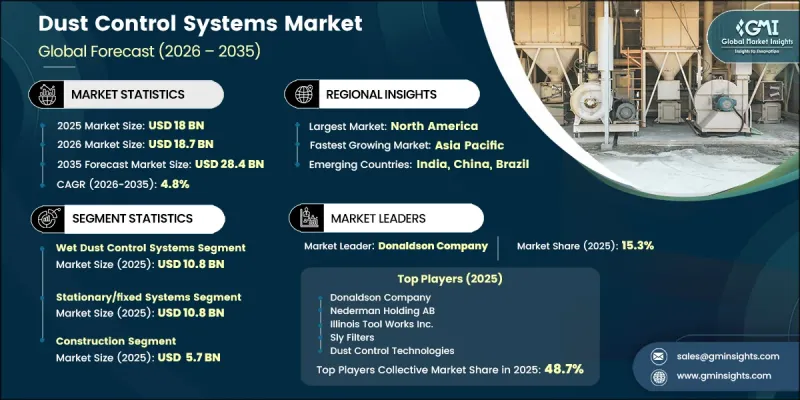
The Global Dust Control Systems Market was valued at USD 18 billion in 2025 and is estimated to grow at a CAGR of 4.8% to reach USD 28.4 billion by 2035.
The global dust control systems industry is gaining traction as industries increasingly prioritize air quality management and regulatory compliance. These systems are essential solutions engineered to manage airborne particulate matter through advanced suppression, containment, and filtration techniques. Their growing deployment is supported by rising awareness of workplace safety, environmental standards, and operational efficiency. Industries are adopting these technologies to maintain cleaner production environments while reducing health risks associated with airborne contaminants. Technological advancements have further strengthened market growth, with innovations such as automated controls, IoT-enabled monitoring, and enhanced filtration materials improving system performance. Modern dust control solutions are designed to operate efficiently across varying industrial conditions, offering flexibility for both large-scale and compact facilities. Increasing emphasis on sustainable operations and reduced environmental impact is also encouraging wider adoption. As industries continue to modernize their infrastructure, the demand for efficient dust suppression systems is expected to remain strong across multiple sectors.
| Market Scope | |
|---|---|
| Start Year | 2025 |
| Forecast Year | 2026-2035 |
| Start Value | $18 Billion |
| Forecast Value | $28.4 Billion |
| CAGR | 4.8% |
The wet dust control systems segment accounted for USD 10.8 billion in 2025. These systems maintain a leading position due to their high efficiency in managing particles across varying sizes and operating conditions. By utilizing water-based suppression techniques, they effectively capture airborne particles and support improved air quality. Their cost-effectiveness, ability to function efficiently in large operational areas, and suitability for demanding environments continue to support strong adoption across industries.
The stationary or fixed dust control systems segment generated USD 10.8 billion in 2025, reflecting their widespread use in permanent industrial installations. These systems are designed for consistent operation at fixed locations, providing continuous dust management across facilities. Their integration into infrastructure allows for efficient resource utilization and centralized control, making them highly suitable for operations requiring ongoing dust suppression at specific points.
North America Dust Control Systems Market is projected to grow from USD 6 billion in 2025 to USD 10 billion by 2035. Regional growth is supported by strict regulatory frameworks, increased industrial activity, and continuous infrastructure development. The demand for advanced dust management solutions remains strong as industries focus on compliance, operational efficiency, and environmental responsibility. Ongoing investments in industrial expansion and modernization continue to create favorable growth opportunities across the region.
Key companies operating in the Dust Control Systems Industry include Colliery Dust Control, CW Machine Worx, Donaldson Company, Dust Control Systems, Dust Control Technologies, Duztech, Illinois Tool Works Inc., Nederman Holding AB, Sly Filters, and Spraying Devices. Companies in the Dust Control Systems Market are strengthening their market position through continuous innovation, strategic partnerships, and geographic expansion. Significant investments in research and development are enabling the introduction of advanced systems with improved efficiency, automation, and real-time monitoring capabilities. Firms are also focusing on integrating smart technologies to enhance system performance and reduce operational costs. Collaborations with industrial clients and infrastructure developers are helping companies secure long-term contracts and expand their customer base. Additionally, manufacturers are increasing their global footprint by establishing regional production facilities and distribution networks. Product portfolio diversification and customized solutions tailored to specific industry requirements further support competitive differentiation and sustained market growth.
Table of Contents
Chapter 1 Methodology & Scope
- 1.1 Market scope and definition
- 1.2 Research design
- 1.2.1 Research approach
- 1.2.2 Data collection methods
- 1.3 Data mining sources
- 1.3.1 Global
- 1.3.2 Regional/Country
- 1.4 Base estimates and calculations
- 1.4.1 Base year calculation
- 1.4.2 Key trends for market estimation
- 1.5 Primary research and validation
- 1.5.1 Primary sources
- 1.6 Forecast model
- 1.7 Research assumptions and limitations
Chapter 2 Executive Summary
- 2.1 Industry 360° synopsis
- 2.2 Key market trends
- 2.2.1 Technology/system type
- 2.2.2 Equipment mobility
- 2.2.3 Deployment format
- 2.2.4 End use
- 2.2.5 Regional
- 2.3 TAM Analysis, 2026-2035
- 2.4 CXO perspectives: Strategic imperatives
Chapter 3 Industry Insights
- 3.1 Industry ecosystem analysis
- 3.1.1 Supplier landscape
- 3.1.2 Profit margin
- 3.1.3 Value addition at each stage
- 3.1.4 Factor affecting the value chain
- 3.1.5 Disruptions
- 3.2 Industry impact forces
- 3.2.1 Growth drivers
- 3.2.2 Industry pitfalls and challenges
- 3.2.3 Market opportunities
- 3.3 Growth potential analysis
- 3.4 Regulatory landscape
- 3.4.1 North America
- 3.4.2 Europe
- 3.4.3 Asia Pacific
- 3.4.4 Latin America
- 3.4.5 Middle East & Africa
- 3.5 Porter's analysis
- 3.6 PESTEL analysis
- 3.7 Price trends
- 3.7.1 By region
- 3.7.2 By technology/system type
- 3.8 Future market trends
- 3.9 Technology and Innovation landscape
- 3.9.1 Current technological trends
- 3.9.2 Emerging technologies
- 3.10 Patent Landscape
- 3.11 Trade statistics (HS code)
- 3.11.1 Major importing countries
- 3.11.2 Major exporting countries
- 3.12 Sustainability and environmental aspects
- 3.12.1 Sustainable practices
- 3.12.2 Waste reduction strategies
- 3.12.3 Energy efficiency in production
- 3.12.4 Eco-friendly initiatives
- 3.13 Carbon footprint consideration
Chapter 4 Competitive Landscape, 2025
- 4.1 Introduction
- 4.2 Company market share analysis
- 4.2.1 By region
- 4.2.1.1 North America
- 4.2.1.2 Europe
- 4.2.1.3 Asia Pacific
- 4.2.1.4 LATAM
- 4.2.1.5 MEA
- 4.2.1 By region
- 4.3 Competitive analysis of major market players
- 4.4 Competitive positioning matrix
- 4.5 Key developments
- 4.5.1 Mergers & acquisitions
- 4.5.2 Partnerships & collaborations
- 4.5.3 New Product Launches
- 4.5.4 Expansion Plans
Chapter 5 Market Estimates and Forecast, By Technology/System Type, 2022-2035 (USD Billion) (Kilo Tons)
- 5.1 Key trends
- 5.2 Wet Dust Control Systems
- 5.3 Dry Dust Control Systems
Chapter 6 Market Estimates and Forecast, By Equipment Mobility, 2022-2035 (USD Billion) (Kilo Tons)
- 6.1 Key trends
- 6.2 Stationary/Fixed Systems
- 6.3 Mobile/Portable Systems
Chapter 7 Market Estimates and Forecast, By Deployment Format, 2022-2035 (USD Billion) (Kilo Tons)
- 7.1 Key trends
- 7.2 Tractor-Mounted
- 7.3 Trailed
- 7.4 Self-Propelled
- 7.5 Handheld/Portable
- 7.6 Others
Chapter 8 Market Estimates and Forecast, By Deployment Format, 2022-2035 (USD Billion) (Kilo Tons)
- 8.1 Key trends
- 8.2 Construction
- 8.3 Chemical
- 8.4 Oil & gas
- 8.5 Food & beverage
- 8.6 Others
Chapter 9 Market Estimates and Forecast, By Region, 2022-2035 (USD Billion) (Kilo Tons)
- 9.1 Key trends
- 9.2 North America
- 9.2.1 U.S.
- 9.2.2 Canada
- 9.3 Europe
- 9.3.1 Germany
- 9.3.2 UK
- 9.3.3 France
- 9.3.4 Spain
- 9.3.5 Italy
- 9.3.6 Rest of Europe
- 9.4 Asia Pacific
- 9.4.1 China
- 9.4.2 India
- 9.4.3 Japan
- 9.4.4 Australia
- 9.4.5 South Korea
- 9.4.6 Rest of Asia Pacific
- 9.5 Latin America
- 9.5.1 Brazil
- 9.5.2 Mexico
- 9.5.3 Argentina
- 9.5.4 Rest of Latin America
- 9.6 Middle East and Africa
- 9.6.1 Saudi Arabia
- 9.6.2 South Africa
- 9.6.3 UAE
- 9.6.4 Rest of Middle East and Africa
Chapter 10 Company Profiles
- 10.1 Colliery Dust Control
- 10.2 CW Machine Worx
- 10.3 Donaldson
- 10.4 Dust Control Systems
- 10.5 Dust Control Technologies
- 10.6 Duztech
- 10.7 Illinois Tool Works
- 10.8 Nederman Holding
- 10.9 Sly Filters
- 10.10 Spraying Devices

