PUBLISHER: Global Market Insights Inc. | PRODUCT CODE: 2038702

PUBLISHER: Global Market Insights Inc. | PRODUCT CODE: 2038702
Silage Additives Market Opportunity, Growth Drivers, Industry Trend Analysis, and Forecast 2026 - 2035
The Global Silage Additives Market was valued at USD 2.6 billion in 2025 and is estimated to grow at a CAGR of 4.4% to reach USD 4 billion by 2035.
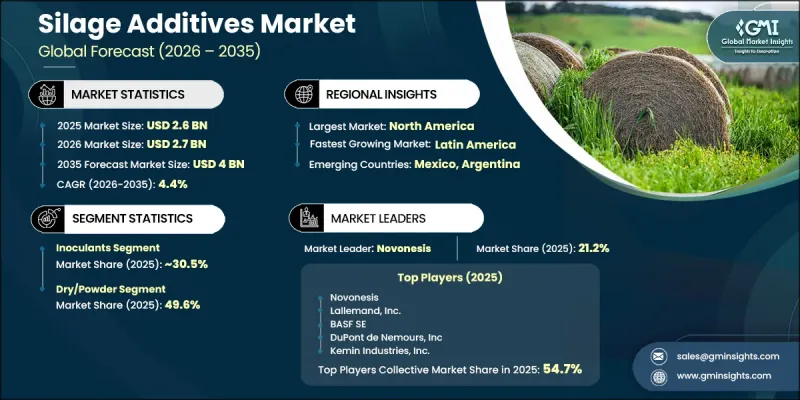
The market is witnessing steady expansion driven by the rising need for high-quality animal nutrition as global meat consumption continues to increase alongside population growth. This has intensified pressure on the livestock sector to enhance feed efficiency and nutritional value. At the same time, advancements in agricultural practices and farm mechanization are improving productivity levels, which is strengthening the adoption of feed preservation solutions. Silage additives play a crucial role in improving fermentation quality, reducing nutrient losses, and enhancing overall livestock performance. They help maintain feed stability during storage while minimizing spoilage, which directly supports higher feed conversion efficiency. Growing emphasis on sustainable livestock production is also encouraging farmers to adopt technologies that improve silage quality. Continuous innovation in additive formulations and the integration of precision agriculture practices are further enhancing preservation efficiency and expanding application scope across modern farming systems.
| Market Scope | |
|---|---|
| Start Year | 2025 |
| Forecast Year | 2026-2035 |
| Start Value | $2.6 Billion |
| Forecast Value | $4 Billion |
| CAGR | 4.4% |
The inoculants segment accounted for a share of 30.5% in 2025 and is projected to grow at a CAGR of 4.7% through 2035. This segment continues to lead due to rising demand for eco-friendly silage preservation solutions that support sustainable livestock farming practices. The growing use of microbial-based formulations has significantly improved fermentation control, resulting in better silage quality and enhanced nutrient retention. Advances in microbial science and targeted additive development are further strengthening product effectiveness, making inoculants a preferred choice among livestock producers.
The dry/powder form segment held a 49.6% share in 2025. Dry silage additives remain widely preferred due to their extended shelf life, ease of handling, and cost efficiency compared to liquid alternatives. Their stability during storage and transport makes them highly suitable for large-scale agricultural operations. Farmers and feed manufacturers favor this form because it allows convenient mixing with feed while maintaining consistent performance. The high concentration of active ingredients also ensures efficient fermentation control and improved nutrient preservation across varied storage conditions.
North America Silage Additives Market was valued at USD 953.7 million in 2025 and is projected to grow at a CAGR of 4.6% from 2026 to 2035. Market expansion in the region is supported by the increasing need for efficient feed storage solutions to improve livestock productivity. The adoption of advanced fermentation technologies and sustainable farming practices is further driving demand. Additionally, the strong livestock base and continuous technological improvements in agricultural systems are reinforcing long-term market growth.
Key companies operating in the Global Silage Additives Industry include ADDCON GmbH, Agri-King, Inc., Alltech, Inc., American Farm Products, Inc., BASF SE, DuPont de Nemours, Inc, Eastman Chemical Company, EW Nutrition GmbH, H. Wilhelm Schaumann GmbH & Co. KG, Kemin Industries, Inc., Lallemand, Inc, Novonesis, Trouw Nutrition, and Volac International Limited. Companies in the silage additives market are focusing on expanding microbial research capabilities to develop high-efficiency inoculant formulations that improve fermentation stability and nutrient preservation. Many players are investing in precision agriculture integration to optimize additive application based on crop and storage conditions. Strategic partnerships with feed manufacturers and livestock producers are helping companies strengthen distribution networks and expand market reach. Firms are also emphasizing product innovation to develop multi-functional additives that enhance both preservation and animal performance. Sustainability-focused strategies, including reduced chemical usage and eco-friendly formulations, are gaining traction.
Table of Contents
Chapter 1 Methodology & Scope
- 1.1 Market scope and definition
- 1.2 Research design
- 1.2.1 Research approach
- 1.2.2 Data collection methods
- 1.3 Data mining sources
- 1.3.1 Global
- 1.3.2 Regional/Country
- 1.4 Base estimates and calculations
- 1.4.1 Base year calculation
- 1.4.2 Key trends for market estimation
- 1.5 Primary research and validation
- 1.5.1 Primary sources
- 1.6 Forecast model
- 1.7 Research assumptions and limitations
Chapter 2 Executive Summary
- 2.1 Industry 360° synopsis
- 2.2 Key market trends
- 2.2.1 Regional
- 2.2.2 Form
- 2.2.3 Type
- 2.2.4 Crop
- 2.2.5 Function
- 2.3 TAM Analysis, 2026-2035
- 2.4 CXO perspectives: Strategic imperatives
Chapter 3 Industry Insights
- 3.1 Industry ecosystem analysis
- 3.1.1 Supplier landscape
- 3.1.2 Profit margin
- 3.1.3 Value addition at each stage
- 3.1.4 Factor affecting the value chain
- 3.1.5 Disruptions
- 3.2 Industry impact forces
- 3.2.1 Growth drivers
- 3.2.1.1 Growing awareness of feed efficiency and sustainability
- 3.2.1.2 Increasing demand for high-quality animal feed
- 3.2.1.3 Technological advancements in agriculture
- 3.2.2 Industry pitfalls and challenges
- 3.2.2.1 Regulatory compliance and safety concerns
- 3.2.2.2 Market fragmentation and competition
- 3.2.3 Market opportunities
- 3.2.3.1 Product innovation in bacterial strains & enzyme formulations
- 3.2.3.2 Expansion in emerging markets
- 3.2.1 Growth drivers
- 3.3 Growth potential analysis
- 3.4 Regulatory landscape
- 3.4.1 North America
- 3.4.2 Europe
- 3.4.3 Asia Pacific
- 3.4.4 Latin America
- 3.4.5 Middle East & Africa
- 3.5 Porter's analysis
- 3.6 PESTEL analysis
- 3.7 Price trends
- 3.7.1 By region
- 3.7.2 By type
- 3.8 Future market trends
- 3.9 Technology and innovation landscape
- 3.9.1 Current technological trends
- 3.9.2 Emerging technologies
- 3.10 Patent Landscape
- 3.11 Trade statistics (HS code)
- 3.11.1 Major importing countries
- 3.11.2 Major exporting countries
- 3.12 Sustainability and environmental aspects
- 3.12.1 Sustainable practices
- 3.12.2 Waste reduction strategies
- 3.12.3 Energy efficiency in production
- 3.12.4 Eco-friendly initiatives
- 3.13 Carbon footprint consideration
Chapter 4 Competitive Landscape, 2025
- 4.1 Introduction
- 4.2 Company market share analysis
- 4.2.1 By region
- 4.2.1.1 North America
- 4.2.1.2 Europe
- 4.2.1.3 Asia Pacific
- 4.2.1.4 LATAM
- 4.2.1.5 MEA
- 4.2.1 By region
- 4.3 Competitive analysis of major market players
- 4.4 Competitive positioning matrix
- 4.5 Key developments
- 4.5.1 Mergers & acquisitions
- 4.5.2 Partnerships & collaborations
- 4.5.3 New Product Launches
- 4.5.4 Expansion Plans
Chapter 5 Market Estimates and Forecast, By Type, 2022-2035 (USD Million) (Kilo Tons)
- 5.1 Key trends
- 5.2 Inoculants
- 5.2.1 Homofermentative bacteria
- 5.2.2 Heterofermentative bacteria
- 5.2.3 Combination / mixed culture
- 5.2.4 Others
- 5.3 Organic acids
- 5.3.1 Formic acid
- 5.3.2 Propionic acid
- 5.3.3 Acetic acid
- 5.3.4 Others
- 5.4 Enzymes
- 5.4.1 Cellulase
- 5.4.2 Hemicellulase
- 5.4.3 Protease
- 5.4.4 Others
- 5.5 Sugar
- 5.6 Preservative
- 5.7 Others
Chapter 6 Market Estimates and Forecast, By Form, 2022-2035 (USD Million) (Kilo Tons)
- 6.1 Key trends
- 6.2 Dry/powder
- 6.3 Liquid
- 6.4 Granular
Chapter 7 Market Estimates and Forecast, By Crop, 2022-2035 (USD Million) (Kilo Tons)
- 7.1 Key trends
- 7.2 Corn
- 7.3 Alfalfa
- 7.4 Sorghum
- 7.5 Oats
- 7.6 Barley
- 7.7 Rye
- 7.8 Others
Chapter 8 Market Estimates and Forecast, By Function, 2022-2035 (USD Million) (Kilo Tons)
- 8.1 Key trends
- 8.2 Stimulation
- 8.3 Inhabitation
- 8.4 Others
Chapter 9 Market Estimates and Forecast, By Region, 2022-2035 (USD Million) (Kilo Tons)
- 9.1 Key trends
- 9.2 North America
- 9.2.1 U.S.
- 9.2.2 Canada
- 9.3 Europe
- 9.3.1 Germany
- 9.3.2 UK
- 9.3.3 France
- 9.3.4 Spain
- 9.3.5 Italy
- 9.3.6 Rest of Europe
- 9.4 Asia Pacific
- 9.4.1 China
- 9.4.2 India
- 9.4.3 Japan
- 9.4.4 Australia
- 9.4.5 South Korea
- 9.4.6 Rest of Asia Pacific
- 9.5 Latin America
- 9.5.1 Brazil
- 9.5.2 Mexico
- 9.5.3 Argentina
- 9.5.4 Rest of Latin America
- 9.6 Middle East and Africa
- 9.6.1 Saudi Arabia
- 9.6.2 South Africa
- 9.6.3 UAE
- 9.6.4 Rest of Middle East and Africa
Chapter 10 Company Profiles
- 10.1 ADDCON GmbH
- 10.2 Agri-King, Inc.
- 10.3 Alltech, Inc.
- 10.4 American Farm Products, Inc.
- 10.5 BASF SE
- 10.6 DuPont de Nemours, Inc
- 10.7 Eastman Chemical Company
- 10.8 EW Nutrition GmbH
- 10.9 H. Wilhelm Schaumann GmbH & Co. KG
- 10.10 Kemin Industries, Inc.
- 10.11 Lallemand, Inc
- 10.12 Novonesis
- 10.13 Trouw Nutrition
- 10.14 Volac International Limited

