PUBLISHER: Global Market Insights Inc. | PRODUCT CODE: 2038708

PUBLISHER: Global Market Insights Inc. | PRODUCT CODE: 2038708
Manure Handling Equipment Market Opportunity, Growth Drivers, Industry Trend Analysis, and Forecast 2026 - 2035
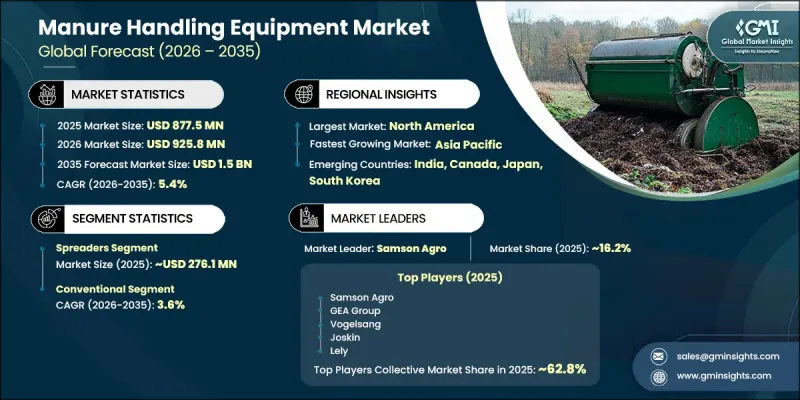
The Global Manure Handling Equipment Market was valued at USD 877.5 million in 2025 and is estimated to grow at a CAGR of 5.4% to reach USD 1.5 billion by 2035.
Market growth is being supported by the continuous expansion of livestock and dairy farming operations worldwide, which is generating higher volumes of animal waste requiring efficient handling solutions. Large commercial farms are increasingly adopting advanced systems for collection, storage, treatment, and disposal of manure to maintain operational efficiency and hygiene standards. Equipment such as spreaders, pumps, separators, and other mechanized systems is being widely used to streamline waste management processes and reduce dependence on manual labor. Mechanization in manure handling is also improving productivity, enhances farm sanitation, and supporting consistent farm operations. Rising awareness of sustainable agriculture practices is further accelerating demand, as farmers increasingly utilize manure as a natural fertilizer to improve soil fertility and reduce reliance on chemical inputs. Regulatory support from government bodies and agricultural organizations is also encouraging environmentally responsible waste management through incentives and compliance frameworks. Additionally, increasing emphasis on nutrient recycling and environmental protection is driving the adoption of efficient manure management systems across modern farming operations.
| Market Scope | |
|---|---|
| Start Year | 2025 |
| Forecast Year | 2026-2035 |
| Start Value | $877.5 Million |
| Forecast Value | $1.5 Billion |
| CAGR | 5.4% |
The spreaders segment accounted for USD 276.1 million in 2025 and is projected to grow at a CAGR of 4.3% from 2026 to 2035. This segment leads the manure handling equipment market due to its critical role in distributing manure evenly across agricultural land, which enhances soil quality and improves crop productivity. Spreaders are widely utilized across small, medium, and large-scale farms due to their ability to support efficient nutrient management practices. Modern equipment designs offer adjustable application rates, higher load capacities, and improved precision, reducing material wastage and improving field efficiency. Their ease of operation and ability to optimize fertilizer distribution make them an essential component of sustainable farming practices.
The conventional segment held a share of 81% in 2025 and is expected to grow at a CAGR of 3.6% from 2026 to 2035. This segment continues to lead due to the widespread use of traditional mechanically operated manure handling systems, which are valued for their reliability and cost efficiency. Conventional equipment, including tractor-mounted and power take-off driven systems, is widely preferred for its simplicity, durability, and ease of maintenance. These systems are particularly suitable for farms with limited access to advanced automation technologies. Their ability to perform consistently under diverse farming conditions makes them a dependable choice for livestock operations. Lower operational complexity and proven performance history further support their sustained adoption across agricultural regions.
U.S. Manure Handling Equipment Market was valued at USD 249.1 million in 2025 and is projected to grow at a CAGR of 4.4% from 2026 to 2035. The market is primarily driven by large-scale livestock operations, especially in dairy and poultry farming sectors, where efficient waste management is essential for maintaining productivity and regulatory compliance. Farmers are increasingly adopting equipment such as manure spreaders, separators, conveyors, and automated handling systems to improve operational efficiency and reduce labor requirements. High-capacity equipment capable of managing large waste volumes while controlling odor and environmental impact is in strong demand. Distribution channels include agricultural equipment dealerships, direct farm sales, and online platforms, ensuring wide accessibility across rural and commercial farming regions.
Major players operating in the Global Manure Handling Equipment Industry include Valmetal, GEA Group, Lely, Bauer Group, Joskin, BouMatic, Patz Corporation, Veenhuis, Bazooka Farmstar, Cadman Power Equipment, Samson Agro, SlurryKat, Vogelsang, Zunhammer, and Kotte Landtechnik. Companies in the Manure Handling Equipment Market are focusing on strengthening product efficiency by developing high-capacity, durable systems that reduce labor dependency and improve operational productivity. They are investing in automation technologies to enhance precision in manure collection, transport, and distribution. Strategic partnerships with agricultural distributors and farm cooperatives are helping expand market reach. Manufacturers are also emphasizing product customization to meet varying farm sizes and livestock requirements. Sustainability-focused innovations are being prioritized to support nutrient recycling and environmental compliance. In addition, companies are increasing R&D efforts to improve equipment durability, reduce maintenance costs, and enhance resistance to harsh farm conditions.
Table of Contents
Chapter 1 Methodology & Scope
- 1.1 Market scope and definition
- 1.2 Research design
- 1.2.1 Research approach
- 1.2.2 Data collection methods
- 1.3 Data mining sources
- 1.3.1 Global
- 1.3.2 Regional/Country
- 1.4 Base estimates and calculations
- 1.4.1 Base year calculation
- 1.4.2 Key trends for market estimation
- 1.5 Primary research and validation
- 1.5.1 Primary sources
- 1.6 Forecast model
- 1.7 Research assumptions and limitations
Chapter 2 Executive Summary
- 2.1 Industry 360° synopsis
- 2.2 Key market trends
- 2.2.1 Regional
- 2.2.2 Equipment type
- 2.2.3 Operation type
- 2.2.4 Application
- 2.2.5 End user
- 2.2.6 Distribution channel
Chapter 3 Industry Insights
- 3.1 Industry ecosystem analysis
- 3.1.1 Supplier landscape
- 3.1.2 Profit margin
- 3.1.3 Value addition at each stage
- 3.1.4 Factor affecting the value chain
- 3.2 Industry impact forces
- 3.2.1 Growth drivers
- 3.2.1.1 Increasing scale of livestock farming and dairy operations
- 3.2.1.2 Government regulations on waste management and environmental compliance
- 3.2.1.3 Rising adoption of sustainable agricultural practices
- 3.2.2 Pitfalls & Challenges
- 3.2.2.1 High initial investment in manure handling systems
- 3.2.2.2 Maintenance complexity and equipment wear due to corrosive materials
- 3.2.3 Opportunities
- 3.2.3.1 Development of automated and smart manure handling systems
- 3.2.3.2 Expansion of precision agriculture and integrated farm management systems
- 3.2.1 Growth drivers
- 3.3 Growth potential analysis
- 3.4 Future market trends
- 3.5 Technology and innovation landscape
- 3.5.1 Current technological trends
- 3.5.2 Emerging technologies
- 3.6 Regulatory landscape
- 3.6.1 Standards and compliance requirements
- 3.6.2 Regional regulatory frameworks
- 3.6.3 Certification standards
- 3.7 Porter's analysis
- 3.8 PESTEL analysis
- 3.9 Pricing analysis (driven by primary research)
- 3.9.1 Historical price trend analysis (driven by primary research)
- 3.9.2 Pricing strategy by player type (premium / value / cost-plus) (driven by primary research)
- 3.9.3 Regional price variations
- 3.9.4 Total cost of ownership analysis
- 3.10 Trade data analysis (HS Code-8432.41) (driven by paid database)
- 3.10.1 Import/export volume and value trends (driven by paid database)
- 3.10.2 Key trade corridors and tariff impact (driven by paid database)
- 3.10.3 Trade policy implications and cross-border dynamics
- 3.11 Capacity and production landscape (driven by primary research)
- 3.11.1 Installed capacity by region and key producer (driven by primary research)
- 3.11.2 Capacity utilization rates and expansion pipelines (driven by primary research)
Chapter 4 Competitive Landscape, 2025
- 4.1 Introduction
- 4.2 Company market share analysis
- 4.2.1 By Region
- 4.2.1.1 North America
- 4.2.1.2 Europe
- 4.2.1.3 Asia Pacific
- 4.2.1.4 Latin America
- 4.2.1.5 Middle East & Africa
- 4.2.1 By Region
- 4.3 Company matrix analysis
- 4.4 Competitive analysis of major market players
- 4.5 Competitive positioning matrix
- 4.6 Key developments
- 4.6.1 Mergers & acquisitions
- 4.6.2 Partnerships & collaborations
- 4.6.3 New product launches
- 4.6.4 Expansion plans
Chapter 5 Market Estimates & Forecast, By Equipment Type, 2022 - 2035, (USD Million) (Thousand Units)
- 5.1 Key trends
- 5.2 Spreaders
- 5.3 Barn Cleaners
- 5.4 Pumps
- 5.5 Agitators
- 5.6 Liquid Separators
- 5.7 Others
Chapter 6 Market Estimates & Forecast, By Operation Type, 2022 - 2035, (USD Million) (Thousand Units)
- 6.1 Key trends
- 6.2 Conventional
- 6.3 Robotic
Chapter 7 Market Estimates & Forecast, By Application, 2022 - 2035, (USD Million) (Thousand Units)
- 7.1 Key trends
- 7.2 Solid manure handling
- 7.3 Liquid manure handling
- 7.4 Semi-solid manure handling
Chapter 8 Market Estimates & Forecast, By End-user, 2022 - 2035, (USD Million) (Thousand Units)
- 8.1 Key trends
- 8.2 Individual farmers
- 8.3 Cooperative farms
- 8.4 Corporate farms
- 8.5 Others
Chapter 9 Market Estimates & Forecast, By Distribution Channel, 2022 - 2035, (USD Million) (Thousand Units)
- 9.1 Key trends
- 9.2 Direct sales
- 9.3 Indirect sales
Chapter 10 Market Estimates & Forecast, By Region, 2022 - 2035, (USD Million) (Thousand Units)
- 10.1 Key trends
- 10.2 North America
- 10.2.1 U.S.
- 10.2.2 Canada
- 10.3 Europe
- 10.3.1 Germany
- 10.3.2 UK
- 10.3.3 France
- 10.3.4 Italy
- 10.3.5 Spain
- 10.4 Asia Pacific
- 10.4.1 China
- 10.4.2 India
- 10.4.3 Japan
- 10.4.4 South Korea
- 10.4.5 Australia
- 10.5 Latin America
- 10.5.1 Brazil
- 10.5.2 Mexico
- 10.5.3 Argentina
- 10.6 MEA
- 10.6.1 Saudi Arabia
- 10.6.2 UAE
- 10.6.3 South Africa
Chapter 11 Company Profiles
- 11.1 Bauer Group
- 11.2 Bazooka Farmstar
- 11.3 BouMatic
- 11.4 Cadman Power Equipment
- 11.5 GEA Group
- 11.6 Joskin
- 11.7 Kotte Landtechnik
- 11.8 Lely
- 11.9 Patz Corporation
- 11.10 Samson Agro
- 11.11 SlurryKat
- 11.12 Valmetal
- 11.13 Veenhuis
- 11.14 Vogelsang
- 11.15 Zunhammer

