PUBLISHER: Global Market Insights Inc. | PRODUCT CODE: 2038709

PUBLISHER: Global Market Insights Inc. | PRODUCT CODE: 2038709
Propylene Carbonate Market Opportunity, Growth Drivers, Industry Trend Analysis, and Forecast 2026 - 2035
The Global Propylene Carbonate Market was valued at USD 437.7 million in 2025 and is estimated to grow at a CAGR of 5.8% to reach USD 763.6 million by 2035.
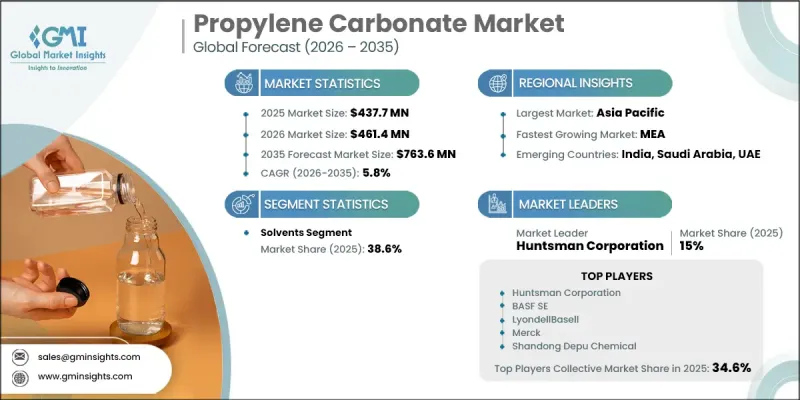
Increasing demand from battery manufacturing is playing a central role in shaping market dynamics, as propylene carbonate is widely used in electrolyte formulations for high-performance energy storage systems. The rapid expansion of electrification and energy storage technologies is reinforcing demand for advanced materials that support efficiency and safety. At the same time, tightening environmental standards and growing preference for low-toxicity chemical solutions are encouraging broader adoption across industrial applications. Manufacturers are focusing on sustainable and high-performance formulations that meet evolving regulatory requirements. Continuous advancements in production processes and the rising need for safer alternatives in chemical applications are further strengthening market expansion, positioning propylene carbonate as a versatile compound across multiple industries.
| Market Scope | |
|---|---|
| Start Year | 2025 |
| Forecast Year | 2026-2035 |
| Start Value | $ 437.7 Million |
| Forecast Value | $ 763.6 Million |
| CAGR | 5.8% |
The propylene carbonate market is benefiting from rising demand linked to energy storage systems and evolving regulatory frameworks that favor safer chemical alternatives. Its increasing use in battery-related applications is closely tied to the growth of energy storage technologies, which require stable and efficient electrolyte components. At the same time, the shift toward environmentally responsible solvent systems is encouraging industries to adopt materials with lower environmental impact and improved safety characteristics. This transition is expanding its application scope across multiple sectors, supporting sustained market demand.
The High-purity grades exceeding 99% are emerging as the fastest-growing segment, particularly in applications that require stringent quality standards. These grades are gaining strong traction due to their ability to deliver superior performance in sensitive processes where contamination must be minimized. Manufacturers are investing in advanced purification technologies and quality control systems to meet the rising demand for high-performance materials, positioning these grades as premium offerings within the market.
The energy and power segment is witnessing the fastest growth, driven by increasing demand for energy storage solutions and advancements in battery technologies. This segment is becoming a key contributor to overall consumption, supported by the ongoing expansion of energy-related infrastructure. At the same time, established industrial applications continue to provide a stable demand base, ensuring balanced market growth across both emerging and mature sectors.
North America Propylene Carbonate Market is projected to grow from USD 105.7 million in 2025 to USD 195.9 million by 2035. Growth in the region is supported by strong demand from specialty chemical applications and the continued development of energy storage infrastructure. Established industrial sectors are increasingly adopting safer and more sustainable chemical solutions, further driving market expansion.
Key companies operating in the Global Propylene Carbonate Market include BASF SE, LyondellBasell, Huntsman Corporation, Merck, Tokyo Chemical Industry, Empower Materials, Shandong Depu Chemical, CDH Fine Chemical, SMC-Global, Dhalop Chemicals, and 3N Composites. Companies in the Propylene Carbonate Market are strengthening their competitive position by focusing on product innovation, sustainability, and capacity expansion. They are investing in advanced purification technologies to develop high-purity grades that cater to specialized applications. Many players are enhancing their production capabilities to meet growing demand from energy storage and industrial sectors. Strategic collaborations and partnerships are being pursued to expand market reach and improve technological capabilities. Additionally, companies are aligning their product offerings with environmental regulations by promoting low-toxicity and eco-friendly solutions.
Table of Contents
Chapter 1 Methodology & Scope
- 1.1 Market scope and definition
- 1.2 Research design
- 1.2.1 Research approach
- 1.2.2 Data collection methods
- 1.3 Data mining sources
- 1.3.1 Global
- 1.3.2 Regional/Country
- 1.4 Base estimates and calculations
- 1.4.1 Base year calculation
- 1.4.2 Key trends for market estimation
- 1.5 Primary research and validation
- 1.5.1 Primary sources
- 1.6 Forecast model
- 1.7 Research assumptions and limitations
Chapter 2 Executive Summary
- 2.1 Industry 360° synopsis
- 2.2 Key market trends
- 2.2.1 Regional
- 2.2.2 Purity
- 2.2.3 Application
- 2.2.4 End Use Industry
- 2.3 TAM Analysis, 2026-2035
- 2.4 CXO perspectives: Strategic imperatives
- 2.4.1 Executive decision points
- 2.4.2 Critical success factors
- 2.5 Future Outlook and Strategic Recommendations
Chapter 3 Industry Insights
- 3.1 Industry ecosystem analysis
- 3.1.1 Supplier landscape
- 3.1.2 Profit margin
- 3.1.3 Value addition at each stage
- 3.1.4 Factor affecting the value chain
- 3.1.5 Disruptions
- 3.2 Industry impact forces
- 3.2.1 Growth drivers
- 3.2.1.1 Accelerating EV battery and electrolyte demand
- 3.2.1.2 Shift toward safer, low toxicity solvents
- 3.2.1.3 Expansion of high performance coatings and polymers
- 3.2.2 Industry pitfalls and challenges
- 3.2.2.1 Dependence on petrochemical feedstocks
- 3.2.2.2 Strict handling and environmental regulations
- 3.2.3 Market opportunities
- 3.2.3.1 Growth in solid state and advanced batteries
- 3.2.3.2 Development of bio based production routes
- 3.2.1 Growth drivers
- 3.3 Growth potential analysis
- 3.4 Regulatory landscape
- 3.4.1 North America
- 3.4.2 Europe
- 3.4.3 Asia Pacific
- 3.4.4 Latin America
- 3.4.5 Middle East & Africa
- 3.5 Porter's analysis
- 3.6 PESTEL analysis
- 3.7 Price trends
- 3.7.1 By region
- 3.7.2 By Product
- 3.8 Production Capacity, 2025
- 3.9 Future market trends
- 3.10 Technology and Innovation landscape
- 3.10.1 Current technological trends
- 3.10.2 Emerging technologies
- 3.11 Patent Landscape
- 3.12 Trade statistics (HS code)
- 3.12.1 Major importing countries
- 3.12.2 Major exporting countries
- 3.13 Sustainability and environmental aspects
- 3.13.1 Sustainable practices
- 3.13.2 Waste reduction strategies
- 3.13.3 Energy efficiency in production
- 3.13.4 Eco-friendly initiatives
- 3.14 Carbon footprint consideration
Chapter 4 Competitive Landscape, 2025
- 4.1 Introduction
- 4.2 Company market share analysis
- 4.2.1 By region
- 4.2.1.1 North America
- 4.2.1.2 Europe
- 4.2.1.3 Asia Pacific
- 4.2.1.4 LATAM
- 4.2.1.5 MEA
- 4.2.1 By region
- 4.3 Company matrix analysis
- 4.4 Competitive analysis of major market players
- 4.5 Competitive positioning matrix
- 4.6 Key developments
- 4.6.1 Mergers & acquisitions
- 4.6.2 Partnerships & collaborations
- 4.6.3 New Product Launches
- 4.6.4 Expansion Plans
Chapter 5 Market Estimates and Forecast, By Purity, 2022-2035 (USD Million) (Kilo Tons)
- 5.1 Key trends
- 5.2 Less than 98%
- 5.3 98% to 99%
- 5.4 More than 99%
Chapter 6 Market Estimates and Forecast, By Application, 2022-2035 (USD Million) (Kilo Tons)
- 6.1 Key trends
- 6.2 Solvent
- 6.3 Cleaners
- 6.4 Binder
- 6.5 Electrolyte
- 6.6 Plasticizer
- 6.7 Others
Chapter 7 Market Estimates and Forecast, By End Use Industry, 2022-2035 (USD Million) (Kilo Tons)
- 7.1 Key trends
- 7.2 Paints and coatings
- 7.3 Cosmetic
- 7.4 Textiles
- 7.5 Energy & power
- 7.6 Mining
- 7.7 Others
Chapter 8 Market Estimates and Forecast, By Region, 2022-2035 (USD Million) (Kilo Tons)
- 8.1 Key trends
- 8.2 North America
- 8.2.1 U.S.
- 8.2.2 Canada
- 8.3 Europe
- 8.3.1 Germany
- 8.3.2 UK
- 8.3.3 France
- 8.3.4 Spain
- 8.3.5 Italy
- 8.3.6 Rest of Europe
- 8.4 Asia Pacific
- 8.4.1 China
- 8.4.2 India
- 8.4.3 Japan
- 8.4.4 Australia
- 8.4.5 South Korea
- 8.4.6 Rest of Asia Pacific
- 8.5 Latin America
- 8.5.1 Brazil
- 8.5.2 Mexico
- 8.5.3 Argentina
- 8.5.4 Rest of Latin America
- 8.6 Middle East and Africa
- 8.6.1 Saudi Arabia
- 8.6.2 South Africa
- 8.6.3 UAE
- 8.6.4 Rest of Middle East and Africa
Chapter 9 Company Profiles
- 9.1 3N composites
- 9.2 BASF SE
- 9.3 CDH Fine Chemical
- 9.4 Dhalop Chemicals
- 9.5 Empower Materials
- 9.6 Huntsman Corporation
- 9.7 LyondellBasell
- 9.8 Merck
- 9.9 Shandong Depu Chemical
- 9.10 SMC-Global
- 9.11 Tokyo Chemical Industry

