
PUBLISHER: Global Market Insights Inc. | PRODUCT CODE: 2038726

PUBLISHER: Global Market Insights Inc. | PRODUCT CODE: 2038726
Dental Articulators Market Opportunity, Growth Drivers, Industry Trend Analysis, and Forecast 2026 - 2035
The Global Dental Articulators Market was valued at USD 168.5 million in 2025 and is estimated to grow at a CAGR of 7% to reach USD 323.8 million by 2035.
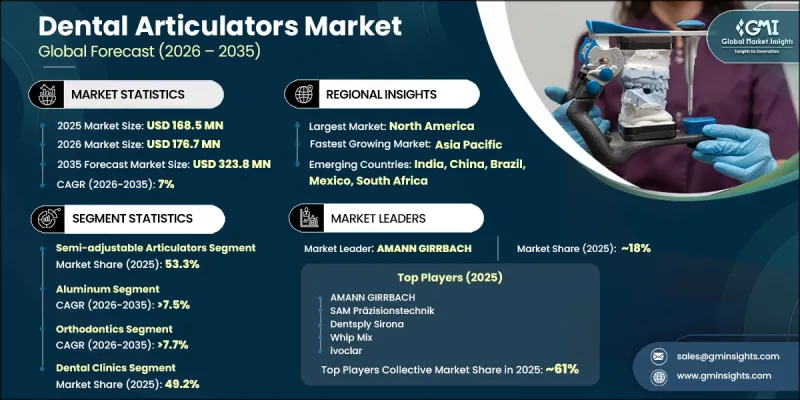
Growth in the market is driven by the rising incidence of dental conditions, increasing demand for restorative and prosthodontic treatments, and ongoing advancements in dental technologies. Dental articulators are essential mechanical instruments that replicate jaw movement, enabling clinicians to evaluate occlusion, alignment, and mandibular function with precision. These devices support accurate treatment planning and fabrication of dental restorations, contributing to improved clinical outcomes. The integration of digital technologies, including 3D imaging and advanced diagnostic systems, is further enhancing their effectiveness and adoption among dental professionals. In addition, the growing emphasis on aesthetic and restorative dentistry is fueling demand for highly accurate tools that ensure optimal bite registration. Expanding healthcare access and rising patient awareness regarding dental care are also contributing to steady market growth across regions.
| Market Scope | |
|---|---|
| Start Year | 2025 |
| Forecast Year | 2026-2035 |
| Start Value | $168.5 Million |
| Forecast Value | $323.8 Million |
| CAGR | 7% |
The semi-adjustable articulators segment held a 53.3% share in 2025. These devices are widely used across dental practices and laboratories due to their ability to deliver a practical balance between operational simplicity and functional precision. Their suitability for a wide range of restorative procedures has strengthened their adoption, particularly as demand for reliable occlusal simulation continues to grow. Cost-effectiveness combined with dependable performance makes them a preferred choice for routine dental applications.
The aluminum segment is expected to witness strong growth, registering a CAGR of 7.5% and surpassing USD 145.7 million by 2035. Aluminum-based articulators are favored for their lightweight structure, resistance to corrosion, and long-term durability, making them highly efficient during extended procedures. Their structural strength supports accurate occlusion analysis, enabling dental professionals to perform precise restorative planning. Increasing compatibility with digital workflows and advanced manufacturing techniques is further enhancing their utility, contributing to segment expansion.
U.S. Dental Articulators Market reached significant share in 2025. Market growth in the country is supported by a rising prevalence of dental conditions that require corrective and restorative treatments. An aging population is also contributing to higher demand for dental restorations that rely on precise occlusal evaluation. Additionally, increased focus on cosmetic dentistry, supported by higher disposable income levels and improved access to dental care services, continues to strengthen adoption. The presence of advanced healthcare infrastructure and innovation-driven manufacturers further supports steady market development.
Key companies operating in the Global Dental Articulators Market include AMANN GIRRBACH, Dentatus, Dentflex, Dentsply Sirona, Great Lakes Dental Technologies, Hager & Werken, ivoclar, KaVo Dental, Kerr, Keystone Industries, PLANMECA, SAM Prazisionstechnik, SHOFU, Straumann, and Whip Mix. Companies in the Dental Articulators Market are reinforcing their competitive position through continuous innovation, strategic partnerships, and portfolio expansion. Many manufacturers are integrating digital technologies such as CAD/CAM systems and 3D imaging capabilities to improve precision and efficiency. Firms are also focusing on developing lightweight, durable materials to enhance product performance and usability. Collaborations with dental clinics and laboratories are helping expand market reach and strengthen customer relationships. In addition, companies are investing in research and development to introduce advanced solutions that meet evolving clinical requirements. Expanding distribution channels and strengthening global presence are further enabling market players to capture new growth opportunities and maintain a strong foothold in the industry.
Table of Contents
Chapter 1 Research Methodology
- 1.1 Research approach
- 1.2 Quality commitments
- 1.2.1 GMI AI policy & data integrity commitment
- 1.2.1.1 Source consistency protocol
- 1.2.1 GMI AI policy & data integrity commitment
- 1.3 Research trail & confidence scoring
- 1.3.1 Research trail components
- 1.3.2 Scoring components
- 1.4 Data collection
- 1.4.1 Partial list of primary sources
- 1.5 Data mining sources
- 1.5.1 Paid sources
- 1.5.1.1 Sources, by region
- 1.5.1 Paid sources
- 1.6 Base estimates and calculations
- 1.6.1 Base year calculation for any one approach
- 1.7 Forecast model
- 1.7.1 Quantified market impact analysis
- 1.7.1.1 Mathematical impact of growth parameters on forecast
- 1.7.1 Quantified market impact analysis
- 1.8 Research transparency addendum
- 1.8.1 Source attribution framework
- 1.8.2 Quality assurance metrics
- 1.8.3 Our commitment to trust
Chapter 2 Executive Summary
- 2.1 Industry 3600 synopsis
- 2.2 Key market trends
- 2.2.1 Regional trends
- 2.2.2 Product type trends
- 2.2.3 Material trends
- 2.2.4 Application trends
- 2.2.5 End use trends
- 2.3 CXO perspectives: Strategic imperatives
Chapter 3 Industry Insights
- 3.1 Industry ecosystem analysis
- 3.2 Industry impact forces
- 3.2.1 Growth drivers
- 3.2.1.1 Increasing prevalence of dental disorders
- 3.2.1.2 Growing geriatric population requiring prosthodontic treatments
- 3.2.1.3 Rising awareness of oral health and growing demand for dental procedures
- 3.2.1.4 Advancements in dental technologies
- 3.2.1.5 Increasing demand for cosmetic and restorative dentistry
- 3.2.2 Industry pitfalls and challenges
- 3.2.2.1 High cost of advanced and fully adjustable articulators
- 3.2.2.2 Limited skilled professionals in emerging markets
- 3.2.3 Market opportunities
- 3.2.3.1 Growth in dental tourism in emerging economies
- 3.2.3.2 Rising demand for cosmetic and full-mouth rehabilitation procedures
- 3.2.1 Growth drivers
- 3.3 Growth potential analysis
- 3.4 Regulatory landscape (Driven by primary research)
- 3.4.1 North America
- 3.4.2 Europe
- 3.4.3 Asia Pacific
- 3.4.4 Latin America
- 3.4.5 Middle East and Africa
- 3.5 Technology landscape (Driven by primary research)
- 3.5.1 Current technological trends
- 3.5.2 Emerging technologies
- 3.6 Future market trends
- 3.7 Pricing analysis, 2025 (Driven by primary research)
- 3.8 Patent analysis (Driven by primary research)
- 3.9 Impact of AI and Generative AI on the market
- 3.10 Porter's analysis
- 3.11 PESTEL analysis
- 3.12 Customer insights (Driven by primary research)
- 3.13 Start-up scenarios
- 3.14 Gap analysis
Chapter 4 Competitive Landscape, 2025
- 4.1 Introduction
- 4.2 Company matrix analysis
- 4.3 Company market share analysis (Driven by primary research)
- 4.3.1 Global
- 4.3.2 North America
- 4.3.3 Europe
- 4.3.4 Asia Pacific
- 4.4 Competitive positioning matrix
- 4.5 Competitive analysis of major market players
- 4.6 Key developments
- 4.6.1 Mergers & acquisitions
- 4.6.2 Partnerships & collaborations
- 4.6.3 New product launches
- 4.6.4 Expansion plans
Chapter 5 Market Estimates and Forecast, By Product Type, 2022 - 2035 ($ Mn)
- 5.1 Key trends
- 5.2 Semi-adjustable articulators
- 5.3 Adjustable articulators
- 5.4 Fully adjustable articulators
Chapter 6 Market Estimates and Forecast, By Material, 2022 - 2035 ($ Mn)
- 6.1 Key trends
- 6.2 Aluminum
- 6.3 Brass
- 6.4 Stainless steel
Chapter 7 Market Estimates and Forecast, By Application, 2022 - 2035 ($ Mn)
- 7.1 Key trends
- 7.2 Orthodontics
- 7.3 Prosthodontics
- 7.4 Restorative dentistry
- 7.5 Other applications
Chapter 8 Market Estimates and Forecast, By End Use, 2022 - 2035 ($ Mn)
- 8.1 Key trends
- 8.2 Dental clinics
- 8.3 Hospitals
- 8.4 Other end users
Chapter 9 Market Estimates and Forecast, By Region, 2022 - 2035 ($ Mn)
- 9.1 Key trends
- 9.2 North America
- 9.2.1 U.S.
- 9.2.2 Canada
- 9.3 Europe
- 9.3.1 Germany
- 9.3.2 UK
- 9.3.3 France
- 9.3.4 Spain
- 9.3.5 Italy
- 9.3.6 Netherlands
- 9.4 Asia Pacific
- 9.4.1 China
- 9.4.2 Japan
- 9.4.3 India
- 9.4.4 Australia
- 9.4.5 South Korea
- 9.5 Latin America
- 9.5.1 Brazil
- 9.5.2 Mexico
- 9.5.3 Argentina
- 9.6 Middle East and Africa
- 9.6.1 South Africa
- 9.6.2 Saudi Arabia
- 9.6.3 UAE
Chapter 10 Company Profiles
- 10.1 AMANN GIRRBACH
- 10.2 Dentatus
- 10.3 Dentflex
- 10.4 Dentsply Sirona
- 10.5 Great Lakes Dental Technologies
- 10.6 Hager & Werken
- 10.7 ivoclar
- 10.8 KaVo Dental
- 10.9 Kerr
- 10.10 Keystone Industries
- 10.11 PLANMECA
- 10.12 SAM Prazisionstechnik
- 10.13 SHOFU
- 10.14 Straumann
- 10.15 Whip Mix

