PUBLISHER: Global Market Insights Inc. | PRODUCT CODE: 2038731

PUBLISHER: Global Market Insights Inc. | PRODUCT CODE: 2038731
Automatic Identification and Data Capture Market Opportunity, Growth Drivers, Industry Trend Analysis, and Forecast 2026 - 2035
The Global Automatic Identification and Data Capture (AIDC) Market was valued at USD 72.1 billion in 2025 and is estimated to grow at a CAGR of 13.5% to reach USD 248.5 billion by 2035.
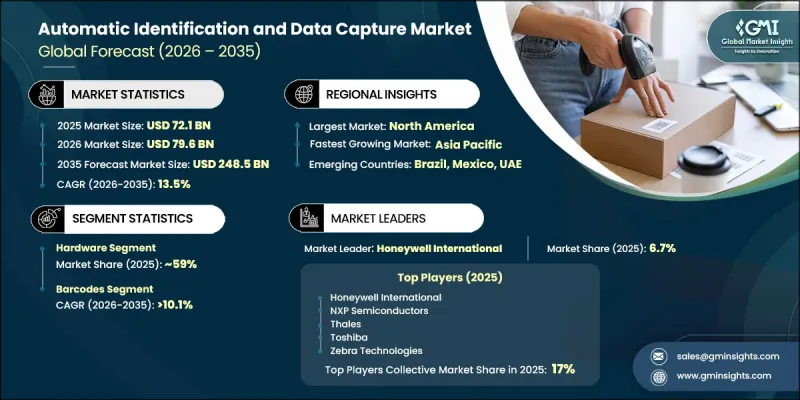
The market is witnessing strong expansion driven by the rapid adoption of advanced tracking and automation technologies, increasing deployment of multi-sensor data capture systems, and rising demand for real-time operational and inventory intelligence. Growing connectivity requirements across manufacturing, retail, logistics, healthcare, and government sectors are further accelerating adoption. Organizations are increasingly investing in AIDC hardware, software, and service ecosystems to enable accurate identification, process automation, and seamless integration with enterprise platforms such as ERP and supply chain management systems. Rising pressure to enhance operational efficiency, minimize human error, and improve data accuracy is pushing enterprises toward fully integrated and intelligent AIDC frameworks. Modern systems are enabling centralized tracking, AI-driven analytics, real-time monitoring, and remote management capabilities, which significantly improve data reliability and operational continuity. These solutions also support continuous updates across hardware and software layers, making them essential for digital transformation initiatives across industries. Overall, the market is evolving toward highly automated, connected, and intelligent identification systems that support real-time decision-making and end-to-end operational visibility.
| Market Scope | |
|---|---|
| Start Year | 2025 |
| Forecast Year | 2026-2035 |
| Start Value | $72.1 Billion |
| Forecast Value | $248.5 Billion |
| CAGR | 13.5% |
The hardware segment accounted for 59% share in 2025 and is projected to grow at a CAGR of 13.6% from 2026 to 2035. This segment continues to dominate due to its essential role in delivering physical AIDC components such as barcode scanners, RFID readers, biometric systems, smart card readers, mobile computing devices, and data capture terminals. These solutions enable accurate identification, real-time tracking, and efficient workflow automation across industries. Widespread deployment across manufacturing, retail and e-commerce, healthcare, logistics, transportation, financial services, and government sectors reinforces the strong reliance on hardware systems as the backbone of real-time data acquisition and operational monitoring. Their ability to integrate seamlessly with enterprise software platforms further strengthens their market leadership.
The barcodes segment held 31% share in 2025 and is expected to grow at a CAGR of 10.1% through 2035. This segment remains dominant due to its extensive use in environments requiring fast identification, reliable inventory control, and cost-effective data capture. Increasing demand for efficient transaction processing, supply chain transparency, product traceability, and real-time asset monitoring is driving widespread adoption of barcode technologies. Both 1D and 2D scanning systems are being increasingly deployed across global operations. Standardized, scalable, and software-enabled barcode solutions continue to support easy integration into enterprise workflows, strengthening their adoption across major global markets.
U.S. Automatic Identification and Data Capture (AIDC) Market accounted for 83% share in 2025, generating USD 19.3 billion. Market growth in the country is supported by its large-scale manufacturing base, highly developed retail and e-commerce sector, advanced healthcare systems, and extensive logistics and warehousing networks. Strong investment activity in warehouse automation, smart manufacturing systems, real-time inventory tracking, and AI-powered identification technologies is significantly boosting demand. Adoption of barcode systems, RFID technologies, biometric solutions, and cloud-enabled data capture platforms continues to rise across industrial, commercial, and public sector applications, reinforcing the country's leadership in the regional market.
Key companies operating in the Automatic Identification and Data Capture Market include Zebra Technologies, Honeywell International, Cognex, Datalogic, NXP Semiconductors, SICK, Omron, SATO, Toshiba, and Thales. Companies in the automatic identification and data capture market are focusing on strengthening their competitive position through continuous innovation in hardware design, software integration, and AI-enabled data processing capabilities. Many players are investing in next-generation scanning and sensing technologies to improve the accuracy, speed, and reliability of data capture. Expansion of cloud-based and edge computing-enabled AIDC solutions is enhancing real-time analytics and operational visibility. Strategic partnerships with enterprise software providers support deeper integration with ERP and supply chain platforms. Firms are also focusing on expanding their product portfolios to include RFID, biometric, and mobile computing solutions for broader application coverage. Additionally, companies are strengthening global distribution networks and increasing investment in R&D to develop scalable, energy-efficient, and interoperable systems that support digital transformation initiatives across industries while improving long-term customer engagement and market penetration.
Table of Contents
Chapter 1 Methodology & Scope
- 1.1 Research approach
- 1.2 Quality Commitments
- 1.2.1 GMI AI policy & data integrity commitment
- 1.2.1.1 Source consistency protocol
- 1.2.1 GMI AI policy & data integrity commitment
- 1.3 Research Trail & Confidence Scoring
- 1.3.1 Research Trail Components
- 1.3.2 Scoring Components
- 1.4 Data Collection
- 1.4.1 Partial list of primary sources
- 1.5 Data mining sources
- 1.5.1 Paid sources
- 1.5.1.1 Sources, by region
- 1.5.1 Paid sources
- 1.6 Base estimates and calculations
- 1.6.1 Base year calculation
- 1.7 Forecast model
- 1.7.1 Quantified market impact analysis
- 1.7.1.1 Mathematical impact of growth parameters on forecast
- 1.7.1 Quantified market impact analysis
- 1.8 Research transparency addendum
- 1.8.1 Source attribution framework
- 1.8.2 Quality assurance metrics
- 1.8.3 Our commitment to trust
Chapter 2 Executive Summary
- 2.1 Industry 360° synopsis
- 2.2 Key market trends
- 2.2.1 Regional
- 2.2.2 Component
- 2.2.3 Technology
- 2.2.4 End Use
- 2.3 TAM Analysis, 2026-2035
- 2.4 CXO perspectives: Strategic imperatives
Chapter 3 Industry Insights
- 3.1 Industry ecosystem analysis
- 3.1.1 Supplier Landscape
- 3.1.2 Profit Margin
- 3.1.3 Cost structure
- 3.1.4 Value addition at each stage
- 3.1.5 Factor affecting the value chain
- 3.1.6 Disruptions
- 3.2 Industry impact forces
- 3.2.1 Growth drivers
- 3.2.1.1 Rising demand for automatic identification and data capture in healthcare industry
- 3.2.1.2 Growing demand for supply chain optimization
- 3.2.1.3 Rise in inclination towards real-time monitoring
- 3.2.1.4 Increasing need for streamlining retail & e-commerce operations
- 3.2.2 Industry pitfalls & challenges
- 3.2.2.1 Significant upfront costs for implementing AIDC systems
- 3.2.2.2 Complexities in AIDC integration
- 3.2.3 Market opportunities
- 3.2.3.1 Expansion of E-commerce & Warehouse Automation
- 3.2.3.2 Growing Adoption in Healthcare
- 3.2.3.3 Biometric Authentication & Security Solutions
- 3.2.3.4 Industry 4.0 and Smart Manufacturing
- 3.2.1 Growth drivers
- 3.3 Growth potential analysis
- 3.4 Technology and Innovation Landscape
- 3.4.1 Current technological trends
- 3.4.2 Emerging technologies
- 3.5 Pricing Analysis (Driven by Primary Research)
- 3.5.1 Historical Price Trend Analysis
- 3.5.2 Pricing Strategy by Player Type
- 3.6 Regulatory landscape
- 3.6.1 North America
- 3.6.1.1 U.S. - Regulatory Framework for AIDC Technologies and Data Privacy Compliance
- 3.6.1.2 Canada - National Standards and Data Protection Regulations for AIDC Systems
- 3.6.2 Europe
- 3.6.2.1 United Kingdom - AIDC Governance under Data Protection and Digital Identification Laws
- 3.6.2.2 Germany - Industrial AIDC Standards and GDPR-Driven Compliance Framework
- 3.6.2.3 France - Regulatory Policies for AIDC Integration and Data Security Requirements
- 3.6.3 Asia Pacific
- 3.6.3.1 India - Emerging AIDC Regulations under Digital Data Protection and Industry Standards
- 3.6.3.2 China - State-Controlled AIDC Regulations and Cybersecurity Compliance Structure
- 3.6.3.3 Japan - AIDC Standardization and Data Governance under Industrial Policies
- 3.6.4 Latin America
- 3.6.4.1 Brazil - AIDC Compliance under National Data Protection and Industry Regulations
- 3.6.5 Middle East & Africa
- 3.6.5.1 United Arab Emirates - Smart Technology Regulations and AIDC Implementation Guidelines
- 3.6.1 North America
- 3.7 Porter's analysis
- 3.8 PESTEL analysis
- 3.9 Patent analysis (Driven by Primary Research)
- 3.10 Impact of AI & generative AI on the market
- 3.10.1 AI-Driven Disruption of Existing Business Models
- 3.10.2 GenAI Use Cases & Adoption Roadmap by Segment
- 3.10.3 Risks, limitations & regulatory considerations
- 3.11 Sustainability and environmental aspects
- 3.11.1 Sustainable practices
- 3.11.2 Waste reduction strategies
- 3.11.3 Energy efficiency in production
- 3.11.4 Eco-friendly initiatives
- 3.11.5 Carbon footprint considerations
- 3.12 Forecast assumptions & scenario analysis (Driven by Primary Research)
- 3.12.1 Base Case - Key Macro & Industry Variables Driving CAGR
- 3.12.2 Optimistic Scenarios - Favorable macro and industry tailwinds
- 3.12.3 Pessimistic Scenario - Macroeconomic slowdown or industry headwinds
Chapter 4 Competitive Landscape, 2025
- 4.1 Introduction
- 4.2 Company market share analysis
- 4.2.1 North America
- 4.2.2 Europe
- 4.2.3 Asia Pacific
- 4.2.4 Latin America
- 4.2.5 Middle East & Africa
- 4.3 Competitive analysis of major market players
- 4.4 Competitive positioning matrix
- 4.5 Strategic outlook matrix
- 4.6 Key developments
- 4.6.1 Mergers & acquisitions
- 4.6.2 Partnerships & collaborations
- 4.6.3 New product launches
- 4.6.4 Expansion plans and funding
- 4.7 Company Tier Benchmarking
- 4.7.1 Tier Classification Criteria & Qualifying Thresholds
- 4.7.2 Tier Positioning Matrix by Revenue, Geography & Innovation
Chapter 5 Market Estimates & Forecast, By Component, 2022 - 2035 ($Bn)
- 5.1 Key trends
- 5.2 Hardware
- 5.3 Software
- 5.4 Services
Chapter 6 Market Estimates & Forecast, By Technology, 2022 - 2035 ($Bn)
- 6.1 Key trends
- 6.2 Barcodes
- 6.3 Radio Frequency Identification (RFID)
- 6.4 Biometrics
- 6.5 Smart cards
- 6.6 Voice recognition
- 6.7 Others
Chapter 7 Market Estimates & Forecast, By End Use, 2022 - 2035 ($Bn)
- 7.1 Key trends
- 7.2 Manufacturing
- 7.3 Retail & e-commerce
- 7.4 Transportation & logistics
- 7.5 BFSI
- 7.6 Hospitality
- 7.7 Healthcare
- 7.8 Government
- 7.9 Others
Chapter 8 Market Estimates & Forecast, By Region, 2022 - 2035 ($Bn)
- 8.1 Key trends
- 8.2 North America
- 8.2.1 US
- 8.2.2 Canada
- 8.3 Europe
- 8.3.1 UK
- 8.3.2 Germany
- 8.3.3 France
- 8.3.4 Italy
- 8.3.5 Spain
- 8.3.6 Belgium
- 8.3.7 Netherlands
- 8.3.8 Sweden
- 8.4 Asia Pacific
- 8.4.1 China
- 8.4.2 India
- 8.4.3 Japan
- 8.4.4 Australia
- 8.4.5 Singapore
- 8.4.6 South Korea
- 8.4.7 Vietnam
- 8.4.8 Indonesia
- 8.5 Latin America
- 8.5.1 Brazil
- 8.5.2 Mexico
- 8.5.3 Argentina
- 8.6 MEA
- 8.6.1 UAE
- 8.6.2 South Africa
- 8.6.3 Saudi Arabia
Chapter 9 Company Profiles
- 9.1 Global Player
- 9.1.1 Cognex
- 9.1.2 Datalogic
- 9.1.3 Honeywell International
- 9.1.4 NXP Semiconductors
- 9.1.5 Omron
- 9.1.6 SATO
- 9.1.7 SICK
- 9.1.8 Thales
- 9.1.9 Toshiba
- 9.1.10 Zebra Technologies
- 9.2 Regional Player
- 9.2.1 Avery Dennison
- 9.2.2 CASIO Computer
- 9.2.3 Code
- 9.2.4 Fujitsu
- 9.2.5 Identiv
- 9.2.6 Invengo Technology
- 9.2.7 SecuGen
- 9.2.8 Shanghai Feig Electronics
- 9.2.9 Synaptics
- 9.2.10 TSC Auto ID

