PUBLISHER: Global Market Insights Inc. | PRODUCT CODE: 2038741

PUBLISHER: Global Market Insights Inc. | PRODUCT CODE: 2038741
Handwheels Market Opportunity, Growth Drivers, Industry Trend Analysis, and Forecast 2026 - 2035
The Global Handwheels Market was valued at USD 773.9 million in 2025 and is estimated to grow at a CAGR of 8.1% to reach USD 1.7 billion by 2035.
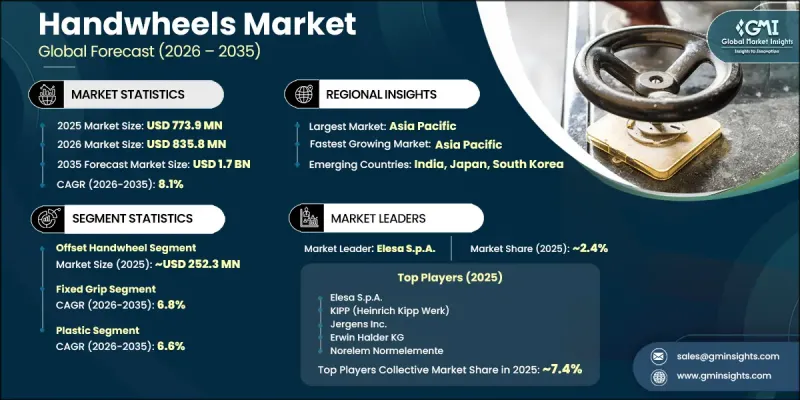
Market growth is supported by the rising demand for dependable manual control components used in industrial machinery and mechanical systems. As industrial environments increasingly incorporate electronic systems, there remains a strong need for precise manual adjustment tools to regulate positioning and flow control functions. Handwheels provide a practical solution where automated systems are not feasible, offering operators reliable performance, ease of handling, and low maintenance requirements. Their simplicity and cost efficiency make them widely adopted across equipment manufacturing industries. The continued expansion of global manufacturing and processing sectors is further reinforcing demand, as these components play a key role in maintaining operational accuracy and system control. Growth in industrial output, particularly across developing regions, is contributing to new equipment installations, while mature markets continue to generate demand through maintenance and replacement cycles, ensuring consistent market progression.
| Market Scope | |
|---|---|
| Start Year | 2025 |
| Forecast Year | 2026-2035 |
| Start Value | $773.9 Million |
| Forecast Value | $1.7 Billion |
| CAGR | 8.1% |
The offset handwheel segment generated USD 252.3 million in 2025 and is anticipated to grow at a CAGR of 7.7% through 2035. This segment holds a strong position due to its user-friendly structure and improved handling efficiency in industrial operations. Its design enhances leverage and grip, enabling smoother and more precise manual adjustments. These features make it suitable for applications requiring accuracy and operator comfort, particularly in environments with limited space. Increasing reliance on dependable manual control solutions continues to support its widespread adoption.
The fixed grip segment accounted for 41.5% share in 2025 and is expected to grow at a CAGR of 6.8% during 2026-2035. Its leadership is driven by a straightforward design, durability, and consistent performance in repetitive tasks. Fixed grip configurations provide stable control and require minimal upkeep, making them highly suitable for demanding industrial settings. Their long service life and cost efficiency further strengthen their position across various machinery and mechanical systems.
China Handwheels Market reached USD 114 million in 2025 and is projected to grow at a CAGR of 9.4% from 2026 to 2035. The country serves as a major production and consumption hub, supported by a well-established manufacturing ecosystem. Strong demand is driven by extensive use in industrial machinery and equipment applications, with manufacturers offering a broad range of products to meet both domestic and international requirements. Competitive production capabilities and scalable operations continue to support sustained market expansion.
Key players operating in the Global Handwheels Market include Elesa S.p.A., Otto Ganter GmbH & Co. KG, JW Winco Inc., Jergens Inc., Carr Lane Manufacturing, Imao Corporation, Heinrich Kipp Werk, Norelem Normelemente, GAMM S.r.l., Tecnodin S.L., Trumbull Manufacturing, Alpha Engineering Co., Erwin Halder KG, ELCO Inc., and Igus (igus SE & Co. KG). Companies in the handwheels market are strengthening their market position by focusing on product innovation, quality enhancement, and expanding their global distribution networks. Manufacturers are developing ergonomically improved designs and durable materials to enhance performance and reliability across industrial applications. Strategic partnerships with equipment manufacturers are helping companies secure long-term supply agreements and expand their customer base. Firms are also investing in efficient production processes to reduce costs while maintaining consistent product quality. Expanding presence in emerging markets and offering customized solutions tailored to specific industrial requirements further support growth.
Table of Contents
Chapter 1 Methodology & Scope
- 1.1 Market scope and definition
- 1.2 Research design
- 1.2.1 Research approach
- 1.2.2 Data collection methods
- 1.3 Data mining sources
- 1.3.1 Global
- 1.3.2 Regional/Country
- 1.4 Base estimates and calculations
- 1.4.1 Base year calculation
- 1.4.2 Key trends for market estimation
- 1.5 Primary research and validation
- 1.5.1 Primary sources
- 1.6 Forecast model
- 1.7 Research assumptions and limitations
Chapter 2 Executive Summary
- 2.1 Industry 360° synopsis
- 2.2 Key market trends
- 2.2.1 Regional
- 2.2.2 Product Type
- 2.2.3 Grip Type
- 2.2.4 Material
- 2.2.5 Type of Assembly
- 2.2.6 End Use Industry
- 2.2.7 Distribution channel
Chapter 3 Industry Insights
- 3.1 Industry ecosystem analysis
- 3.1.1 Supplier landscape
- 3.1.2 Profit margin
- 3.1.3 Value addition at each stage
- 3.1.4 Factor affecting the value chain
- 3.2 Industry impact forces
- 3.2.1 Growth drivers
- 3.2.1.1 Growing demand for manual control components in industrial machinery
- 3.2.1.2 Expansion of manufacturing and process industries globally
- 3.2.1.3 Rising need for precision control in mechanical operations
- 3.2.2 Pitfalls & Challenges
- 3.2.2.1 Shift toward automation and digitally controlled systems
- 3.2.2.2 Wear and tear due to frequent manual operation
- 3.2.3 Opportunities
- 3.2.3.1 Development of ergonomic and user-friendly handwheel designs
- 3.2.3.2 Integration with hybrid systems combining manual and automated controls
- 3.2.1 Growth drivers
- 3.3 Growth potential analysis
- 3.4 Future market trends
- 3.5 Technology and innovation landscape
- 3.5.1 Current technological trends
- 3.5.2 Emerging technologies
- 3.6 Regulatory landscape
- 3.6.1 Standards and compliance requirements
- 3.6.2 Regional regulatory frameworks
- 3.6.3 Certification standards
- 3.7 Porter's analysis
- 3.8 PESTEL analysis
- 3.9 Pricing analysis (driven by primary research)
- 3.9.1 Historical price trend analysis (driven by primary research)
- 3.9.2 Pricing strategy by player type (premium / value / cost-plus) (driven by primary research)
- 3.10 Trade data analysis (HS code 8483 50) (driven by paid data base)
- 3.10.1 Import/export volume and value trends (driven by paid data base)
- 3.10.2 Key trade corridors and tariff impact (driven by paid data base)
- 3.11 Impact of AI and generative AI on the market
- 3.11.1 AI-driven disruption of existing business models
- 3.11.2 GenAI use cases and adoption roadmap by segment
- 3.11.3 Risks, limitations and regulatory considerations
- 3.12 Capacity and production landscape (driven by primary research)
- 3.12.1 Installed capacity by region and key producer (driven by primary research)
- 3.12.2 Capacity utilization rates and expansion pipelines (driven by primary research)
Chapter 4 Competitive Landscape, 2025
- 4.1 Introduction
- 4.2 Company market share analysis
- 4.2.1 By Region
- 4.2.1.1 North America
- 4.2.1.2 Europe
- 4.2.1.3 Asia Pacific
- 4.2.1.4 Latin America
- 4.2.1.5 Middle East & Africa
- 4.2.1 By Region
- 4.3 Company matrix analysis
- 4.4 Competitive analysis of major market players
- 4.5 Competitive positioning matrix
- 4.6 Key developments
- 4.6.1 Mergers & acquisitions
- 4.6.2 Partnerships & collaborations
- 4.6.3 New product launches
- 4.6.4 Expansion plans
Chapter 5 Market Estimates & Forecast, By Product Type, 2022 - 2035, (USD Million) (Thousand Units)
- 5.1 Key trends
- 5.2 Offset handwheel
- 5.3 Spoked handwheel
- 5.4 Flat handwheel
- 5.5 Handlebar handwheel
- 5.6 Others
Chapter 6 Market Estimates & Forecast, By Grip Type, 2022 - 2035, (USD Million) (Thousand Units)
- 6.1 Key trends
- 6.2 Fixed grip
- 6.3 Folding grip
- 6.4 Revolving grip
- 6.5 Others
Chapter 7 Market Estimates & Forecast, By Material, 2022 - 2035, (USD Million) (Thousand Units)
- 7.1 Key trends
- 7.2 Aluminum
- 7.3 Plastic
- 7.4 Stainless steel
- 7.5 Cast iron
- 7.6 Others
Chapter 8 Market Estimates & Forecast, By Type of Assembly, 2022 - 2035, (USD Million) (Thousand Units)
- 8.1 Key trends
- 8.2 Plain hole
- 8.3 Keyway hole
- 8.4 Others
Chapter 9 Market Estimates & Forecast, By End Use Industry, 2022 - 2035, (USD Million) (Thousand Units)
- 9.1 Key trends
- 9.2 Automotive
- 9.3 Oil & gas
- 9.4 Food & beverage
- 9.5 Manufacturing industry
- 9.6 Construction
- 9.7 Others
Chapter 10 Market Estimates & Forecast, By Distribution Channel, 2022 - 2035, (USD Million) (Thousand Units)
- 10.1 Key trends
- 10.2 Direct sales
- 10.3 Indirect sales
Chapter 11 Market Estimates & Forecast, By Region, 2022 - 2035, (USD Million) (Thousand Units)
- 11.1 Key trends
- 11.2 North America
- 11.2.1 U.S.
- 11.2.2 Canada
- 11.3 Europe
- 11.3.1 Germany
- 11.3.2 UK
- 11.3.3 France
- 11.3.4 Italy
- 11.3.5 Spain
- 11.4 Asia Pacific
- 11.4.1 China
- 11.4.2 India
- 11.4.3 Japan
- 11.4.4 South Korea
- 11.4.5 Australia
- 11.5 Latin America
- 11.5.1 Brazil
- 11.5.2 Mexico
- 11.5.3 Argentina
- 11.6 MEA
- 11.6.1 Saudi Arabia
- 11.6.2 UAE
- 11.6.3 South Africa
Chapter 12 Company Profiles
- 12.1 Alpha Engineering Co.
- 12.2 Carr Lane Manufacturing
- 12.3 ELCO Inc.
- 12.4 Elesa S.p.A.
- 12.5 Erwin Halder KG
- 12.6 GAMM S.r.l.
- 12.7 Igus (igus SE & Co. KG)
- 12.8 Imao Corporation
- 12.9 Jergens Inc.
- 12.10 JW Winco Inc.
- 12.11 KIPP (Heinrich Kipp Werk)
- 12.12 Norelem Normelemente
- 12.13 Otto Ganter GmbH & Co. KG
- 12.14 Tecnodin S.L.
- 12.15 Trumbull Manufacturing

