PUBLISHER: Global Market Insights Inc. | PRODUCT CODE: 2038745

PUBLISHER: Global Market Insights Inc. | PRODUCT CODE: 2038745
Aircraft Fairings Market Opportunity, Growth Drivers, Industry Trend Analysis, and Forecast 2026 - 2035
The Global Aircraft Fairings Market was valued at USD 3.1 million in 2025 and is estimated to grow at a CAGR of 6.7% to reach USD 5.9 million by 2035.
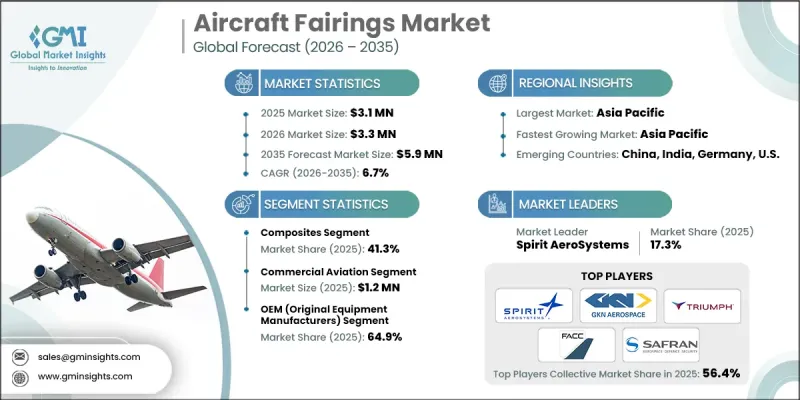
Market expansion is driven by rising commercial aircraft production, increasing emphasis on aerodynamic efficiency, and growing demand for fuel optimization across aviation fleets. The adoption of lightweight composite structures is accelerating as manufacturers prioritize weight reduction and performance enhancement. In addition, expanding maintenance, repair, and overhaul activities are supporting steady aftermarket demand for aircraft fairings. Defense aviation modernization programs are also contributing to sustained procurement of advanced external structural components. Airlines and aircraft OEMs are increasingly focused on improving fuel economy and operational efficiency, which is encouraging greater integration of advanced fairing designs. Continuous fleet expansion and high aircraft utilization rates are reinforcing aftermarket replacement cycles. Technological progress in materials engineering and structural design is enabling improved durability and aerodynamic performance. The shift toward modular and platform-based fairing design approaches is further reshaping manufacturing strategies, improving production efficiency, and supporting long-term market growth across both commercial and military aviation sectors.
| Market Scope | |
|---|---|
| Start Year | 2025 |
| Forecast Year | 2026-2035 |
| Start Value | $3.1 Million |
| Forecast Value | $5.9 Million |
| CAGR | 6.7% |
The composites segment held a 41.3% share in 2025. This dominance is driven by widespread use of carbon fiber and reinforced composite materials in both commercial and defense aircraft. These materials are highly valued for their strength-to-weight efficiency, corrosion resistance, and capability to support complex aerodynamic structures, ensuring continued demand across OEM production and aftermarket applications.
The commercial aviation segment accounted for USD 1.2 million in 2025. Strong aircraft production volumes and extensive integration of fairings across fuselage, wing, and engine assemblies are key factors supporting this segment. Ongoing fleet expansion and replacement programs are sustaining consistent demand for fairings in commercial aircraft manufacturing and maintenance operations.
North America Aircraft Fairings Market held a 31.4% share in 2025. The region's growth is supported by the strong presence of leading aircraft OEMs, tier-1 aerostructure suppliers, and a large operational fleet of commercial and defense aircraft. High production activity and early adoption of advanced composite and aerodynamic technologies continue to drive demand across new aircraft programs. The region also benefits from a well-established MRO ecosystem and consistent defense spending, which further support replacement and upgrade requirements for aircraft fairings.
Key companies operating in the Global Aircraft Fairings Market include Spirit AeroSystems, GKN Aerospace, Triumph Group, Safran, FACC AG, Leonardo S.p.A., Aernnova Aerospace, Kaman Corporation, Senior plc, Stelia Aerospace, MTorres, Meggitt, Nordam Group, ShinMaywa Industries, and AVIC. Companies in the Aircraft Fairings Market are strengthening their position through continuous investment in advanced composite materials and lightweight structural technologies. Manufacturers are focusing on improving aerodynamic efficiency and reducing aircraft weight to meet evolving fuel efficiency targets. Strategic partnerships with aircraft OEMs and defense contractors are enabling long-term supply agreements and program integration. Firms are also expanding their aftermarket service capabilities to capture maintenance-driven demand. Increased investment in digital design tools, simulation technologies, and automated manufacturing processes is enhancing production accuracy and reducing lead times. Additionally, companies are developing modular and platform-based fairing solutions to improve scalability and cost efficiency.
Table of Contents
Chapter 1 Methodology and Scope
- 1.1 Market scope and definition
- 1.2 Research design
- 1.2.1 Research approach
- 1.2.2 Data collection methods
- 1.3 Data mining sources
- 1.3.1 Global
- 1.3.2 Regional/Country
- 1.4 Base estimates and calculations
- 1.4.1 Base year calculation
- 1.4.2 Key trends for market estimation
- 1.5 Primary research and validation
- 1.5.1 Primary sources
- 1.6 Forecast model
- 1.7 Research assumptions and limitations
Chapter 2 Executive Summary
- 2.1 Industry 360° synopsis, 2022 - 2035
- 2.2 Key market trends
- 2.2.1 Material type trends
- 2.2.2 Platform trends
- 2.2.3 Application rends
- 2.2.4 End-user trends
- 2.2.5 Regional trends
- 2.3 TAM Analysis, 2026-2035
- 2.4 CXO perspectives: Strategic imperatives
Chapter 3 Industry Insights
- 3.1 Industry ecosystem analysis
- 3.1.1 Supplier Landscape
- 3.1.2 Profit Margin
- 3.1.3 Cost structure
- 3.1.4 Value addition at each stage
- 3.1.5 Factor affecting the value chain
- 3.1.6 Disruptions
- 3.2 Industry impact forces
- 3.2.1 Growth drivers
- 3.2.1.1 Rising production of commercial aircraft
- 3.2.1.2 Growing focus on fuel efficiency and drag reduction
- 3.2.1.3 Increased use of advanced composite materials
- 3.2.1.4 Expansion of the aircraft MRO and aftermarket segment
- 3.2.1.5 Rising defense aircraft modernization and fleet upgrades
- 3.2.2 Industry pitfalls and challenges
- 3.2.2.1 High design complexity and certification requirements
- 3.2.2.2 Exposure to aircraft production delays and program disruptions
- 3.2.3 Market opportunities
- 3.2.3.1 Rising development of advanced air mobility and electric vertical take-off and landing (eVTOL) aircraft platforms
- 3.2.3.2 Adoption of additive manufacturing and rapid tooling for fairing production
- 3.2.1 Growth drivers
- 3.3 Growth potential analysis
- 3.4 Regulatory landscape
- 3.4.1 North America
- 3.4.2 Europe
- 3.4.3 Asia Pacific
- 3.4.4 Latin America
- 3.4.5 Middle East & Africa
- 3.5 Porter's analysis
- 3.6 PESTEL analysis
- 3.7 Technology and Innovation landscape
- 3.7.1 Current technological trends
- 3.7.2 Emerging technologies
- 3.8 Price trends
- 3.8.1 By region
- 3.8.2 By product
- 3.9 Pricing Strategies
- 3.10 Emerging Business Models
- 3.11 Compliance Requirements
- 3.12 Patent and IP analysis
Chapter 4 Competitive Landscape, 2025
- 4.1 Introduction
- 4.2 Company market share analysis
- 4.2.1 By region
- 4.2.1.1 North America
- 4.2.1.2 Europe
- 4.2.1.3 Asia Pacific
- 4.2.1.4 Latin America
- 4.2.1.5 Middle East & Africa
- 4.2.2 Market concentration analysis
- 4.2.1 By region
- 4.3 Competitive benchmarking of key players
- 4.3.1 Financial performance comparison
- 4.3.1.1 Revenue
- 4.3.1.2 Profit margin
- 4.3.1.3 R&D
- 4.3.2 Product portfolio comparison
- 4.3.2.1 Product range breadth
- 4.3.2.2 Technology
- 4.3.2.3 Innovation
- 4.3.3 Geographic presence comparison
- 4.3.3.1 Global footprint analysis
- 4.3.3.2 Service network coverage
- 4.3.3.3 Market penetration by region
- 4.3.4 Competitive positioning matrix
- 4.3.4.1 Leaders
- 4.3.4.2 Challengers
- 4.3.4.3 Followers
- 4.3.4.4 Niche players
- 4.3.5 Strategic outlook matrix
- 4.3.1 Financial performance comparison
- 4.4 Key developments
- 4.4.1 Mergers and acquisitions
- 4.4.2 Partnerships and collaborations
- 4.4.3 Technological advancements
- 4.4.4 Expansion and investment strategies
- 4.4.5 Digital transformation initiatives
- 4.5 Emerging/ startup competitors landscape
Chapter 5 Market Estimates and Forecast, By Material Type, 2022 - 2035 (USD Million)
- 5.1 Key trends
- 5.2 Composites
- 5.3 Metals
- 5.4 Hybrids
Chapter 6 Market Estimates and Forecast, By Platform, 2022 - 2035 (USD Million)
- 6.1 Key trends
- 6.2 Commercial aviation
- 6.2.1 Narrow-body aircraft
- 6.2.2 Wide-body aircraft
- 6.2.3 Regional jets
- 6.3 Military Aviation
- 6.3.1 Fighter aircraft
- 6.3.2 Transport aircraft
- 6.3.3 Military UAVs
- 6.4 General aviation
- 6.5 Helicopters (rotary-wing)
- 6.5.1 Civil helicopters
- 6.5.2 Military helicopters
Chapter 7 Market Estimates and Forecast, By Application, 2022 - 2035 (USD Million)
- 7.1 Key trends
- 7.2 Fuselage fairings
- 7.3 Wing fairings
- 7.4 Landing gear fairings
- 7.5 Propulsion fairings
- 7.6 Control surface fairings
- 7.7 Radars & antenna fairings
- 7.8 Others
Chapter 8 Market Estimates and Forecast, By End-User, 2022 - 2035 (USD Million)
- 8.1 Key trends
- 8.2 OEM (original equipment manufacturers)
- 8.3 Aftermarket (MRO & replacement)
Chapter 9 Market Estimates and Forecast, By Region, 2022 - 2035 (USD Million)
- 9.1 Key trends
- 9.2 North America
- 9.2.1 U.S.
- 9.2.2 Canada
- 9.3 Europe
- 9.3.1 Germany
- 9.3.2 UK
- 9.3.3 France
- 9.3.4 Spain
- 9.3.5 Italy
- 9.3.6 Russia
- 9.4 Asia Pacific
- 9.4.1 China
- 9.4.2 India
- 9.4.3 Japan
- 9.4.4 Australia
- 9.4.5 South Korea
- 9.5 Latin America
- 9.5.1 Brazil
- 9.5.2 Mexico
- 9.5.3 Argentina
- 9.6 Middle East and Africa
- 9.6.1 South Africa
- 9.6.2 Saudi Arabia
- 9.6.3 UAE
Chapter 10 Company Profiles
- 10.1 Global Key Players
- 10.1.1 Spirit AeroSystems
- 10.1.2 GKN Aerospace
- 10.1.3 Triumph Group
- 10.1.4 FACC AG
- 10.1.5 Safran
- 10.2 Regional key players
- 10.2.1 North America
- 10.2.1.1 Kaman Corporation
- 10.2.1.2 Nordam Group
- 10.2.1.3 Meggitt
- 10.2.2 Asia Pacific
- 10.2.2.1 ShinMaywa Industries
- 10.2.2.2 AVIC
- 10.2.3 Europe
- 10.2.3.1 Leonardo S.p.A.
- 10.2.3.2 Senior plc
- 10.2.3.3 Aernnova Aerospace
- 10.2.3.4 Stelia Aerospace
- 10.2.3.5 MTorres
- 10.2.1 North America

