PUBLISHER: Global Market Insights Inc. | PRODUCT CODE: 2038749

PUBLISHER: Global Market Insights Inc. | PRODUCT CODE: 2038749
Circular Polymers Market Opportunity, Growth Drivers, Industry Trend Analysis, and Forecast 2026 - 2035
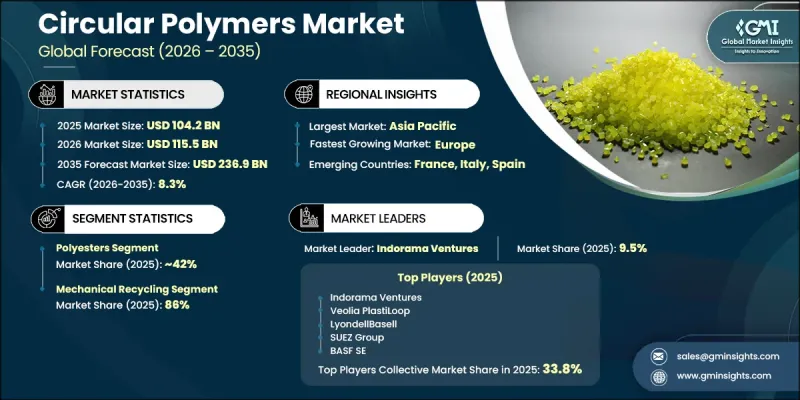
The Global Circular Polymers Market was valued at USD 104.2 billion in 2025 and is estimated to grow at a CAGR of 8.3% to reach USD 236.9 billion by 2035.
The industry continues to gain traction as sustainability priorities reshape material usage across sectors. Companies are increasingly adopting resource-efficient practices to minimize waste and improve lifecycle performance. Rising environmental awareness among consumers is accelerating the shift toward recyclable and reusable materials, particularly in packaging and consumer goods. Circular polymers are emerging as a preferred alternative due to their ability to reduce plastic waste while maintaining product durability. Advancements in recycling infrastructure, combined with innovations in sorting, cleaning, and reprocessing technologies, are improving material quality and usability. Regulatory frameworks promoting recycled content usage and incentivizing eco-friendly production further support market expansion. Growing alignment between industrial sustainability goals and consumer expectations is reinforcing adoption across manufacturing, automotive, and packaging industries, creating a strong foundation for long-term growth.
| Market Scope | |
|---|---|
| Start Year | 2025 |
| Forecast Year | 2026-2035 |
| Start Value | $104.2 Billion |
| Forecast Value | $236.9 Billion |
| CAGR | 8.3% |
The mechanical recycling segment captured a share of 86% in 2025, supported by its cost efficiency and well-established infrastructure. This method relies on physical processing techniques to convert plastic waste into reusable material without altering its chemical composition, making it highly suitable for widely used polymers. Its simplicity, scalability, and compatibility with existing systems continue to strengthen its dominance across multiple industries.
The polyesters segment held a 42% share in 2025 and is forecast to grow at a CAGR of 7.2% through 2035. Their strong recyclability, durability, and adaptability make them a preferred choice for a wide range of applications. Increasing demand for sustainable materials in packaging and textile production continues to drive the adoption of polyester-based circular solutions.
North America Circular Polymers Market is expected to grow at a CAGR of 7.8% between 2026 and 2035. Growth in the region is driven by stricter environmental regulations, improved recycling capabilities, and heightened consumer awareness regarding sustainability. Investments in advanced recycling systems and eco-conscious manufacturing practices are further strengthening regional market expansion.
Key participants in the Global Circular Polymers Market include Amcor, Brightmark, BASF SE, Carbios, Eastman, Enka, Gr3n, Indorama Ventures, KW Plastics, Loop Industries, LyondellBasell, MBA Polymers, Plastic Energy, Plastipak, PureCycle Technologies, SUEZ Group, and Veolia PlastiLoop. Companies operating in the circular polymers market are focusing on expanding recycling capabilities, investing in advanced processing technologies, and forming strategic collaborations to strengthen their competitive position. Many players are prioritizing chemical recycling innovations to complement mechanical methods and improve material recovery rates. Partnerships across the value chain, including waste management firms and packaging companies, are helping ensure consistent raw material supply. Businesses are also emphasizing product innovation by developing high-quality recycled polymers that meet performance standards.
Table of Contents
Chapter 1 Methodology & Scope
- 1.1 Market scope and definition
- 1.2 Research design
- 1.2.1 Research approach
- 1.2.2 Data collection methods
- 1.3 Data mining sources
- 1.3.1 Global
- 1.3.2 Regional/Country
- 1.4 Base estimates and calculations
- 1.4.1 Base year calculation
- 1.4.2 Key trends for market estimation
- 1.5 Primary research and validation
- 1.5.1 Primary sources
- 1.6 Forecast model
- 1.7 Research assumptions and limitations
Chapter 2 Executive Summary
- 2.1 Industry 360° synopsis
- 2.2 Key market trends
- 2.2.1 Regional
- 2.2.2 Polymer type
- 2.2.3 Recycling technology
- 2.2.4 Application
- 2.3 TAM Analysis, 2026-2035
- 2.4 CXO perspectives: Strategic imperatives
Chapter 3 Industry Insights
- 3.1 Industry ecosystem analysis
- 3.1.1 Supplier landscape
- 3.1.2 Profit margin
- 3.1.3 Value addition at each stage
- 3.1.4 Factor affecting the value chain
- 3.1.5 Disruptions
- 3.2 Industry impact forces
- 3.2.1 Growth drivers
- 3.2.1.1 Rising awareness among various industries to use recycled materials to reduce their carbon footprints
- 3.2.1.2 Increasing adoption of recyclable materials in the packaging industry is driving the market
- 3.2.1.3 Favorable initiatives to promote recycled plastics
- 3.2.2 Industry pitfalls and challenges
- 3.2.2.1 High recycling costs hinder profitability for circular polymers
- 3.2.2.2 Limited consumer awareness reduces demand for recycled polymers
- 3.2.3 Market opportunities
- 3.2.3.1 Growing regulatory support promotes adoption of circular polymers
- 3.2.3.2 Increasing global demand for sustainable packaging solutions
- 3.2.1 Growth drivers
- 3.3 Growth potential analysis
- 3.4 Regulatory landscape
- 3.4.1 North America
- 3.4.2 Europe
- 3.4.3 Asia Pacific
- 3.4.4 Latin America
- 3.4.5 Middle East & Africa
- 3.5 Porter's analysis
- 3.6 PESTEL analysis
- 3.7 Price trends
- 3.7.1 By region
- 3.7.2 By polymer type
- 3.8 Future market trends
- 3.9 Technology and innovation landscape
- 3.9.1 Current technological trends
- 3.9.2 Emerging technologies
- 3.10 Patent Landscape
- 3.11 Trade statistics (HS code)
- 3.11.1 Major importing countries
- 3.11.2 Major exporting countries
- 3.12 Sustainability and environmental aspects
- 3.12.1 Sustainable practices
- 3.12.2 Waste reduction strategies
- 3.12.3 Energy efficiency in production
- 3.12.4 Eco-friendly initiatives
- 3.13 Carbon footprint consideration
Chapter 4 Competitive Landscape, 2025
- 4.1 Introduction
- 4.2 Company market share analysis
- 4.2.1 By region
- 4.2.1.1 North America
- 4.2.1.2 Europe
- 4.2.1.3 Asia Pacific
- 4.2.1.4 LATAM
- 4.2.1.5 MEA
- 4.2.1 By region
- 4.3 Competitive analysis of major market players
- 4.4 Competitive positioning matrix
- 4.5 Key developments
- 4.5.1 Mergers & acquisitions
- 4.5.2 Partnerships & collaborations
- 4.5.3 New Product Launches
- 4.5.4 Expansion Plans
Chapter 5 Market Estimates and Forecast, By Polymer Type, 2022-2035 (USD Billion) (Kilo Tons)
- 5.1 Key trends
- 5.2 Polyesters
- 5.2.1 PET (Polyethylene Terephthalate)
- 5.2.2 PTT (Polytrimethylene Terephthalate)
- 5.2.3 PBT (Polybutylene Terephthalate)
- 5.3 Polyolefins
- 5.3.1 Polyethylene (PE)
- 5.3.2 Polypropylene (PP)
- 5.4 Vinyl Polymers
- 5.4.1 PVC (Polyvinyl Chloride)
- 5.4.2 PVA (Polyvinyl Alcohol)
- 5.5 Styrenics
- 5.5.1 Polystyrene (PS)
- 5.5.2 ABS (Acrylonitrile Butadiene Styrene)
- 5.5.3 SAN (Styrene Acrylonitrile)
- 5.6 Engineering & Specialty Polymers
- 5.6.1 Polyamides (PA/Nylon)
- 5.6.2 Polycarbonate (PC)
- 5.6.3 Other Engineering Polymers
Chapter 6 Market Estimates and Forecast, By Recycling Technology, 2022-2035 (USD Billion) (Kilo Tons)
- 6.1 Key trends
- 6.2 Mechanical recycling
- 6.2.1 Post-consumer recycled (PCR)
- 6.2.2 Post-industrial recycled (PIR)
- 6.3 Chemical recycling
- 6.3.1 Pyrolysis
- 6.3.2 Depolymerization
- 6.3.3 Solvent-based purification
- 6.3.4 Gasification
- 6.4 Bio-based circular polymers
- 6.4.1 Drop-in bio-based polymers
- 6.4.2 Novel bio-polymers
Chapter 7 Market Estimates and Forecast, By Application, 2022-2035 (USD Billion) (Kilo Tons)
- 7.1 Key trends
- 7.2 Packaging
- 7.2.1 Food-grade packaging
- 7.2.2 Non-food packaging
- 7.2.3 Flexible packaging
- 7.2.4 Rigid packaging
- 7.3 Building & construction
- 7.3.1 Insulation materials
- 7.3.2 Pipes & plumbing systems
- 7.3.3 Profiles & fittings
- 7.3.4 Flooring, decking & roofing
- 7.4 Automotive
- 7.4.1 Interior components
- 7.4.2 Exterior components
- 7.4.3 Under-the-hood components
- 7.4.4 Structural & safety components
- 7.5 Electrical & electronics
- 7.5.1 Consumer electronics
- 7.5.2 Cables & wiring
- 7.5.3 Components & connectors
- 7.5.4 White goods & appliances
- 7.6 Agriculture
- 7.6.1 Films
- 7.6.2 Irrigation systems
- 7.6.3 Containers & storage
- 7.7 Textiles & apparel
- 7.7.1 Polyester fibers (rPET)
- 7.7.2 Nylon fibers (recycled pa)
- 7.7.3 Non-woven fabrics
- 7.8 Consumer goods & others
- 7.8.1 Furniture & home goods
- 7.8.2 Toys & recreational products
- 7.8.3 Other applications
Chapter 8 Market Estimates and Forecast, By Region, 2022-2035 (USD Billion) (Kilo Tons)
- 8.1 Key trends
- 8.2 North America
- 8.2.1 U.S.
- 8.2.2 Canada
- 8.3 Europe
- 8.3.1 Germany
- 8.3.2 UK
- 8.3.3 France
- 8.3.4 Spain
- 8.3.5 Italy
- 8.3.6 Rest of Europe
- 8.4 Asia Pacific
- 8.4.1 China
- 8.4.2 India
- 8.4.3 Japan
- 8.4.4 Australia
- 8.4.5 South Korea
- 8.4.6 Rest of Asia Pacific
- 8.5 Latin America
- 8.5.1 Brazil
- 8.5.2 Mexico
- 8.5.3 Argentina
- 8.5.4 Rest of Latin America
- 8.6 Middle East and Africa
- 8.6.1 Saudi Arabia
- 8.6.2 South Africa
- 8.6.3 UAE
- 8.6.4 Rest of Middle East and Africa
Chapter 9 Company Profiles
- 9.1 Amcor
- 9.2 BASF SE
- 9.3 Brightmark
- 9.4 Carbios
- 9.5 Eastman
- 9.6 Enka
- 9.7 Gr3n
- 9.8 Indorama Ventures
- 9.9 KW Plastics
- 9.10 Loop Industries
- 9.11 LyondellBasell
- 9.12 MBA Polymers
- 9.13 Plastic Energy
- 9.14 Plastipak
- 9.15 PureCycle Technologies
- 9.16 SUEZ Group
- 9.17 Veolia PlastiLoop

