PUBLISHER: Global Market Insights Inc. | PRODUCT CODE: 2038758

PUBLISHER: Global Market Insights Inc. | PRODUCT CODE: 2038758
Endocrine Testing Market Opportunity, Growth Drivers, Industry Trend Analysis, and Forecast 2026 - 2035
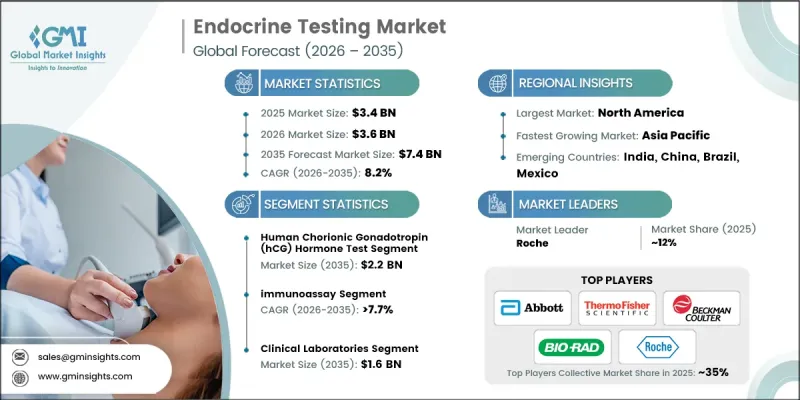
The Global Endocrine Testing Market was valued at USD 3.4 billion in 2025 and is estimated to grow at a CAGR of 8.2% to reach USD 7.4 billion by 2035.
The industry is expanding steadily due to the rising burden of hormonal disorders, including metabolic and gland-related conditions, along with increasing awareness regarding early diagnosis and preventive healthcare. Growing emphasis on routine screening and disease monitoring is encouraging higher adoption of diagnostic testing across healthcare systems. In addition, continuous government support through funding programs and healthcare initiatives is strengthening testing accessibility and infrastructure development. Expanding healthcare expenditure, coupled with advancements in diagnostic technologies, is further enhancing testing accuracy and efficiency. The integration of automated systems and improved laboratory capabilities is enabling faster turnaround times and large-scale testing volumes. Increasing focus on personalized healthcare and long-term disease management is also contributing to the sustained demand for endocrine diagnostics. These combined factors are positioning the endocrine testing market for consistent growth across both developed and emerging economies.
| Market Scope | |
|---|---|
| Start Year | 2025 |
| Forecast Year | 2026-2035 |
| Start Value | $3.4 Billion |
| Forecast Value | $7.4 Billion |
| CAGR | 8.2% |
Endocrine testing encompasses a variety of laboratory-based diagnostic procedures used to evaluate hormonal balance and glandular function within the body. These tests measure hormone levels and related biomarkers to support the diagnosis and monitoring of endocrine system conditions. Growing investments in healthcare infrastructure and public health programs are improving access to diagnostic services, particularly in regions with limited resources. Increased focus on early detection and preventive care is encouraging wider use of hormone testing across healthcare facilities. Government-backed screening initiatives and funding support for diagnostic laboratories are further contributing to the expansion of testing services, strengthening overall market growth.
The human chorionic gonadotropin testing segment accounted for 31.1% share in 2025. This segment maintains a leading position due to its widespread clinical use and growing preference for rapid and minimally invasive diagnostic approaches. High testing volumes across healthcare settings and strong demand for convenient diagnostic solutions continue to support its dominance in the endocrine testing market.
The immunoassay segment is anticipated to grow at a CAGR of 7.7%, reaching USD 2.8 billion by 2035. This technology remains a preferred choice due to its high sensitivity, accuracy, and cost efficiency. Its compatibility with automated systems and ability to handle large testing volumes are key factors driving its adoption. Continuous technological advancements and broad acceptance across diagnostic laboratories further reinforce its importance within the market.
North America Endocrine Testing Market generated USD 1.5 billion in 2025 and is expected to witness significant growth throughout the forecast period. The region benefits from well-established healthcare infrastructure, strong adoption of advanced diagnostic technologies, and high demand for routine and specialized testing. Increasing healthcare awareness, along with supportive reimbursement frameworks and access to modern diagnostic platforms, continues to sustain consistent testing demand across the region.
Key players operating in the Global Endocrine Testing Market include Thermo Fisher Scientific, Roche, Abbott, Siemens Healthineers, Beckman Coulter, Bio-Rad, Merck, Diasorin, SCIEX, Snibe Diagnostic, Autobio, DRG International, Monobind, Tosoh Bioscience, and QuidelOrtho. Companies in the Endocrine Testing Market are focusing on strengthening their competitive position through continuous investment in advanced diagnostic technologies and automation. They are prioritizing research and development to enhance test accuracy, sensitivity, and efficiency while reducing turnaround time. Strategic collaborations, partnerships, and acquisitions are being leveraged to expand geographic reach and diversify product portfolios. Firms are also emphasizing the development of cost-effective and high-throughput solutions to meet increasing demand across healthcare facilities.
Table of Contents
Chapter 1 Research Methodology
- 1.1 Research approach
- 1.2 Quality commitments
- 1.2.1 GMI AI policy & data integrity commitment
- 1.2.1.1 Source consistency protocol
- 1.2.1 GMI AI policy & data integrity commitment
- 1.3 Research trail & confidence scoring
- 1.3.1 Research trail components
- 1.3.2 Scoring components
- 1.4 Data collection
- 1.4.1 Partial list of primary sources
- 1.5 Data mining sources
- 1.5.1 Paid sources
- 1.5.1.1 Sources, by region
- 1.5.1 Paid sources
- 1.6 Base estimates and calculations
- 1.6.1 Base year calculation
- 1.7 Forecast model
- 1.7.1 Quantified market impact analysis
- 1.7.1.1 Mathematical impact of growth parameters on forecast
- 1.7.1 Quantified market impact analysis
- 1.8 Research transparency addendum
- 1.8.1 Source attribution framework
- 1.8.2 Quality assurance metrics
- 1.8.3 Our commitment to trust
Chapter 2 Executive Summary
- 2.1 Industry 360° synopsis
- 2.2 Key market trends
- 2.2.1 Regional trends
- 2.2.2 Test type trends
- 2.2.3 Technology trends
- 2.2.4 End use trends
- 2.3 CXO perspectives: Strategic imperatives
Chapter 3 Industry Insights
- 3.1 Industry ecosystem analysis
- 3.2 Industry impact forces
- 3.2.1 Growth drivers
- 3.2.1.1 Increasing prevalence of diabetes, thyroid, and obesity
- 3.2.1.2 Rising prevalence of endocrine disorders
- 3.2.1.3 Supportive government funding initiatives
- 3.2.1.4 Technological advancements
- 3.2.1.5 Growing awareness of routine health monitoring
- 3.2.2 Industry pitfalls and challenges
- 3.2.2.1 High cost for the development of testing technologies
- 3.2.2.2 Lack of awareness
- 3.2.3 Opportunities
- 3.2.3.1 Expansion of point-of-care and rapid endocrine testing
- 3.2.1 Growth drivers
- 3.3 Growth potential analysis
- 3.4 Regulatory landscape
- 3.4.1 North America
- 3.4.2 Europe
- 3.4.3 Asia Pacific
- 3.4.4 Latin America
- 3.4.5 MEA
- 3.5 Technology and innovation landscape (Driven by Primary Research)
- 3.5.1 Current technological trends
- 3.5.2 Emerging technologies
- 3.6 Future market trends (Driven by Primary Research)
- 3.7 Impact of AI & Generative AI on the Market (Driven by Primary Research)
- 3.8 Pricing analysis, 2025
- 3.9 Patent analysis
- 3.10 Consumer insights
- 3.11 Porter's analysis
- 3.12 PESTEL analysis
Chapter 4 Competitive Landscape, 2025
- 4.1 Introduction
- 4.2 Company matrix analysis
- 4.3 Company market share analysis (Driven by Primary Research)
- 4.3.1 Global
- 4.3.2 North America
- 4.3.3 Europe
- 4.3.4 Asia Pacific
- 4.4 Competitive analysis of major market players
- 4.5 Competitive positioning matrix
- 4.6 Key developments
- 4.6.1 Mergers & acquisitions
- 4.6.2 Partnerships & collaborations
- 4.6.3 New product launches
- 4.6.4 Expansion plans
Chapter 5 Market Estimates and Forecast, By Test Type, 2022 - 2035 ($ Mn)
- 5.1 Key trends
- 5.2 Human chorionic gonadotropin (hCG) hormone test
- 5.3 Thyroid stimulating hormone (TSH) test
- 5.4 Insulin test
- 5.5 Progesterone test
- 5.6 Luteinizing hormone (LH) test
- 5.7 Prolactin test
- 5.8 Other test types
Chapter 6 Market Estimates and Forecast, By Technology, 2022 - 2035 ($ Mn)
- 6.1 Key trends
- 6.2 Immunoassay
- 6.3 Mass spectroscopy
- 6.4 Chromatography
- 6.5 Nucleic acid based
- 6.6 Other technologies
Chapter 7 Market Estimates and Forecast, By End Use, 2022 - 2035 ($ Mn)
- 7.1 Key trends
- 7.2 Clinical laboratories
- 7.3 Hospitals
- 7.4 Diagnostic centers
- 7.5 Other end users
Chapter 8 Market Estimates and Forecast, By Region, 2022 - 2035 ($ Mn)
- 8.1 Key trends
- 8.2 North America
- 8.2.1 U.S.
- 8.2.2 Canada
- 8.3 Europe
- 8.3.1 Germany
- 8.3.2 UK
- 8.3.3 France
- 8.3.4 Spain
- 8.3.5 Italy
- 8.3.6 Netherlands
- 8.4 Asia Pacific
- 8.4.1 China
- 8.4.2 Japan
- 8.4.3 India
- 8.4.4 Australia
- 8.4.5 South Korea
- 8.5 Latin America
- 8.5.1 Brazil
- 8.5.2 Mexico
- 8.5.3 Argentina
- 8.6 Middle East and Africa
- 8.6.1 South Africa
- 8.6.2 Saudi Arabia
- 8.6.3 UAE
Chapter 9 Company Profiles
- 9.1 Abbott
- 9.2 Autobio
- 9.3 BECKMAN COULTER
- 9.4 BIO RAD
- 9.5 Diasorin
- 9.6 DRG International
- 9.7 Merck
- 9.8 Monobind
- 9.9 QuidelOrtho
- 9.10 Roche
- 9.11 SCIEX
- 9.12 SIEMENS Healthineers
- 9.13 Snibe Diagnostic
- 9.14 Thermo Fisher SCIENTIFIC
- 9.15 TOSOH BIOSCIENCE

