
PUBLISHER: Global Market Insights Inc. | PRODUCT CODE: 2038759

PUBLISHER: Global Market Insights Inc. | PRODUCT CODE: 2038759
Fish Gelatin Market Opportunity, Growth Drivers, Industry Trend Analysis, and Forecast 2026 - 2035
The Global Fish Gelatin Market was valued at USD 279 million in 2025 and is estimated to grow at a CAGR of 5.6% to reach USD 476.3 million by 2035.
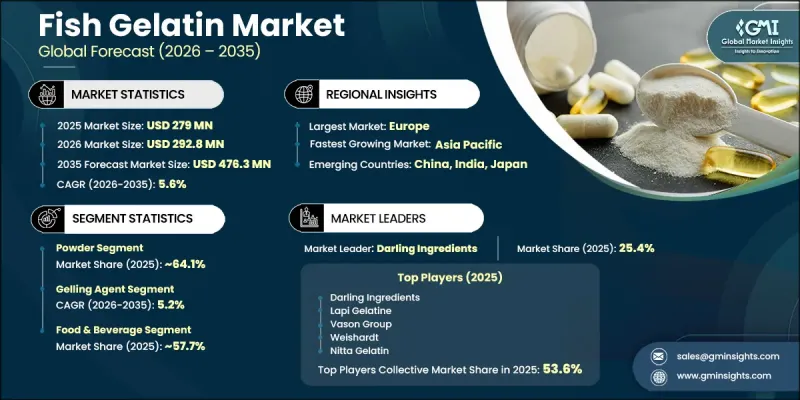
Rising consumer awareness around health, sustainability, and dietary preferences is contributing significantly to market expansion. Fish gelatin is gaining traction as a natural and more acceptable alternative to conventional gelatin sources, particularly among consumers seeking cleaner and more inclusive ingredient options. Its functional versatility as a stabilizing, thickening, and gelling agent supports its widespread adoption in product formulations that require improved texture, consistency, and shelf life. Additionally, its compatibility with various dietary needs and its lower fat composition are enhancing its appeal in health-focused applications. Ongoing advancements in processing technologies and increasing focus on sustainable sourcing practices are further strengthening market growth and positioning fish gelatin as a valuable ingredient across diverse industrial applications.
| Market Scope | |
|---|---|
| Start Year | 2025 |
| Forecast Year | 2026-2035 |
| Start Value | $279 Million |
| Forecast Value | $476.3 Million |
| CAGR | 5.6% |
The fish gelatin market continues to benefit from its adaptability across different applications, where it serves as a multifunctional ingredient with strong performance characteristics. Its use in various formulations is supported by its ability to improve product quality while maintaining safety and compatibility with a wide range of consumers. The increasing shift toward natural and sustainable ingredients is further encouraging manufacturers to incorporate fish gelatin into their product portfolios, supporting long-term demand growth.
The powder form segment accounted for 64.1% share in 2025 and is expected to grow at a CAGR of 5.2% through 2035. This format is widely preferred due to its ease of handling, accurate measurement, and quick solubility in different applications. Continuous improvements in processing techniques have enhanced product quality and shelf stability, further supporting its adoption across industries that require reliable and efficient ingredient solutions.
The gelling agent segment held a 49.2% share in 2025 and is projected to grow at a CAGR of 5.2% from 2026 to 2035. Its strong functionality in enhancing texture and consistency makes it a preferred choice in multiple applications. The growing demand for clean-label and allergen-conscious products is reinforcing its role as a suitable alternative to traditional gelatin sources. Its performance as a stabilizing and thickening agent also contributes to its increasing use in a wide range of formulations.
North America Fish Gelatin Market accounted for 27.3% share in 2025, supported by strong demand for natural and health-oriented products. The region continues to experience growth due to increasing consumer preference for sustainable ingredients and evolving dietary trends. Regulatory frameworks and certification requirements are further supporting market expansion, while advancements in processing technologies are improving product quality and consistency.
Key companies operating in the Global Fish Gelatin Market include Weishardt, Darling Ingredients, Nitta Gelatin, Gelken Gelatin, Lapi Gelatine, Norland Products, Vason Group, Athos Collagen, Amar Polyfils, Yasin Gelatin, BDF Natural Ingredients, and Banagel. Companies in the Fish Gelatin Market are focusing on innovation, sustainability, and product quality to strengthen their market position. They are investing in advanced extraction and processing technologies to improve purity, functionality, and shelf life. Many players are expanding their product portfolios to cater to diverse industry requirements while aligning with clean-label and natural ingredient trends. Strategic partnerships and global distribution expansion are helping companies reach new markets and enhance brand visibility. Additionally, firms are emphasizing sustainable sourcing practices and certifications to meet evolving consumer and regulatory expectations, while continuous research and development efforts support the introduction of high-performance and application-specific solutions.
Table of Contents
Chapter 1 Methodology & Scope
- 1.1 Market scope and definition
- 1.2 Research design
- 1.2.1 Research approach
- 1.2.2 Data collection methods
- 1.3 Data mining sources
- 1.3.1 Global
- 1.3.2 Regional/Country
- 1.4 Base estimates and calculations
- 1.4.1 Base year calculation
- 1.4.2 Key trends for market estimation
- 1.5 Primary research and validation
- 1.5.1 Primary sources
- 1.6 Forecast model
- 1.7 Research assumptions and limitations
Chapter 2 Executive Summary
- 2.1 Industry 360° synopsis
- 2.2 Key market trends
- 2.2.1 Regional
- 2.2.2 Form
- 2.2.3 Function
- 2.2.4 Application
- 2.3 TAM Analysis, 2026-2035
- 2.4 CXO perspectives: Strategic imperatives
- 2.4.1 Executive decision points
Chapter 3 Industry Insights
- 3.1 Industry ecosystem analysis
- 3.1.1 Supplier landscape
- 3.1.2 Profit margin
- 3.1.3 Value addition at each stage
- 3.1.4 Factor affecting the value chain
- 3.1.5 Disruptions
- 3.2 Industry impact forces
- 3.2.1 Growth drivers
- 3.2.2 Industry pitfalls and challenges
- 3.2.3 Market opportunities
- 3.3 Growth potential analysis
- 3.4 Regulatory landscape
- 3.4.1 North America
- 3.4.2 Europe
- 3.4.3 Asia Pacific
- 3.4.4 Latin America
- 3.4.5 Middle East & Africa
- 3.5 Porter's analysis
- 3.6 PESTEL analysis
- 3.7 Price trends
- 3.7.1 By region
- 3.7.2 By type
- 3.8 Future market trends
- 3.9 Technology and Innovation landscape
- 3.9.1 Current technological trends
- 3.9.2 Emerging technologies
- 3.10 Patent Landscape
- 3.11 Trade statistics (HS code)
- 3.11.1 Major importing countries
- 3.11.2 Major exporting countries
- 3.12 Sustainability and environmental aspects
- 3.12.1 Sustainable practices
- 3.12.2 Waste reduction strategies
- 3.12.3 Energy efficiency in production
- 3.12.4 Eco-friendly initiatives
- 3.13 Carbon footprint consideration
Chapter 4 Competitive Landscape, 2025
- 4.1 Introduction
- 4.2 Company market share analysis
- 4.2.1 By region
- 4.2.1.1 North America
- 4.2.1.2 Europe
- 4.2.1.3 Asia Pacific
- 4.2.1.4 LATAM
- 4.2.1.5 MEA
- 4.2.1 By region
- 4.3 Company matrix analysis
- 4.4 Competitive analysis of major market players
- 4.5 Competitive positioning matrix
- 4.6 Key developments
- 4.6.1 Mergers & acquisitions
- 4.6.2 Partnerships & collaborations
- 4.6.3 New Product Launches
- 4.6.4 Expansion Plans
Chapter 5 Market Estimates and Forecast, By Form, 2022-2035 (USD Million) (Kilo Tons)
- 5.1 Key trends
- 5.2 Powder
- 5.3 Granules
- 5.4 Sheets
Chapter 6 Market Estimates and Forecast, By Function, 2022-2035 (USD Million) (Kilo Tons)
- 6.1 Key trends
- 6.2 Gelling agent
- 6.3 Stabilizer
- 6.4 Thickener
- 6.5 Emulsifier
- 6.6 Others
Chapter 7 Market Estimates and Forecast, By Application, 2022-2035 (USD Million) (Kilo Tons)
- 7.1 Key trends
- 7.2 Food & beverage
- 7.3 Pharmaceutical
- 7.4 Cosmetics & personal care
- 7.5 Nutraceuticals
- 7.6 Others
Chapter 8 Market Estimates and Forecast, By Region, 2022-2035 (USD Million) (Kilo Tons)
- 8.1 Key trends
- 8.2 North America
- 8.2.1 U.S.
- 8.2.2 Canada
- 8.3 Europe
- 8.3.1 Germany
- 8.3.2 UK
- 8.3.3 France
- 8.3.4 Spain
- 8.3.5 Italy
- 8.3.6 Rest of Europe
- 8.4 Asia Pacific
- 8.4.1 China
- 8.4.2 India
- 8.4.3 Japan
- 8.4.4 Australia
- 8.4.5 South Korea
- 8.4.6 Rest of Asia Pacific
- 8.5 Latin America
- 8.5.1 Brazil
- 8.5.2 Mexico
- 8.5.3 Argentina
- 8.5.4 Rest of Latin America
- 8.6 Middle East and Africa
- 8.6.1 Saudi Arabia
- 8.6.2 South Africa
- 8.6.3 UAE
- 8.6.4 Rest of Middle East and Africa
Chapter 9 Company Profiles
- 9.1 Amar Polyfils
- 9.2 Athos Collagen
- 9.3 BDF Natural Ingredients
- 9.4 Banagel
- 9.5 Darling Ingredients
- 9.6 Gelken Gelatin
- 9.7 Lapi Gelatine
- 9.8 Nitta Gelatin
- 9.9 Norland Products
- 9.10 Vason Group
- 9.11 Weishardt
- 9.12 Yasin Gelatin

