
PUBLISHER: Global Market Insights Inc. | PRODUCT CODE: 2038762

PUBLISHER: Global Market Insights Inc. | PRODUCT CODE: 2038762
Europe Inboard Boat Market Opportunity, Growth Drivers, Industry Trend Analysis, and Forecast 2026 - 2035
Europe Inboard Boat Market was valued at USD 1.16 billion in 2025 and is estimated to grow at a CAGR of 6% to reach USD 2.01 billion by 2035.
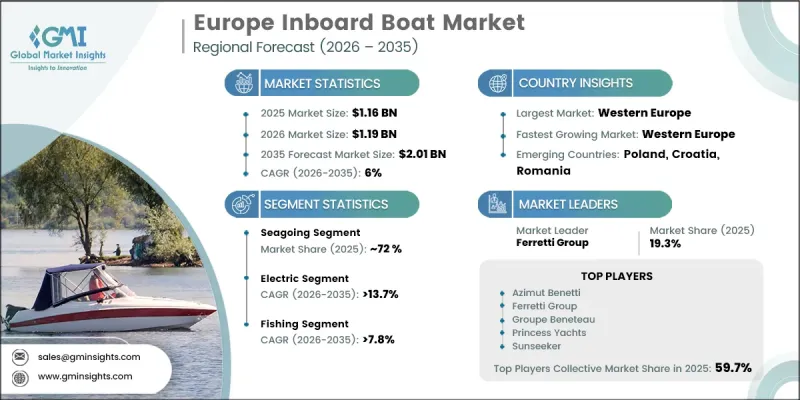
Growth in the Europe inboard boat industry is shaped by a strong shift toward sustainable marine mobility and rising demand for advanced propulsion systems across recreational and commercial applications. Increasing environmental awareness, supportive policy frameworks, and expanding investments in marina electrification are accelerating the transition toward low-emission and electric boating solutions. The region benefits from widespread availability of renewable electricity, which improves the economic feasibility of electric propulsion systems. At the same time, continuous innovation in onboard energy storage, propulsion efficiency, and digital marine systems is enhancing vessel performance. The growing emphasis on cleaner maritime operations, combined with technological advancements in hybrid and electric drive systems, is further strengthening long-term growth prospects for the Europe inboard boat market.
| Market Scope | |
|---|---|
| Start Year | 2025 |
| Forecast Year | 2026-2035 |
| Start Value | $1.16 Billion |
| Forecast Value | $2.01 Billion |
| CAGR | 6% |
The Europe inboard boat industry is also influenced by tightening environmental regulations that are reshaping marine transport standards across the region. Operators in both passenger and commercial segments are increasingly adopting electrified and hybrid propulsion systems to comply with evolving emissions targets. This shift is driving advancements in energy optimization, onboard power management, and thermal control technologies, which are becoming essential for next-generation vessels.
The seagoing segment held a 72% share, generating USD 833.3 million in 2025. Its dominance is supported by strong recreational boating activity and extensive coastal infrastructure across Europe. High demand for leisure boating and tourism-related marine services continues to drive vessel adoption, particularly in coastal regions where rental and private boating remain highly popular.
The 201 to 500 hp segment reached USD 474.5 million in 2025. This power range remains widely preferred due to its adaptability across multiple vessel categories, including cruising boats and fishing vessels. Its popularity is reinforced by mature engine technologies, strong manufacturer support, and reliable performance across varied marine operating conditions.
Germany Inboard Boat Market captured USD 168.4 million in 2025 and is expected to grow at a CAGR of 7% between 2026 and 2035. Market expansion in Germany is supported by strong maritime infrastructure, advanced engineering capabilities, and growing emphasis on sustainable marine technologies. Demand is further driven by recreational boating activities and the country's established marine manufacturing ecosystem, which supports continuous innovation in propulsion systems.
Major companies operating in the Europe Inboard Boat Industry include Groupe Beneteau, Ferretti Group, Brunswick, Azimut Benetti, Bavaria Yachtbau, Princess Yachts, Sunseeker, Fairline Boats, Marex Boats, and Hanse Yacht. Companies in the Europe Inboard Boat Market are strengthening their competitive position through innovation in propulsion technologies and a strong focus on sustainability. Manufacturers are increasingly investing in electric and hybrid systems to meet regulatory requirements and evolving customer preferences. Strategic collaborations with marine technology providers are enabling enhanced system integration and improved vessel performance. Companies are also expanding production capabilities and focusing on lightweight, energy-efficient designs to improve operational efficiency. In addition, strengthening distribution networks and expanding service capabilities are helping companies improve customer engagement and after-sales support.
Table of Contents
Chapter 1 Methodology
- 1.1 Research approach
- 1.2 Quality Commitments
- 1.2.1 GMI AI policy & data integrity commitment
- 1.3 Research Trail & Confidence Scoring
- 1.3.1 Research Trail Components
- 1.3.2 Scoring Components
- 1.4 Data Collection
- 1.5 Data mining sources
- 1.5.1 Paid sources
- 1.6 Base estimates and calculations
- 1.6.1 Base year calculation
- 1.7 Forecast model
- 1.7.1 Quantified market impact analysis
- 1.8 Research transparency addendum
- 1.8.1 Source attribution framework
- 1.8.2 Quality assurance metrics
- 1.8.3 Our commitment to trust
Chapter 2 Executive Summary
- 2.1 Industry 360° synopsis
- 2.2 Key market trends
- 2.2.1 Regional
- 2.2.2 Boat
- 2.2.3 Propulsion
- 2.2.4 Engine
- 2.2.5 Horsepower
- 2.2.6 Waterways
- 2.2.7 Application
- 2.3 TAM Analysis, 2026-2035
- 2.4 CXO perspectives: Strategic imperatives
Chapter 3 Industry Insights
- 3.1 Industry ecosystem analysis
- 3.1.1 Supplier landscape
- 3.1.2 Profit margin
- 3.1.3 Cost structure
- 3.1.4 Value addition at each stage
- 3.1.5 Factor affecting the value chain
- 3.1.6 Disruptions
- 3.2 Industry impact forces
- 3.2.1 Growth drivers
- 3.2.1.1 Growing recreational boating participation post-pandemic
- 3.2.1.2 Rising demand for water sports and tow-sport activities
- 3.2.1.3 Increasing demand for luxury yachts and leisure vessels
- 3.2.1.4 Growth in marine tourism and leisure activities
- 3.2.2 Industry pitfalls and challenges
- 3.2.2.1 Seasonal nature of boating industry demand
- 3.2.2.2 Economic uncertainty affecting discretionary spending
- 3.2.3 Market opportunities
- 3.2.3.1 Retrofit market for emission compliance upgrades
- 3.2.3.2 Development of alternative fuel infrastructure (LNG, hydrogen, electric)
- 3.2.3.3 Growth of electric and hybrid propulsion systems
- 3.2.1 Growth drivers
- 3.3 Technology and innovation landscape
- 3.3.1 Current technological trends
- 3.3.1.1 Four-Stroke Inboard Engine Systems
- 3.3.1.2 Diesel Direct Injection Technology
- 3.3.1.3 GPS-Based Navigation Systems
- 3.3.2 Emerging technologies
- 3.3.2.1 Electric Inboard Propulsion Systems
- 3.3.2.2 Hybrid Diesel-Electric Powertrains
- 3.3.2.3 Autonomous Navigation and Docking Systems
- 3.3.1 Current technological trends
- 3.4 Growth potential analysis
- 3.5 Pricing Analysis (Driven by Primary Research)
- 3.5.1 Historical Price Trend Analysis
- 3.5.2 Pricing Strategy by Player Type (Premium / Value / Cost-plus)
- 3.6 Regulatory landscape
- 3.6.1 EU - Directive (EU) 2016/1629
- 3.6.2 EU - EU Emission Standards for Marine Engines
- 3.6.3 Germany - Federal Ministry for Digital and Transport (BMDV)
- 3.6.4 Spain - Direccion General de la Marina Mercante
- 3.6.5 Italy - Codice della Nautica da Diporto
- 3.7 Porter's analysis
- 3.8 PESTEL analysis
- 3.9 Trade Data Analysis (Driven by Paid Database)
- 3.9.1 Import/Export Volume & Value Trends
- 3.9.2 Key Trade Corridors & Tariff Impact
- 3.10 Capacity & Production Landscape (Driven by Primary Research)
- 3.10.1 Installed Capacity by Region & Key Producer
- 3.10.2 Capacity Utilization Rates & Expansion Pipelines
- 3.11 Cost breakdown analysis
- 3.11.1 Raw materials & components costs
- 3.11.2 Labor & assembly costs
- 3.11.3 Engine & propulsion system costs
- 3.11.4 Overhead & facility costs
- 3.11.5 Compliance, testing & certification costs
- 3.12 Patent analysis (Driven by Primary Research)
- 3.13 Sustainability and environmental aspects
- 3.13.1 Sustainable Practices
- 3.13.2 Waste Reduction Strategies
- 3.13.3 Energy Efficiency in Production
- 3.13.4 Eco-friendly Initiatives
- 3.13.5 Carbon Footprint Considerations
- 3.14 Regional infrastructure & deployment trends
- 3.14.1 Marina infrastructure capacity & electrification readiness by region
- 3.14.2 Alternative fuel infrastructure development & deployment timeline
- 3.15 Impact of AI & generative AI on the market
- 3.15.1 AI-driven disruption of existing business models
- 3.15.2 GenAI use cases & adoption roadmap by segment
- 3.15.3 Risks, limitations & regulatory considerations
- 3.16 Forecast assumptions & scenario analysis (Driven by Primary Research)
- 3.16.1 Base Case- Key Macro & Industry Variables Driving CAGR
- 3.16.2 Optimistic Scenarios- Favorable macro and industry tailwinds
- 3.16.3 Pessimistic Scenario - Macroeconomic slowdown or industry headwinds
Chapter 4 Competitive Landscape, 2025
- 4.1 Introduction
- 4.2 Company market share analysis
- 4.3 Competitive analysis of major market players
- 4.4 Competitive positioning matrix
- 4.5 Key developments
- 4.5.1 Mergers & acquisitions
- 4.5.2 Partnerships & collaborations
- 4.5.3 New product launches
- 4.5.4 Expansion plans and funding
- 4.6 Company Tier Benchmarking
- 4.6.1 Tier Classification Criteria & Qualifying Thresholds
- 4.6.2 Tier Positioning Matrix by Revenue, Geography & Innovation
Chapter 5 Market Estimates and Forecast, By Boat, 2022 - 2035 ($ Million, Units)
- 5.1 Key trends
- 5.2 Express cruiser
- 5.3 Pontoon
- 5.4 Center Console
- 5.5 Runabout Bowrider
- 5.6 Others
Chapter 6 Market Estimates and Forecast, By Propulsion, 2022 - 2035 ($ Million, Units)
- 6.1 Key trends
- 6.2 Gasoline
- 6.3 Diesel
- 6.4 Electric
Chapter 7 Market Estimates and Forecast, By Engine, 2022 - 2035 ($ Million, Units)
- 7.1 Key trends
- 7.2 2-stroke
- 7.3 4-stroke
- 7.4 Electric
Chapter 8 Market Estimates and Forecast, By Horsepower, 2022 - 2035 ($ Million, Units)
- 8.1 Key trends
- 8.2 Below 200 hp
- 8.3 201 to 500 hp
- 8.4 501 to 1000 hp
- 8.5 Above 1000 hp
Chapter 9 Market Estimates and Forecast, By Waterways, 2022 - 2035 ($ Million, Units)
- 9.1 Key trends
- 9.2 Seagoing
- 9.3 Inland
Chapter 10 Market Estimates and Forecast, By Application, 2022 - 2035 ($ Million, Units)
- 10.1 Key trends
- 10.2 Leisure
- 10.3 Transport of goods
- 10.4 Transport of people
- 10.5 Fishing
- 10.6 Government use
Chapter 11 Market Estimates and Forecast, By Region, 2022 - 2035 ($ Million, Units)
- 11.1 Key trends
- 11.2 Western Europe
- 11.2.1 Germany
- 11.2.2 Austria
- 11.2.3 France
- 11.2.4 Switzerland
- 11.2.5 Belgium
- 11.2.6 Luxembourg
- 11.2.7 Netherlands
- 11.2.8 Portugal
- 11.2.9 Rest of Western Europe
- 11.3 Eastern Europe
- 11.3.1 Poland
- 11.3.2 Romania
- 11.3.3 Czech Republic
- 11.3.4 Slovenia
- 11.3.5 Bulgaria
- 11.3.6 Slovakia
- 11.3.7 Hungary
- 11.3.8 Rest of Eastern Europe
- 11.4 Northern Europe
- 11.4.1 UK
- 11.4.2 Denmark
- 11.4.3 Sweden
- 11.4.4 Finland
- 11.4.5 Norway
- 11.4.6 Rest of Northern Europe
- 11.5 Southern Europe
- 11.5.1 Italy
- 11.5.2 Spain
- 11.5.3 Greece
- 11.5.4 Albania
- 11.5.5 Rest of Southern Europe
Chapter 12 Company Profiles
- 12.1 Global players
- 12.1.1 Groupe Beneteau
- 12.1.2 Azimut-Benetti
- 12.1.3 Ferretti
- 12.1.4 Brunswick
- 12.1.5 Princess Yachts
- 12.1.6 Sanlorenzo
- 12.1.7 Sunseeker International
- 12.2 Regional players
- 12.2.1 BAVARIA Yachts
- 12.2.2 Fairline Yachts
- 12.2.3 Cruisers Yachts
- 12.2.4 Tiara Yachts
- 12.2.5 Regal Boats
- 12.2.6 Chaparral Boats
- 12.2.7 Formula Boats
- 12.3 Emerging players
- 12.3.1 Malibu Boats
- 12.3.2 MasterCraft Boat
- 12.3.3 Correct Craft
- 12.3.4 Centurion Boats
- 12.3.5 Viking Yachts
- 12.3.6 Hatteras Yachts

