PUBLISHER: Global Market Insights Inc. | PRODUCT CODE: 2038767

PUBLISHER: Global Market Insights Inc. | PRODUCT CODE: 2038767
Urometer Market Opportunity, Growth Drivers, Industry Trend Analysis, and Forecast 2026 - 2035
The Global Urometer Market was valued at USD 575.2 million in 2025 and is estimated to grow at a CAGR of 7.9% to reach USD 1.2 billion by 2035.
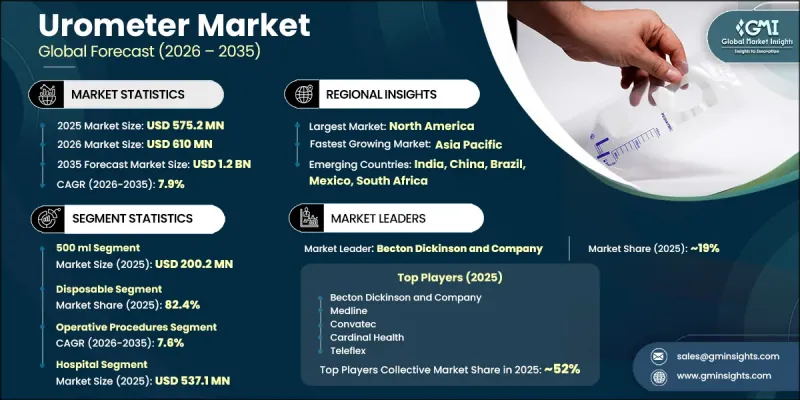
This expansion is supported by the growing incidence of urological conditions, a higher number of surgical procedures, and increasing admissions in critical care settings. In addition, the expanding elderly population is contributing significantly to demand, as aging individuals are more prone to conditions requiring continuous monitoring of urinary output. The adoption of stringent infection prevention protocols across healthcare facilities is further strengthening the use of advanced monitoring devices. A urometer is a specialized medical device used to measure and track urine output accurately over a specified period, typically integrated within a closed drainage system connected to a catheter and collection unit. Changing lifestyles and the growing burden of chronic diseases are also increasing the need for efficient monitoring systems, reinforcing the importance of urometers in both acute and long-term care environments.
| Market Scope | |
|---|---|
| Start Year | 2025 |
| Forecast Year | 2026-2035 |
| Start Value | $575.2 Million |
| Forecast Value | $1.2 Billion |
| CAGR | 7.9% |
The 500 ml segment generated USD 200.2 million in 2025. This segment's strong position is supported by its widespread use in clinical environments where continuous and precise monitoring is required. Its balanced design allows for effective measurement over extended durations, making it suitable for adult patient care. The ability to support consistent monitoring needs in high-dependency settings has contributed significantly to its dominance.
The disposable segment accounted for 82.4% share in 2025, driven by its operational efficiency and strong infection control benefits. Single-use devices eliminate the need for cleaning and sterilization, reducing time, labor, and resource requirements. These advantages make them highly suitable for fast-paced healthcare environments where maintaining hygiene standards and minimizing turnaround time are essential. Additionally, predictable cost structures associated with disposable products further support their widespread adoption.
United States Urometer Market was valued at USD 213.7 million in 2025, supported by a well-developed healthcare ecosystem and strong clinical adoption. Healthcare professionals across the country consistently rely on urometers in various care settings to ensure accurate monitoring of patient conditions. Established clinical protocols and increasing awareness of patient safety are contributing to sustained demand. Furthermore, the growing burden of chronic health conditions is reinforcing the need for precise and continuous monitoring, supporting ongoing market expansion.
Key companies operating in the Global Urometer Market include Becton, Dickinson and Company, B. Braun, Cardinal Health, Teleflex, Convatec, Medline, Laborie, Romsons Group, Sterimed Group, Advin Health Care, ANGIPLAST, Fannin, Forlong Medical, Hitec Medical, and Observe Medical. Companies in the Urometer Market are strengthening their competitive position through product innovation, strategic partnerships, and expansion of distribution networks. They are investing in advanced designs that improve measurement accuracy, ease of use, and patient safety. Many players are focusing on developing cost-effective disposable solutions to meet the rising demand for infection control. Collaborations with healthcare providers and institutions are helping expand market reach and improve product adoption. In addition, companies are enhancing their global presence by entering emerging markets and strengthening supply chain capabilities.
Table of Contents
Chapter 1 Research Methodology
- 1.1 Research approach
- 1.2 Quality commitments
- 1.2.1 GMI AI policy & data integrity commitment
- 1.2.1.1 Source consistency protocol
- 1.2.1 GMI AI policy & data integrity commitment
- 1.3 Research trail & confidence scoring
- 1.3.1 Research trail components
- 1.3.2 Scoring components
- 1.4 Data collection
- 1.4.1 Partial list of primary sources
- 1.5 Data mining sources
- 1.5.1 Paid sources
- 1.5.1.1 Sources, by region
- 1.5.1 Paid sources
- 1.6 Base estimates and calculations
- 1.6.1 Base year calculation for any one approach
- 1.7 Forecast model
- 1.7.1 Quantified market impact analysis
- 1.7.1.1 Mathematical impact of growth parameters on forecast
- 1.7.1 Quantified market impact analysis
- 1.8 Research transparency addendum
- 1.8.1 Source attribution framework
- 1.8.2 Quality assurance metrics
- 1.8.3 Our commitment to trust
Chapter 2 Executive Summary
- 2.1 Industry 3600 synopsis
- 2.2 Key market trends
- 2.2.1 Regional trends
- 2.2.2 Product trends
- 2.2.3 Usability trends
- 2.2.4 Application trends
- 2.2.5 End use trends
- 2.3 CXO perspectives: Strategic imperatives
Chapter 3 Industry Insights
- 3.1 Industry ecosystem analysis
- 3.2 Industry impact forces
- 3.2.1 Growth drivers
- 3.2.1.1 Rising prevalence of urological disorders
- 3.2.1.2 Increasing number of surgical procedures and critical care admissions
- 3.2.1.3 Growing geriatric population and associated chronic conditions
- 3.2.1.4 Increasing focus on infection control and adoption of disposable urometers
- 3.2.2 Industry pitfalls and challenges
- 3.2.2.1 Risk of catheter-associated urinary tract infections (CAUTIs)
- 3.2.2.2 Environmental concerns related to medical plastic waste
- 3.2.3 Market opportunities
- 3.2.3.1 Expansion of home healthcare and remote patient monitoring
- 3.2.1 Growth drivers
- 3.3 Growth potential analysis
- 3.4 Regulatory landscape (Driven by primary research)
- 3.4.1 North America
- 3.4.2 Europe
- 3.4.3 Asia Pacific
- 3.4.4 Latin America
- 3.4.5 MEA
- 3.5 Technology landscape (Driven by primary research)
- 3.5.1 Current technological trends
- 3.5.2 Emerging technologies
- 3.6 Pricing analysis, 2025 (Driven by primary research)
- 3.7 Future market trends
- 3.8 Impact of AI and Generative AI on the market
- 3.9 Porter's analysis
- 3.10 PESTEL analysis
- 3.11 Value chain analysis
- 3.12 Customer insights (Driven by primary research)
- 3.13 Star-up scenario (Driven by primary research)
- 3.14 Gap analysis
Chapter 4 Competitive Landscape, 2025
- 4.1 Introduction
- 4.2 Company matrix analysis
- 4.3 Company market share analysis (Driven by primary research)
- 4.3.1 Global
- 4.3.2 North America
- 4.3.3 Europe
- 4.3.4 Asia Pacific
- 4.4 Competitive positioning matrix
- 4.5 Competitive analysis of major market players
- 4.6 Key developments
- 4.6.1 Mergers & acquisitions
- 4.6.2 Partnerships & collaborations
- 4.6.3 New product launches
- 4.6.4 Expansion plans
Chapter 5 Market Estimates and Forecast, By Product, 2022 - 2035 ($ Mn)
- 5.1 Key trends
- 5.2 100 ml
- 5.3 200 ml
- 5.4 400 ml
- 5.5 450 ml
- 5.6 500 ml
- 5.7 Above 500 ml
Chapter 6 Market Estimates and Forecast, By Usability, 2022 - 2035 ($ Mn)
- 6.1 Key trends
- 6.2 Disposable
- 6.3 Reusable
Chapter 7 Market Estimates and Forecast, By Application, 2022 - 2035 ($ Mn)
- 7.1 Key trends
- 7.2 Operative procedures
- 7.3 Emergency trauma
- 7.4 Palliative care
- 7.5 Other applications
Chapter 8 Market Estimates and Forecast, By End Use, 2022 - 2035 ($ Mn)
- 8.1 Key trends
- 8.2 Hospitals
- 8.3 Clinics
- 8.4 Home care settings
- 8.5 Other end users
Chapter 9 Market Estimates and Forecast, By Region, 2022 - 2035 ($ Mn)
- 9.1 Key trends
- 9.2 North America
- 9.2.1 U.S.
- 9.2.2 Canada
- 9.3 Europe
- 9.3.1 Germany
- 9.3.2 UK
- 9.3.3 France
- 9.3.4 Spain
- 9.3.5 Italy
- 9.3.6 Netherlands
- 9.4 Asia Pacific
- 9.4.1 China
- 9.4.2 Japan
- 9.4.3 India
- 9.4.4 Australia
- 9.4.5 South Korea
- 9.5 Latin America
- 9.5.1 Brazil
- 9.5.2 Mexico
- 9.5.3 Argentina
- 9.6 Middle East and Africa
- 9.6.1 South Africa
- 9.6.2 Saudi Arabia
- 9.6.3 UAE
Chapter 10 Company Profiles
- 10.1 Advin Health Care
- 10.2 ANGIPLAST
- 10.3 B. Braun
- 10.4 Becton, Dickinson and Company
- 10.5 Cardinal Health
- 10.6 Convatec
- 10.7 Fannin
- 10.8 Forlong Medical
- 10.9 Hitec Medical
- 10.10 Laborie
- 10.11 Medline
- 10.12 Observe Medical
- 10.13 Romsons Group
- 10.14 Sterimed Group
- 10.15 Teleflex

